Why Be Just When Injustice Pays?
Suppose you could act without being caught. Would justice still matter? In The Republic, Plato makes this question the starting point for an inquiry into a good human life. His answer connects personal character, political power, education, and knowledge.
The central argument is that justice is a healthy order within the person. Reason should guide desire with support from courage and a trained sense of honor. Injustice damages this order, even when it wins money or power. A successful wrongdoer may command other people while remaining unable to govern himself.
Plato develops this claim through a dialogue led by Socrates. The work has ten books, or major divisions. Socrates is a character in Plato’s composition; the dialogue should not be treated as a transcript of the historical Socrates. This summary follows Benjamin Jowett’s translation, hosted by the Internet Classics Archive at MIT, and paraphrases its arguments.
The Challenge: Justice Without Its Rewards
Book I tests familiar definitions. Cephalus connects justice with truthfulness and paying debts. Socrates asks whether returning weapons to an owner who has become dangerously disturbed could really be just. A rule needs judgment about its purpose and effects.
Polemarchus proposes helping friends and harming enemies. Socrates challenges whether making people worse can be the work of justice. Thrasymachus then gives the sharper objection: rulers make laws for their own advantage, so conventional justice serves the powerful. Why should someone capable of exploiting others accept restraint? These exchanges leave the central problem unresolved. Book I
In Book II, Glaucon strengthens the challenge through the ring of Gyges. The ring makes its wearer invisible. Its possessor uses this freedom to seize power. Glaucon asks whether a supposedly just person would behave differently with the same protection.
Adeimantus adds that parents and poets commonly praise the rewards of a good reputation. That teaches people to seem just. The brothers ask Socrates to explain what justice does for its possessor, even when a just person suffers and a corrupt person receives praise. Book II
Build a City to Understand a Person
Socrates proposes examining justice on a larger scale first. A city begins because people need one another. Farmers, builders, and other workers exchange their different skills. As desires expand beyond basic needs, the imagined city requires more resources and military protection.
This creates a difficult problem. The guardians must be strong enough to defend the community without turning their strength against it. Education and character therefore matter as much as military ability. The political inquiry grows from a question about dependence: how can people with different needs and powers live well together? Book II
By Book IV, the ideal city has three main groups: producers supply material needs, auxiliaries defend it, and rulers guide it. Civic justice means that each performs its proper work without taking over the others’ roles.
Justice as Order Within the Soul
Socrates then distinguishes three sources of motivation within a person:
| Part of the soul | What it seeks or does |
|---|---|
| Reason | Judges what benefits the whole person |
| Spirit | Seeks honor and responds with anger or courage |
| Appetite | Desires food, drink, sex, wealth, and other satisfactions |
These can conflict. Someone may feel thirsty yet judge that drinking would be harmful. Spirit can support reason, as when anger at one’s own weakness helps resist a temptation.
Justice means these parts work in their proper relation. Reason governs, spirit supports it, and appetite accepts limits. The aim is ordered cooperation, rather than the destruction of desire. Socrates compares this condition with bodily health. Injustice resembles internal conflict, with one part claiming control at the expense of the whole. Book IV
For a modern illustration, imagine wanting to distort a report to win praise. Appetite wants the reward; wounded pride may demand recognition. Reason must consider the whole situation, including the people harmed. This example applies Plato’s framework. It is not an incident from the dialogue.
Education Shapes What People Love
The guardians’ education combines stories, music, physical training, and disciplined habits. Socrates wants people to learn appropriate emotional responses before they can defend them through argument. Repeated exposure shapes what feels admirable, shameful, or frightening.
This concern leads to censorship. Stories that portray gods or heroes as deceitful or uncontrolled face restriction. Socrates also proposes a founding story about citizens with different metals in their souls. Often called the noble lie, it is intended to support unity and acceptance of social roles. Children whose abilities differ from their parents’ are supposed to move into the appropriate group.
Guardians must also avoid private wealth that could turn public service into private advantage. Their shared way of life aims to reduce conflicts of interest. Book III
The tension is serious: an education meant to produce virtue also controls what citizens may hear and believe. Concern for character does not settle who should hold that power.
Why Philosophers Should Rule
Book V makes the famous proposal that political power and philosophy must come together. Plato’s philosopher seeks truth and understanding, rather than merely enjoying arguments or collecting information. Such rulers should care about the community’s good more than status.
Socrates argues that qualified women should receive guardian education and share governing and military duties. This challenges a strict division of work by sex. Yet it coexists with claims about women’s general weakness and does not establish modern equality.
The guardian community also abandons exclusive family households. Rulers arrange reproduction, and children are raised communally. Socrates intends to prevent private loyalties from dividing the city, but the proposal places intimate life under political control. Book V
Book VI explains why knowledge matters. Plato distinguishes changing examples of things from stable Forms, understood through thought. Many acts may appear just; understanding justice requires more than collecting appearances.
The highest object of study is the Good. Socrates compares it to the sun: as sunlight makes sight possible, the Good makes knowledge and intelligibility possible. He offers this analogy rather than a complete definition. The divided line then distinguishes images, visible things, mathematical reasoning, and understanding reached through examining first principles. Book VI
The Cave: Learning Changes Your Bearings
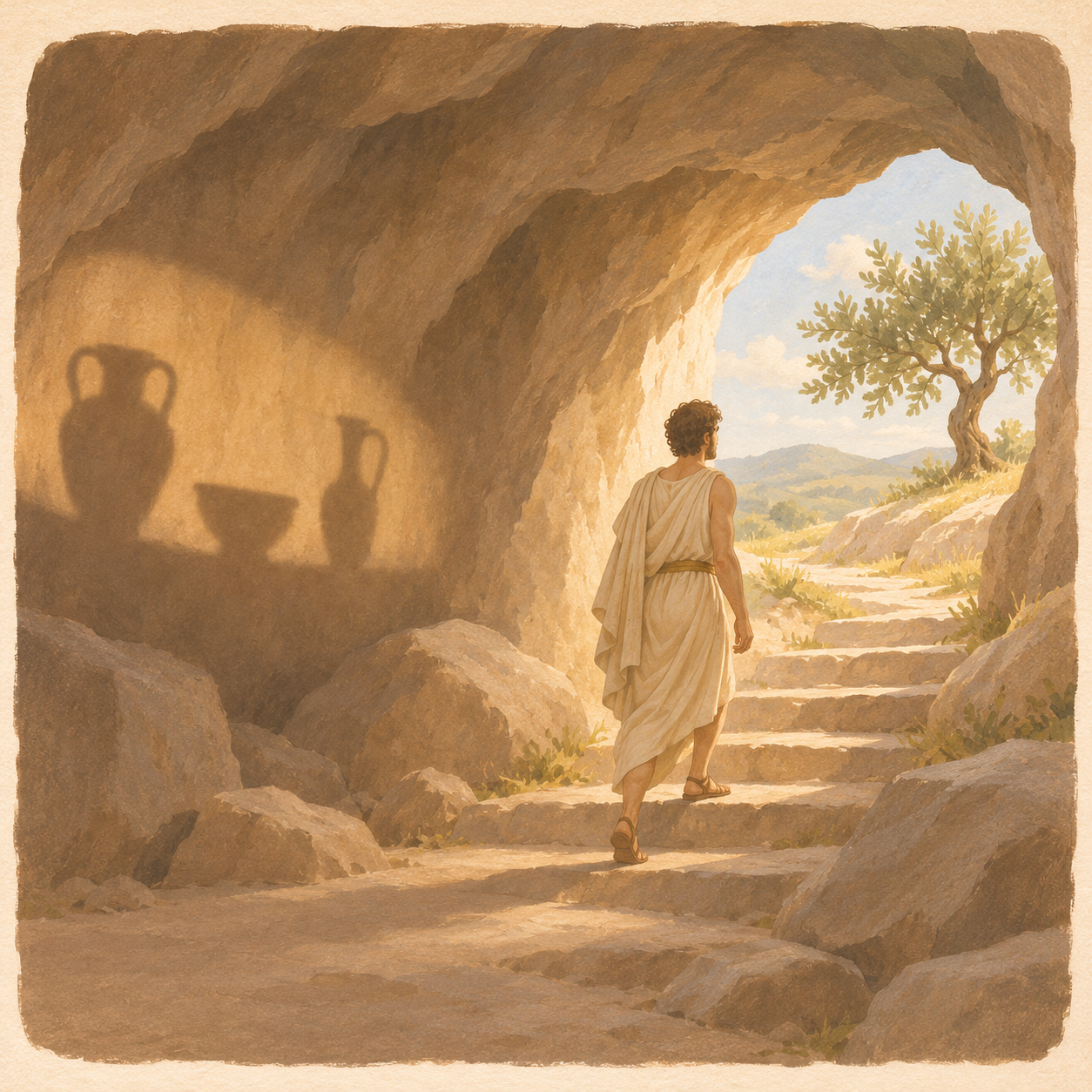
Book VII gives these ideas their most memorable image. Prisoners face a cave wall and see shadows cast by objects carried behind them. They take the shadows for reality because they know nothing else.
A freed prisoner initially finds the unfamiliar light painful. Learning requires adjustment. Outside the cave, he gradually becomes able to see things and finally the sun. Returning below, he struggles to see in the darkness. The others may treat his difficulty as evidence that leaving was harmful.
The image concerns education as a turning of the whole soul toward what is real. It also explains why knowledge can isolate someone from a community’s familiar judgments.
Yet the educated guardians must return to public duties. They owe service to the city that trained them. Mathematics, dialectic, and practical experience prepare them for this responsibility. Dialectic means examining assumptions through reasoned questioning; it is more demanding than winning a debate. Book VII
Political Decline Mirrors Inner Disorder
Books VIII and IX return to the question of happiness by comparing defective governments with corresponding characters.
Rule by the wise gives way to timocracy, where honor and military status dominate. Oligarchy values wealth and divides rich from poor. Democracy elevates freedom and permits many ways of life. Socrates argues that freedom without disciplined judgment can leave a city vulnerable to a leader who promises protection and becomes a tyrant. This is his philosophical account of decline, not an established law of political history. Book VIII
The tyrannical person supplies Plato’s strongest reply to the ring of Gyges. Unchecked desire creates dependency, fear, and endless need. The tyrant appears free because he can impose his will. Internally, he serves demands he cannot satisfy.
Socrates also argues that the philosopher judges pleasures best because he has experience of ordinary rewards as well as understanding. He treats pleasures grounded in knowledge as more genuine than satisfactions that merely relieve a lack. These are arguments for the superiority of the just life, not measurements of happiness. Book IX
Poetry, Choice, and the Ending
Book X renews the attack on imitative poetry. A convincing representation can stir emotion without providing knowledge of its subject. Socrates worries that repeated indulgence in grief or uncontrolled feeling weakens rational judgment.
The dialogue closes with the myth of Er. After death, souls face judgment and later choose new lives. The crucial skill is choosing wisely rather than being dazzled by power or appearance. Having defended justice for its effect on the soul, Socrates restores its wider rewards. The myth reinforces the argument through a story; it is not empirical evidence about an afterlife. Book X
What the Argument Reveals—and Leaves Unsettled
Plato offers a useful test of success: what kind of person does pursuing it make you? He also asks whether education trains judgment or merely strengthens the desires a culture already rewards. Applied today, these questions invite scrutiny of ambition, public leadership, and persuasive media. They do not require accepting his political design.
Several difficulties remain. Inner harmony does not by itself prove that a person will respect others’ rights. The move from a well-ordered mind to a hierarchical city needs justification. Expertise also does not automatically confer a right to rule without consent or effective accountability.
Most troublingly, the ideal city protects unity through censorship, deception, and control of family life. Its ordinary producers have little political voice. Readers can recognize Plato’s concern about corrupt power while rejecting the authority he gives his guardians.
The Republic therefore rewards an active, questioning reading. Test its account of a good life alongside its costs. Its central challenge remains demanding: examine whether your desires serve a life you can defend, or whether your life has become their instrument.
Sources
- Plato, The Republic, translated by Benjamin Jowett, Internet Classics Archive at MIT: primary text, author credit, and links to all ten books. Direct book links above identify the passages summarized. Jowett is the translator, not a coauthor.
- Eric Brown, “Plato’s Ethics and Politics in The Republic,” Stanford Encyclopedia of Philosophy: scholarly context for the central question, the city–soul analogy, and disputed ethical and political interpretations.


