Living and Governing Without Forcing
The Tao Te Ching asks what happens when people try too hard to control life. Rulers multiply commands. Ambitious people chase status. Moral teachers insist on correct behavior. The text suggests that these efforts can deepen the disorder they seek to remove.
Its central proposal is to live in accord with the Tao, or Way. This means reducing grasping, accepting limits, and allowing things to develop without needless force. The same principle guides personal conduct and government. A person can act with care without demanding possession or credit. A ruler can support people without directing every part of their lives.
A Short Text With an Uncertain History
The book is also called the Daodejing. Tao and Dao are different romanizations of the same Chinese word. Te, usually written de today, can mean virtue, power, or the qualities through which the Way becomes present in a life. The title is often understood as the classic of the Way and its virtue.
The traditional author is Lao Tzu, also called Laozi. However, his historical identity and the text’s formation remain uncertain. It is safer to treat this attribution as a tradition than as a verified biography. The familiar version contains 81 short chapters. These combine verse, images, political advice, and paradox rather than building a step-by-step argument. Penguin’s edition record confirms the traditional credit; the Stanford Encyclopedia of Philosophy explains the authorship and textual questions.
This summary follows the received chapter sequence and uses James Legge’s public-domain translation as a primary reference. Its wording is dated. The explanations below paraphrase the ideas rather than adopting all his terms. Chapter numbers identify passages, not fixed English titles.
The Way Exceeds Our Names
The opening chapter warns that a Way fully captured in speech cannot be the enduring Way. Chapter 25 describes something formless that precedes heaven and earth. The speaker gives it a name while admitting that its true name is unknown.
This creates a deliberate tension. The book uses words to point toward what words cannot fully contain. Its teaching asks readers to notice the limits of their categories. A label can help us act, but it can also make a changing situation seem fixed.
Chapter 2 develops this point through pairs. We recognize long through short, difficult through easy, and beautiful through ugly. These judgments depend on relationships. They do not stand alone as complete descriptions of reality.
The practical implication is humility in judgment. Someone called difficult in one setting may respond well in another. That is a modern illustration, not an example from the book. The broader warning is to avoid confusing a useful description with the whole person or situation.
Empty Space Makes Things Useful
Chapter 11 gives some of the book’s clearest examples. A wheel needs the opening at its hub. A vessel needs its hollow interior. A room needs open space within its walls.
Solid material and empty space work together. The potter makes the clay vessel, but the hollow allows it to hold something. Absence can make a positive contribution.
This image helps explain the text’s interest in stillness and restraint. A life filled with activity can leave little room to notice what is happening. A leader who supplies every answer can leave little room for others to respond. These are applications of the image, rather than claims that chapter 11 discusses modern work.
Chapter 15 offers a related image: muddy water gradually clears when left still. The suggestion is to allow clarity to emerge before adding further disturbance. Waiting can be a deliberate response when agitation is part of the problem.
Wu Wei: Action Without Grasping
Wu wei is commonly translated as nonaction. Read literally as doing nothing at all, it makes much of the book hard to understand. The text also describes nourishing life, helping people, and dealing with problems early.
A useful reading is action free from coercion and self-serving insistence. The sage, the book’s ideal wise person, acts without trying to make every outcome an extension of personal desire. This interpretation fits the contrast between the Way’s quiet activity and human efforts to dominate. It also leaves room for debate about how radical nonaction should be.
The related term ziran is often translated as naturalness or spontaneity. It suggests things being so of themselves. Chapter 25 links human life, earth, heaven, and the Way, ending with this quality of naturalness. Following it means respecting how things develop. It does not make every passing impulse wise.
Chapter 48 contrasts accumulating learning with the repeated reduction involved in following the Way. The contrast challenges the assumption that improvement always requires adding more. A person may also need to remove habits of interference, display, or restless pursuit.
Chapter 64 supplies a necessary balance. It advises attending to things while they are small and manageable. Wu wei can therefore involve timely care. It does not require waiting until a preventable difficulty becomes a crisis.
For a modern illustration, consider someone helping a new colleague. They explain the task, provide what is needed, and allow the colleague to try. They step in when help is useful. Constant correction might prevent the independence they want to develop. This example applies the book’s orientation; it is not a method prescribed by Lao Tzu.
Water and the Strength of Yielding
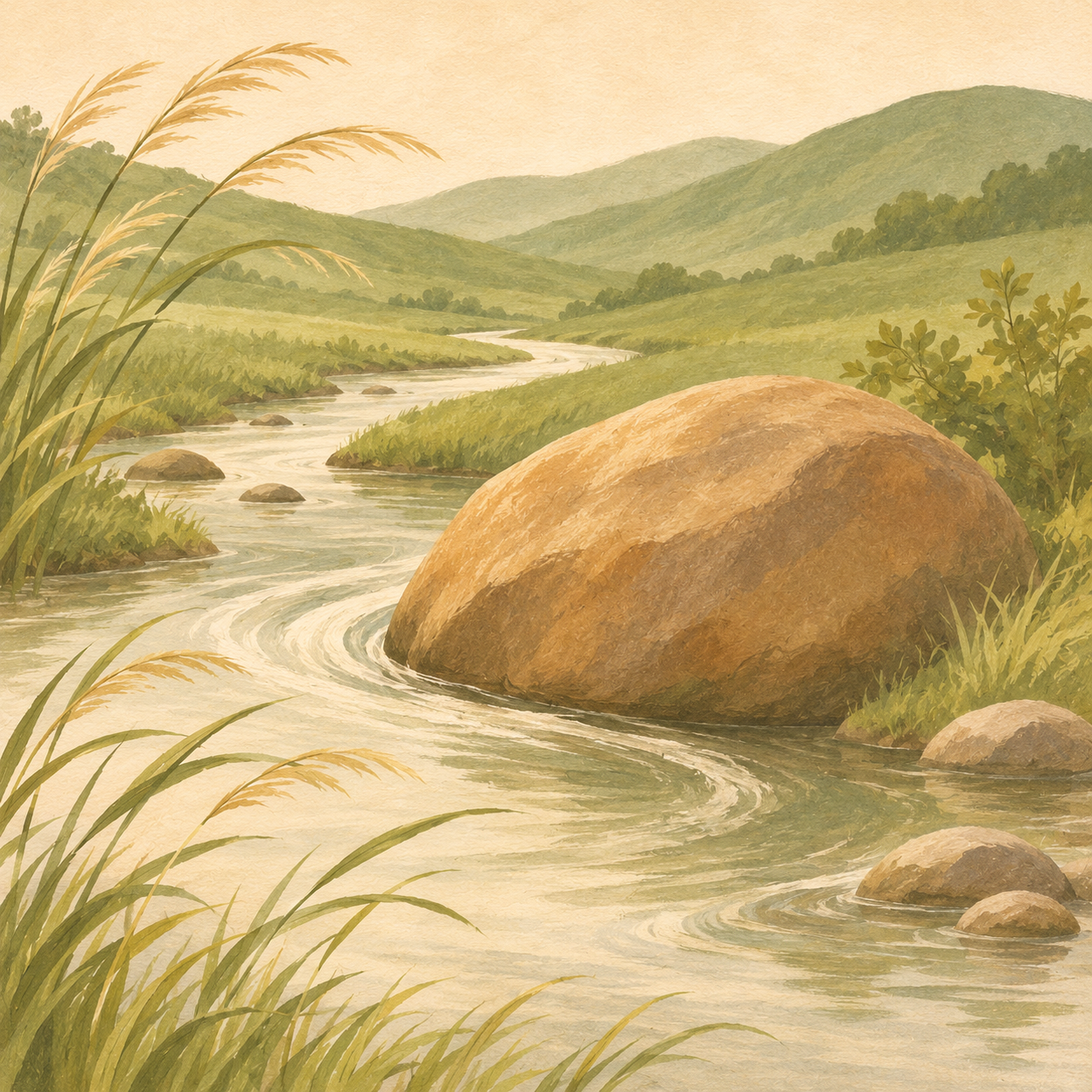
Water is one of the text’s central images. Chapter 8 praises it for benefiting things and occupying low places that people tend to reject. Chapter 78 returns to the contrast between water’s softness and its power against what is hard.
Water suggests a form of strength that does not depend on standing above others. It adapts to its surroundings. It serves without demanding distinction. Chapter 66 makes the political connection: rivers and seas receive the waters of valleys because they lie below them. A ruler should learn a comparable humility.
Chapter 76 connects softness with life. Living bodies and growing plants are supple. Death brings stiffness and dryness. The image challenges the easy equation of rigidity with strength.
These passages invite readers to reconsider what effective conduct looks like. Changing course can preserve a purpose. Giving another person room can reduce conflict. The images do not prove that yielding succeeds in every situation. Their force comes from exposing possibilities that pride or habit can hide.
Enough, Simplicity, and Genuine Virtue
The book repeatedly asks what people lose by seeking more. Chapter 9 warns against excess and against clinging to achievement. Chapter 44 asks readers to weigh fame and wealth against their own lives. Chapter 46 links contentment with sufficiency.
This teaching concerns desire as well as possessions. If every success creates a new comparison, satisfaction remains out of reach. Knowing when to stop becomes a form of freedom.
The image of uncarved wood expresses a related ideal. Before carving, wood has not been shaped into a specialized object. In the text, this simplicity suggests a life less distorted by imposed ambitions and distinctions. It is an image of preserved potential, not a detailed program for abandoning useful skills.
Chapter 38 applies the criticism to morality. The highest virtue does not anxiously display itself as virtuous. As trust and genuine conduct decline, formal demands can take their place. Eventually, correct behavior may be enforced through pressure.
This is a sharp challenge to moral performance. A person can become more concerned with appearing good than with responding well. Yet the book does name commitments. Chapter 67 identifies compassion, frugality, and reluctance to put oneself first as three treasures. Simplicity carries ethical responsibilities.
Government, War, and the Costs of Control
Political teaching is central to the book. Chapter 17 imagines leadership so unobtrusive that people understand successful work as their own accomplishment. Chapter 57 warns that multiplying restrictions and clever interventions can increase poverty and disorder.
Chapter 53 describes an especially concrete failure: rulers enjoy fine clothes, abundant food, and wealth while fields and granaries suffer. Chapter 75 connects hunger with heavy taxation. These passages show concern for material hardship. The text asks rulers to examine how their own conduct produces the problems they blame on the governed.
Its treatment of war follows the same concern. Chapters 30 and 31 oppose the pursuit of domination through arms. Even when force becomes necessary, victory gives no reason for delight in killing. The proper response includes grief for the dead.
These are moral and political claims, not tested rules for every government. They also do not map neatly onto a modern political party. The text’s ideal ruler remains a ruler. Restraint in exercising authority does not by itself establish public consent or equal rights.
What Remains Difficult
Some passages resist a comfortable modern reading. Chapters 3 and 65 can sound as though a ruler should limit people’s knowledge and desires to make them easier to govern. Interpreters may understand this as resistance to cunning and artificial ambition. Even so, the danger of paternalism remains. A ruler can claim to preserve simplicity while denying people choices.
Chapter 80 imagines small, contented communities with little travel or use for available equipment. This offers a strong alternative to restless expansion. It also leaves questions about exchange, discovery, and the freedom to seek another life.
The text gives no complete test for deciding when restraint becomes neglect. An abusive relationship, a public emergency, or an unjust institution may require firm resistance. That is a limit of applying these sayings as universal instructions. Its natural images invite reflection; they do not establish scientific laws of society.
A useful way to read the book is slowly, with attention to its tensions. Ask what a passage reveals about a particular desire to control. Then ask what care or responsibility still requires. The text’s enduring challenge is to act without letting the need for mastery consume the purpose of the action.
Sources
- Lao Tzu, The Tao Teh King, translated by James Legge, Project Gutenberg: complete public-domain primary text; chapter references above follow its received sequence.
- Penguin Random House, Tao Te Ching: book identity, traditional author credit, and edition context.
- Alan Chan, “Laozi,” Stanford Encyclopedia of Philosophy: authorship, textual history, key terms, and competing interpretations. Used for historical and interpretive context rather than as a substitute for the primary text.

