How ordinary street life keeps a city working
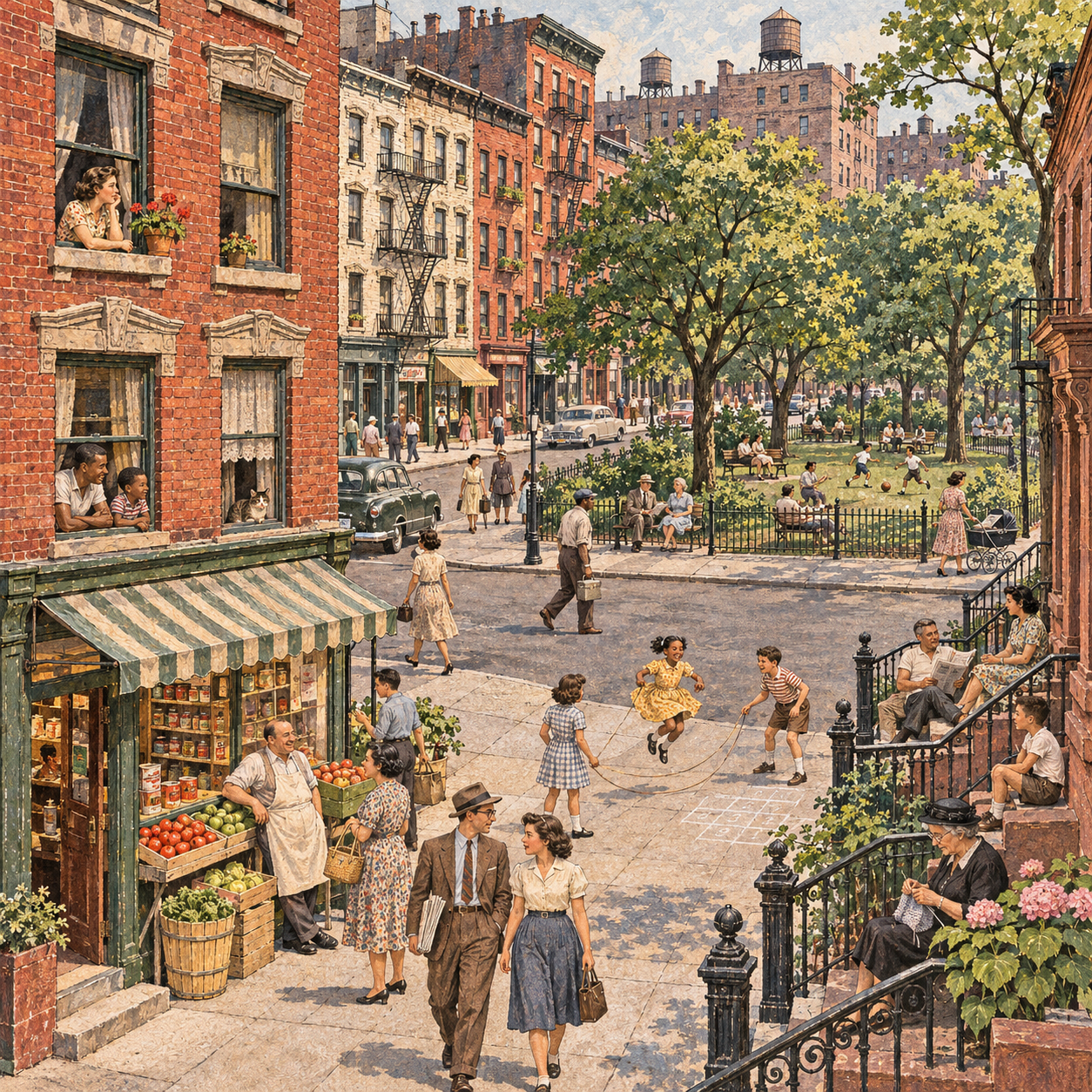
A busy sidewalk can look disorderly. People shop, deliver goods, watch children, and stop to talk. Buildings differ in age and purpose. Yet these activities can support a durable social order that a tidy development plan fails to recognize.
In The Death and Life of Great American Cities, first published in 1961, Jane Jacobs argues that successful cities depend on many different activities working together at close range. Urban renewal often destroys those relationships when it clears existing neighborhoods, separates uses, and replaces streets with isolated projects. The publisher identifies this conflict between urban vitality and prevailing planning practice as the book’s central concern.
Jacobs begins with observation. How does a sidewalk become safe? Why does one park attract people while another stays empty? What allows small businesses to survive? Her answers lead from street life to economics, investment, housing, and government.
Begin with use, not appearance
Jacobs attacks planning traditions that treat the city as a composition to arrange from above. Garden City ideas favor dispersal and separation. Le Corbusier’s tower schemes offer concentrated buildings surrounded by open ground. Monumental civic design seeks visual grandeur. Despite their differences, Jacobs argues that these approaches neglect the working relationships of city streets.
A plan can supply sunlight, grass, and orderly buildings while removing the routes, customers, and informal supervision that made a place useful. Physical neatness therefore provides weak evidence of urban health.
This does not make every old neighborhood successful or every new building harmful. Her question is what an intervention does to an existing system of uses. A building’s contribution depends partly on what happens around it.
Sidewalks provide safety and limited trust
Jacobs’s famous idea of eyes on the street concerns ordinary attention. Shopkeepers, residents, customers, and passersby help supervise public space while pursuing other purposes. A street needs a clear distinction between public and private territory, buildings that face it, and enough continuing activity to attract attention.
Strangers can contribute to this order. Jacobs does not imagine safety as the exclusive work of neighbors who all know one another. Her account of Hudson Street describes many separate routines that overlap through the day. She calls their combined movement a sidewalk ballet. The sidewalk chapter, available through Columbia University, explains this connection between daily activity and informal public responsibility.
Repeated small encounters also build trust. People can recognize a shopkeeper, exchange information, or ask a modest favor without becoming close friends. This limited contact protects privacy while making cooperation possible. Requiring everyone to share an intimate community would impose a much heavier burden.
Children benefit from this ordinary public world. Adults who are present for unrelated reasons can offer supervision and demonstrate responsibility beyond the family. Jacobs challenges the assumption that moving play away from streets automatically makes it safer or socially richer.
Four conditions generate urban diversity
Jacobs uses diversity to mean a close mixture of activities, enterprises, buildings, and people that support one another. In Part Two of the book, she proposes four conditions for generating it. She presents them as a combination: no single ingredient can do the work of the others.
1. Mix primary uses across different schedules
Primary uses bring people to a district for their own purposes. Homes, workplaces, and major cultural destinations can play this role. Their schedules should overlap without being identical.
For an illustrative example, office workers may buy lunch, residents may shop after work, and theater visitors may eat later. Together they can support businesses that would struggle if customers arrived during only one short period. A district with many restaurants but only one source of customers may still lack a useful mixture.
The economic advantage comes from sharing facilities and customers across time. Placing different uses near one another helps only when their users can reach and support common places.
2. Keep blocks short and routes connected
Frequent intersections give people choices. Different journeys can meet, and businesses gain access to people moving along several routes.
Long blocks can isolate parallel streets even when destinations are physically close. People must take inconvenient detours, and foot traffic remains concentrated on a few corridors. Short blocks allow more combinations of movement. Their value lies in these connections, rather than in a decorative street pattern.
3. Mix buildings of different ages and costs
New construction usually needs enough income to cover its costs. Established businesses may afford that burden. Experimental enterprises, small workshops, and modest services may need cheaper space.
Older buildings can provide room for activities that could not begin in an entirely new district. Jacobs values ordinary older structures as economic resources, including buildings with little architectural distinction. Her argument concerns the range of costs a district can accommodate.
A mixture of old and new buildings permits different enterprises to coexist. Replacing everything at once can remove the lower-cost spaces on which future variety depends. Keeping every building unchanged would also miss her concern with gradual adaptation.
4. Concentrate enough people
A district needs enough people to support convenient services, varied enterprises, and sustained street activity. Low population levels can leave too little demand for that variety.
Jacobs separates density from overcrowding. Many homes on an area of land do not necessarily mean too many people inside each home. Nor does high density require one standardized building form.
Density works with the other conditions. Many residents in isolated buildings, surrounded by long blocks and few destinations, may generate little public life. Numbers alone cannot substitute for useful relationships.
Parks and neighborhoods depend on their surroundings
Jacobs rejects the assumption that open space automatically improves a city. A neighborhood park needs people who have reasons to use it at different times. Nearby activities supply those users. Design matters, but it cannot compensate for a setting that offers little continuing demand.
Neighborhoods also operate at several scales. A street supports daily contact. A larger district can connect local groups and organize influence. Citywide institutions supply resources and decisions beyond the reach of any street.
This makes the self-contained neighborhood a poor model for metropolitan life. Residents need access to work, interests, and relationships across the city. Local attachment should support those connections.
How cities lose the diversity they create
Success can undermine its own foundations. When a district becomes desirable, the uses that can pay most may replace those that cannot. A popular area can become dominated by a narrower range of profitable activities. Jacobs calls this the self-destruction of diversity. Protecting urban vitality therefore requires more thought than attracting investment or raising property values.
Large single-use territories can create another problem: border vacuums. Railways, expressways, campuses, or extensive project grounds may interrupt ordinary circulation. Streets near their edges can lose passing users and businesses. The Congress for the New Urbanism’s discussion of this concept explains how such edges can weaken surrounding streets. The institution or infrastructure may remain useful; its boundary still needs careful treatment.
Jacobs also contrasts gradual investment with concentrated, disruptive investment. Small improvements can let places adapt while retaining people, buildings, and enterprises. Long neglect followed by wholesale redevelopment can destroy that continuity. Her analysis asks both where money goes and how its timing changes a neighborhood.
Planning should strengthen existing relationships
Jacobs proposes intervention as well as criticism. She wants housing assistance to address the cost of decent shelter without requiring poor households to live in isolated, uniform enclaves. She also argues for repairing existing projects by reconnecting them with surrounding streets and adding varied uses. Her later foreword revisits this proposal to bring separated projects into ordinary city life.
For traffic, she describes a destructive cycle. Road widening and parking consume destinations and pedestrian space. As walking becomes less useful, dependence on automobiles increases, encouraging further road expansion. Her alternative is a gradual reduction of automobile dominance as other ways of reaching places become more practical.
Government must also become better at coordinating local problems. Districts need enough administrative attention and political strength to connect street-level knowledge with citywide decisions. Jacobs’s argument requires informed public action, rather than assuming that cities will always repair themselves.
A city is a problem of organized complexity
The final chapter names the method behind the book. Drawing on Warren Weaver, Jacobs describes cities as problems of organized complexity. Many factors change together, and their effects depend on their relationships. The published excerpt of this chapter uses park activity to show why one isolated measure cannot explain the whole system.
Her approach is to study processes, reason from particular observations, and examine unusual cases that reveal hidden relationships. A quiet park cannot be understood through its acreage alone. Its entrances, nearby uses, users’ schedules, and surrounding routes all matter.
A practical application is to observe a proposed development site at several times of day. Trace who passes through, which businesses share customers, and which routes connect destinations. Then assess what the project would add or remove. This is an application of her method, rather than a formal evaluation procedure established by the book.
What the argument leaves open
Jacobs offers close observation and a forceful theory. These do not establish universal causal rules. Her focus on large American cities also limits direct transfer to places with different institutions, climates, travel patterns, or housing systems.
Later evidence can test parts of the theory. A 2016 study using mobile-phone activity in six Italian cities found associations consistent with her conditions. Such associations support further inquiry; they do not prove that applying a physical checklist will produce safety, affordability, or social inclusion.
A further critical implication concerns power. A lively street can remain inaccessible to disabled people or unaffordable to existing residents. Informal attention can also become exclusion. Jacobs’s account of self-destruction recognizes that success threatens diversity, but her design principles do not settle how housing costs and displacement should be governed.
The most useful way to read the book is as a demand for better questions. Before changing a place, discover which relationships keep it working. Then judge the change by whether more people can use, sustain, and participate in that life.
Sources
- Penguin Random House: book and author information — title, Jane Jacobs’s sole author credit, original publication year, and central argument.
- Jane Jacobs: Part Two, university-hosted scan — primary discussion of the four conditions for diversity.
- Jane Jacobs: sidewalk chapter, Columbia University scan — primary account of street safety and Hudson Street.
- Penguin Random House: Jacobs’s later foreword — her retrospective account and discussion of reconnecting projects.
- Jacobs: excerpt from the final chapter, Patterns Digital Library — organized complexity and methods of inquiry.
- CNU: How border vacuums prevent revitalization — explanation with references to Jacobs’s text.
- De Nadai and colleagues: The Death and Life of Great Italian Cities — later empirical research, distinct from the book’s claims.

