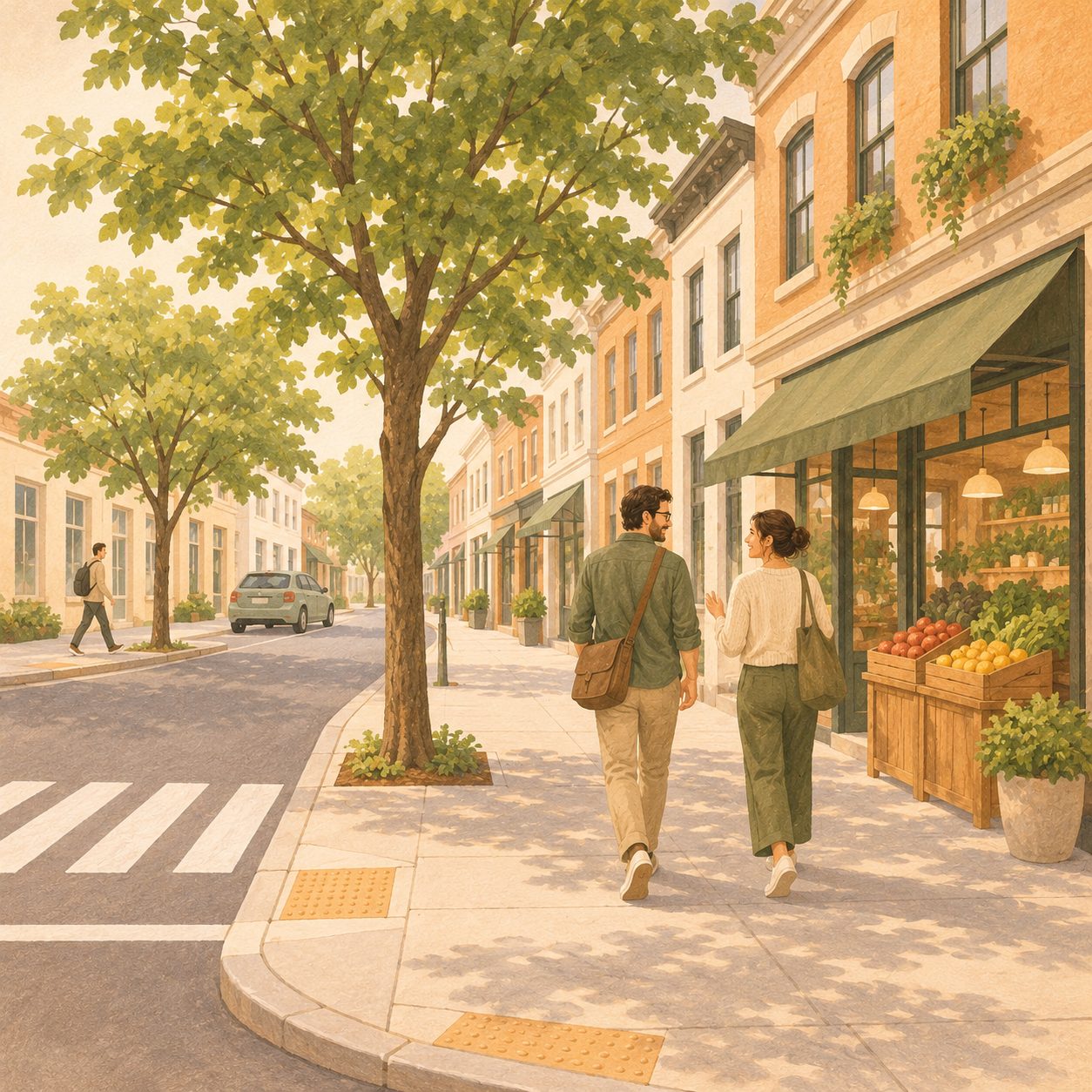
Make walking a useful part of daily life
A downtown can be easy to drive through and unpleasant to visit. Wider roads move traffic, parking lots store cars, and long crossings discourage people from walking between destinations. Each decision may solve a narrow problem while weakening the place as a whole.
Jeff Speck’s Walkable City: How Downtown Can Save America, One Step at a Time, first published in 2012, argues that walkability offers a practical way to repair this pattern. A city thrives when ordinary journeys on foot become convenient and appealing. That requires coordinated choices about streets, buildings, parking, and public transport. The publisher’s account presents walkability as the book’s organizing principle for urban health and prosperity.
This summary covers the original argument and ten steps. Later interviews help clarify Speck’s position; they are identified where used. The tenth-anniversary edition adds material, and Walkable City Rules is a separate follow-up book.
Four conditions must work together
Speck’s General Theory of Walkability asks whether a walk is useful, safe, comfortable, and interesting. These conditions address different reasons someone might choose to drive.
- Useful: Can the trip accomplish something? Homes, jobs, shops, and services need to be close enough and connected well enough for walking to serve daily life.
- Safe: Does the route protect people from traffic, and does it feel safe enough to use?
- Comfortable: Do buildings and landscape give the street a welcoming shape and a sense of enclosure?
- Interesting: Do the buildings and activities along the route reward attention?
In the opening excerpt, Speck contrasts a frightening crossing in Lowell, Massachusetts, with enjoyable walks in Rome despite its imperfect pedestrian facilities. His point concerns the whole urban setting: the streets, blocks, and buildings between attractions help make a city worth exploring.
Rome’s appeal does not excuse inaccessible paving or missing ramps. The useful distinction is between installing pedestrian equipment and creating a place where people can conduct their lives on foot.
Why walkability matters beyond walking
Speck connects walkability to economic vitality, health, and environmental responsibility. A downtown that attracts people can support businesses and investment. Daily trips can create opportunities for movement. Shorter journeys and alternatives to driving can reduce dependence on cars. These are the book’s arguments, rather than a promise that every street project will deliver every benefit.
His environmental discussion challenges a common measurement error. A map of emissions per unit of land makes dense places look dirty because it concentrates many households in one area. Emissions per household can tell a different story. In an authorized book excerpt published by Salon, Speck discusses maps of household driving emissions that reverse the apparent advantage of outlying suburbs.
The distinction is precise: those maps concern household automobile emissions, not a complete account of every source of carbon. His broader lesson is to examine the travel a location requires. A building’s efficient equipment cannot, by itself, tell us the environmental cost of living or working there. The excerpt’s vehicle comparisons reflect its period and should not serve as present-day buying advice.
The useful walk: destinations, cars, parking, and transit
The first four steps address whether walking can accomplish ordinary tasks.
1. Put cars in their place. Speck challenges the habit of judging downtown streets mainly by how efficiently they move cars. He discusses induced demand: added road capacity can encourage additional driving. A road project therefore needs a wider test than whether traffic initially moves faster. What happens to crossings, destinations, and the life of the street? The contemporary review reproduced by the Venice Neighborhood Council confirms this argument and the ten-step structure.
2. Mix the uses. A district needs reasons to visit at different times and for different purposes. Housing, workplaces, shops, and public destinations should support journeys between one another. An attractive sidewalk has limited value if every useful destination requires a drive.
Consider an illustrative office district with a lunch café but few residents. It may have busy sidewalks at noon and little activity after work. Adding homes and daily services changes what people can do there throughout the day. This is an application of the principle, not a reported case from the book.
3. Get the parking right. Free parking still consumes land and money. Speck draws on Donald Shoup to show how its costs can enter rents and purchases, including those paid by people who do not drive. Mandatory parking can also obstruct development that would bring destinations closer together.
The parking chapter, reproduced as an attachment to a public comment letter, supports a coordinated response: reconsider requirements, manage shared supply, price curb spaces to improve availability, and return benefits to the district. In its account of Old Pasadena, local reinvestment helped make paid parking acceptable to merchants. The aim is a functioning place, with parking managed in service of it.
4. Let transit work. Walking has a limited range. Public transport connects a walkable district to jobs and destinations farther away. Speck’s 2013 talk on making cities walkable explains how transit helps people reach the wider city without organizing every journey around a car.
A practical implication is to assess the entire trip. A station near a destination offers less help when reaching its entrance requires an intimidating crossing. Land use and transport need to support each other at the point where passengers become pedestrians.
The safe walk: design for people outside cars
5. Protect the pedestrian. Speck asks designers to examine what street geometry encourages drivers to do. In a later Common Edge interview, he explains that a posted speed limit cannot overcome a street that invites faster driving. He favors reviewing lane widths, lane counts, street direction, and the allocation of road space.
His position allows cars to remain part of downtown life. The question is whether their movement permits other people to use the same place safely. Street changes require local assessment; the book supplies a direction for inquiry, not a universal engineering specification.
6. Welcome bikes. Cycling extends the range of travel without a car. It also belongs in the street’s overall design. Speck argues in the same interview that a proper cycling network can reduce conflicts caused when cyclists lack suitable space and mix with pedestrians. Planning for bicycles and walking should therefore happen together.
The comfortable walk: shape space and provide trees
7. Shape the spaces. Comfort includes the feeling of being in a defined place. Buildings that frame a street can give it a readable edge. Large gaps and leftover open areas can weaken that experience. Speck’s conference abstract on walkability reiterates the importance of spatial enclosure within his four conditions.
Imagine the difference between sitting at the edge of a sheltered courtyard and standing in an exposed expanse beside scattered buildings. Both are outdoors, but their boundaries create different experiences. This comparison illustrates the design concern; it does not establish a required building height.
8. Plant trees. Street trees contribute shade and make the pedestrian setting more inviting. Their place in the ten steps shows that landscape belongs to the basic walking experience. Applying this idea also means allowing room for roots, maintaining clear routes, and planning care over time. Planting is only the beginning of providing lasting shade.
The interesting walk: active edges and focused investment
9. Make friendly and unique faces. A building meets a pedestrian through its ground floor. Entrances, windows, awnings, and visible activity can make that encounter rewarding. A long blank edge gives someone little reason to slow down or continue exploring. Speck’s concern is the experience along the route, which architectural spectacle alone cannot supply.
10. Pick your winners. Resources are limited. Speck recommends concentrating improvements where existing conditions offer a credible chance of creating a successful walking district. Downtowns often provide a starting point because destinations and older street networks already exist. The contemporary review describes this approach as urban triage.
The practical lesson is to connect useful places into a convincing whole. Several isolated improvements may leave every ordinary trip with an unpleasant gap. One complete route can demonstrate what coordinated change achieves.
Apply the framework without ignoring its limits
A useful way to apply the book is to follow an actual journey: from a home to groceries, from a bus stop to work, or from parking to several shops. Ask which of the four conditions fails. Observe the route at different times and include people with different mobility needs. These are suggested applications of the framework.
Two limits deserve particular attention. First, an appealing street must also work for people using wheelchairs, walking aids, or limited vision. Clear paths, usable crossings, resting places, and maintenance deserve explicit evaluation. Charm is insufficient evidence of access.
Second, success raises questions about who can remain nearby. In a 2023 interview, Speck acknowledges that making places better can raise rents and create displacement risks. He argues for making walkable places more common. My reading is that cities must also examine housing access and protections alongside street investment. A promising downtown strategy cannot settle those questions on its own.
The book’s lasting contribution is a shared test for decisions usually made separately. Ask how a change affects a person’s complete journey. That question connects the destination, the crossing, the building edge, and the transport network to the daily life they should support.
Sources
- Macmillan: Walkable City — verified authorship, thesis, and anniversary-edition context.
- Opening book excerpt, hosted by WBUR — four conditions, Lowell, and Rome.
- Jeff Speck’s authorized excerpt in Salon — environmental argument and measurement limits.
- Parking chapter attached to a WalkUP Roslindale public comment — parking costs, management, and Old Pasadena.
- Contemporary Christian Science Monitor review, reproduced by Venice Neighborhood Council — original ten steps and investment priorities.
- Speck’s TED talk and conference abstract — supporting explanations of his framework.
- Common Edge interview and One-Key interview — later clarification of street design, cycling, and affordability concerns.


