How pictures teach us to see
A painting consists of marks on a surface. Yet we see a face, sunlight, or space that seems to extend behind its frame. How does this happen? And why have artists in different periods represented the same world in such different ways?
These questions drive E. H. Gombrich’s Art and Illusion: A Study in the Psychology of Pictorial Representation. First published in 1960, the book grew from his Mellon Lectures. It connects the history of image making with the psychology of perception. Its subject is the construction of convincing appearances, rather than a survey of great works. The publisher’s edition on JSTOR gives the book’s structure and chapter openings.
Gombrich’s central argument has two connected parts. Artists work with learned ways of making images, which they test and change. Viewers bring expectations that help them interpret those images. A convincing picture emerges from the interaction between marks, habits, and recognition.
Schema and correction: a starting point that can change
Gombrich calls an artist’s starting pattern a schema. It can be a basic shape, a familiar arrangement, or an established way of drawing a particular kind of thing. The artist adjusts this starting point against the demands of the subject. This process is schema and correction.
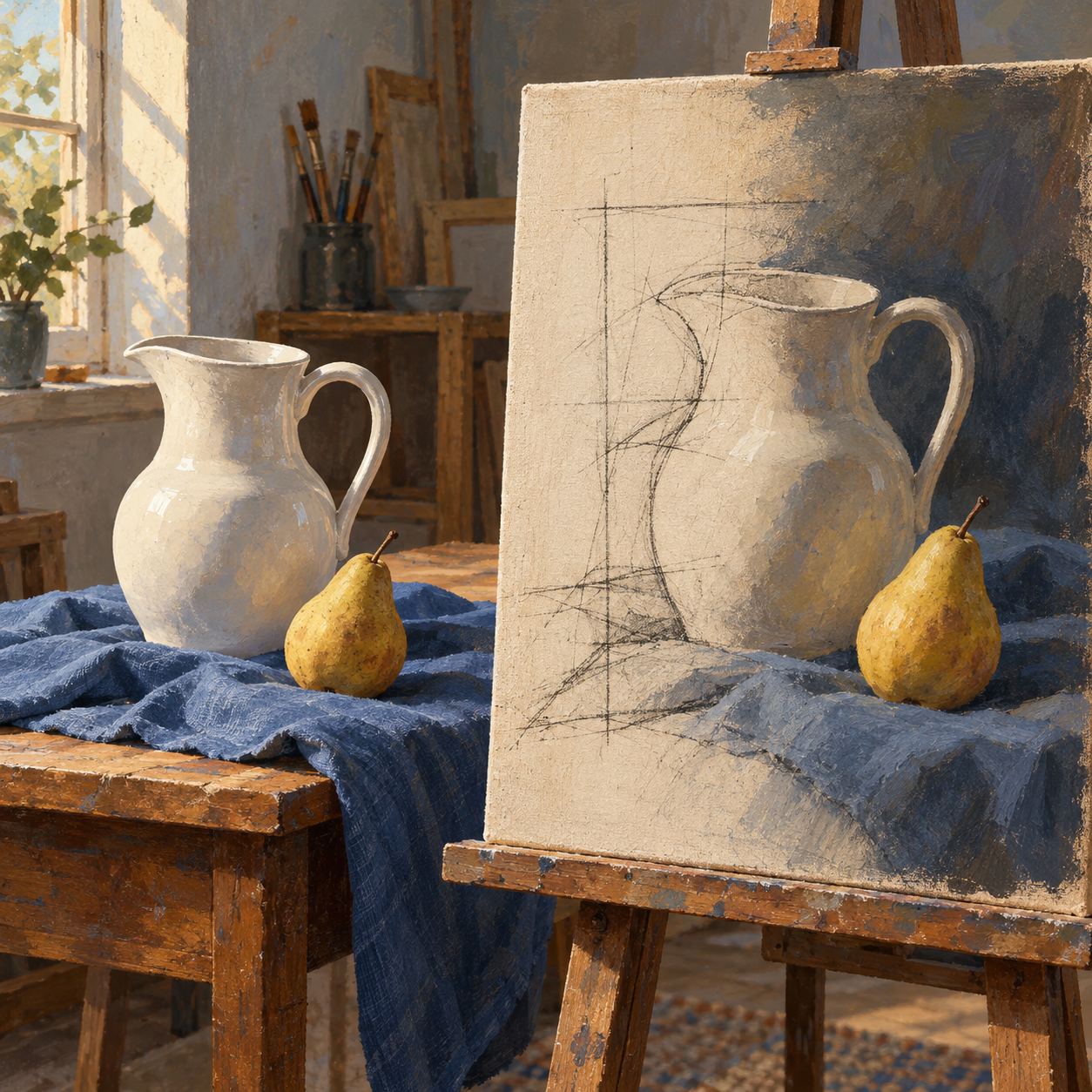
Consider an illustrative drawing exercise. You begin a pitcher with an oval opening and a rough outline. Looking again, you find that its neck is narrower than your drawing suggests. You change the outline. The first marks give you something specific to compare with the object. They also make your errors visible.
The schema is therefore useful even when it is wrong. It makes a difficult task manageable. The danger comes when a familiar pattern resists correction. We may draw the object we expect instead of attending to its particular form.
This explains Gombrich’s emphasis on making before matching. Observation works through available means of representation. Michael Podro’s British Academy account of Gombrich explains both the value and the breadth of this model.
Why style cannot be removed by looking harder
If artists merely copied what reached their eyes, shared subjects should produce much more similar pictures. Gombrich instead treats style as part of the equipment artists use to represent the world.
In the book’s account of Ludwig Richter, artists draw the same place but produce different results. Their tools, training, and preferences shape their choices. Gombrich uses such cases to challenge the idea of an innocent eye: sight freed from all prior knowledge and habits.
This does not make accuracy impossible. A picture can provide reliable information about a subject. But we must ask what information it is meant to provide. A map, a portrait, and a landscape answer different questions. Each selects relationships from a world too rich for any single image to contain.
His argument leaves room for both convention and correction. A learned style can guide attention without making every result equally accurate. The authorized excerpt in Aesthetics: A Reader in Philosophy of the Arts presents this distinction.
A rhinoceros made from other images
Dürer’s rhinoceros is a useful example of how an image can become an authority. Dürer made his woodcut without seeing the animal. He relied on a description and a sketch. The result has convincing weight and detail, but it also has armorlike plates and an extra horn.
The image remained influential because later makers could use it as a ready model. A strong representation can shape what people expect an unfamiliar animal to look like. Its apparent precision may hide the weak basis of some details. The Natural History Museum’s account independently documents the print’s errors and influence.
Read alongside schema and correction, this case suggests a practical warning. Detail does not establish accuracy. When judging an image, ask how its maker obtained the information, and whether later versions checked the subject or simply repeated an earlier picture.
From light into paint
Gombrich begins his discussion of likeness with Constable’s Wivenhoe Park. Its sunlight and open space seem natural. That ease can conceal the difficulty of producing the effect.
A painter cannot put outdoor sunlight on a canvas. Paint offers a limited range of brightness. The artist must arrange differences within that range so that we experience light, shadow, and distance. Podro highlights Gombrich’s insistence that the effect depends on relationships between tones, rather than the isolated brightness of individual colors.
An everyday comparison helps explain the problem. A white patch can appear bright against a dark field and dull against a lighter one. Its role changes with its surroundings. Judging the patch alone misses what it does in the whole picture.
For a reader, this changes the question to ask of a painting. Instead of checking each color against a remembered object, examine how the colors work together. Which contrasts create the strongest light? Which edges separate objects? Which soften into atmosphere?
The beholder’s share
The viewer supplies what Gombrich calls the beholder’s share. We recognize objects, infer space, and complete information that the artist leaves unstated. A picture offers cues; perception organizes them into a plausible scene.
This contribution becomes easier to notice when the information is incomplete. Gombrich discusses our ability to find forms in clouds and our response to suggestive painted marks. A few brushstrokes can become a landscape once we recognize the arrangement.
In a later clarification, he explains that even an ordinary photograph needs this constructive contribution. We readily recognize trees and buildings, although the photograph cannot establish every branch’s direction or every building’s dimensions. Recognition can feel complete while leaving much unresolved. See his discussion of perception and imagination.
The viewer’s contribution also has limits. We cannot freely decide that every patch means anything at all. The marks and their arrangement constrain a successful reading. In his 1962 response on illusions in painting, Gombrich uses stage scenery to explain how perspective can unsettle our sense of where physical space ends and painted space begins.
Invention, caricature, and expression
The book’s later discussion of caricature extends its account of visual discovery. A distorted face can remain recognizable. Representation therefore does not always require a complete inventory of correct measurements. Artists can discover economical ways to suggest identity and expression.
The broader implication is that invention can reveal which cues matter. An artist tries a pictorial effect; the result changes what artists and viewers can notice. Technical skill includes discovering useful departures from literal resemblance.
This helps explain why Gombrich’s subject extends beyond deceptive painting. In his preface to the 2000 edition, he explicitly rejects the assumption that studying illusion means recommending illusionistic art. His question concerns how representation works. Artistic value requires further judgments.
What the argument explains, and where it stops
The book offers a strong account of learning within traditions. It explains how inherited methods can enable observation, and how correction can change those methods. It also gives viewers a reason to examine their own expectations.
Its key term is broad, however. A schema can mean a geometric aid, a copied model, or a mental expectation. These are related, but they are not identical. Veronika Kopecky’s study of Gombrich’s correspondence documents questions about this flexibility and the book’s reception.
There are further limits to keep in view. An account of convincing appearances does not fully explain a work’s religious use, political force, or emotional importance. Nor should naturalism become a scale on which every artistic tradition must be ranked. These are limits of the framework’s scope, rather than reasons to dismiss its insights.
For practical use, try looking at one image twice. First identify what you recognize immediately. Then inspect the marks that support that recognition. Compare the two experiences. You may find that something which seemed fully described depends on a few carefully placed cues.
For someone making images, the corresponding exercise is to keep an initial sketch and compare it with later revisions. Identify where you corrected the subject’s shape, and where you changed the image to make its effect clearer. This is an application of Gombrich’s argument, rather than a formal exercise prescribed by the book. It turns his account into a way to study how making and seeing develop together.
Sources
- Princeton University Press edition on JSTOR: verified title, author, contents, and chapter openings.
- Authorized Gombrich excerpt in Aesthetics: style, representation, and accuracy.
- The Gombrich Archive: 2000 preface, perception and imagination, and 1962 reply on illusion: the author’s clarifications.
- Michael Podro, British Academy memoir, and Veronika Kopecky on the book’s correspondence: scholarly context and limitations.
- Natural History Museum: Dürer’s rhinoceros: independent evidence for the example.