Artists’ lives as a history of artistic change
Giorgio Vasari’s The Lives of the Artists turns biographies into an argument about history. Artists inherit skills, study earlier works, and solve problems that their predecessors could not solve. In Vasari’s account, these advances restore the achievements of ancient art. They eventually produce a modern art that can rival or surpass antiquity.
Vasari was himself a painter and architect. He first published the book in 1550 and issued a much larger edition in 1568. Its fuller title names painters, sculptors, and architects. Modern selections vary in their contents, so a short edition may give only part of his project. The National Gallery’s biography establishes the publication history; Oxford’s edition description outlines the book’s broad structure.
This is also a work of praise, criticism, and storytelling. Vasari wants readers to remember artists as people whose choices matter. His account helped define a lasting picture of the Renaissance, but its judgments come from a committed participant with strong preferences.
Three ages, with perfection as the destination
Vasari organizes the lives into three broad ages. They resemble the growth of a person from infancy through youth to maturity.
The first age begins with figures such as Cimabue and Giotto. Vasari credits them with renewing art through closer attention to nature. The second includes Brunelleschi, Donatello, Ghiberti, and Masaccio. These artists develop stronger methods for representing bodies, space, and proportion. The third reaches its highest achievements through Leonardo, Raphael, and above all Michelangelo.
In the preface to the second part, Vasari explains why this division matters. He wants to explain improvement and decline, rather than compile an inventory of works. He also asks readers to judge early artists partly by the obstacles they faced. A modest beginning can deserve praise when the maker had few useful models.
This produces a productive tension. Vasari recognizes that artists work within different conditions. Yet he measures their achievements against an ideal that he locates in his own period. His history gives earlier artists dignity while making them steps toward a later destination.
That destination is his interpretation. Readers do not have to accept it to learn from his comparisons.
Disegno: drawing as thought made visible
One idea connects the three arts: disegno. The term includes drawing, but also the understanding and design that drawing expresses. It joins the trained hand to the mind’s judgment of form.
Vasari’s technical introduction makes this connection concrete. Architecture, sculpture, and painting require knowledge of materials and methods. His discussion moves among stone, models, drawing, and ways of applying paint. These are working practices, not merely subjects for abstract praise. The separately translated Vasari on Technique preserves this introduction.
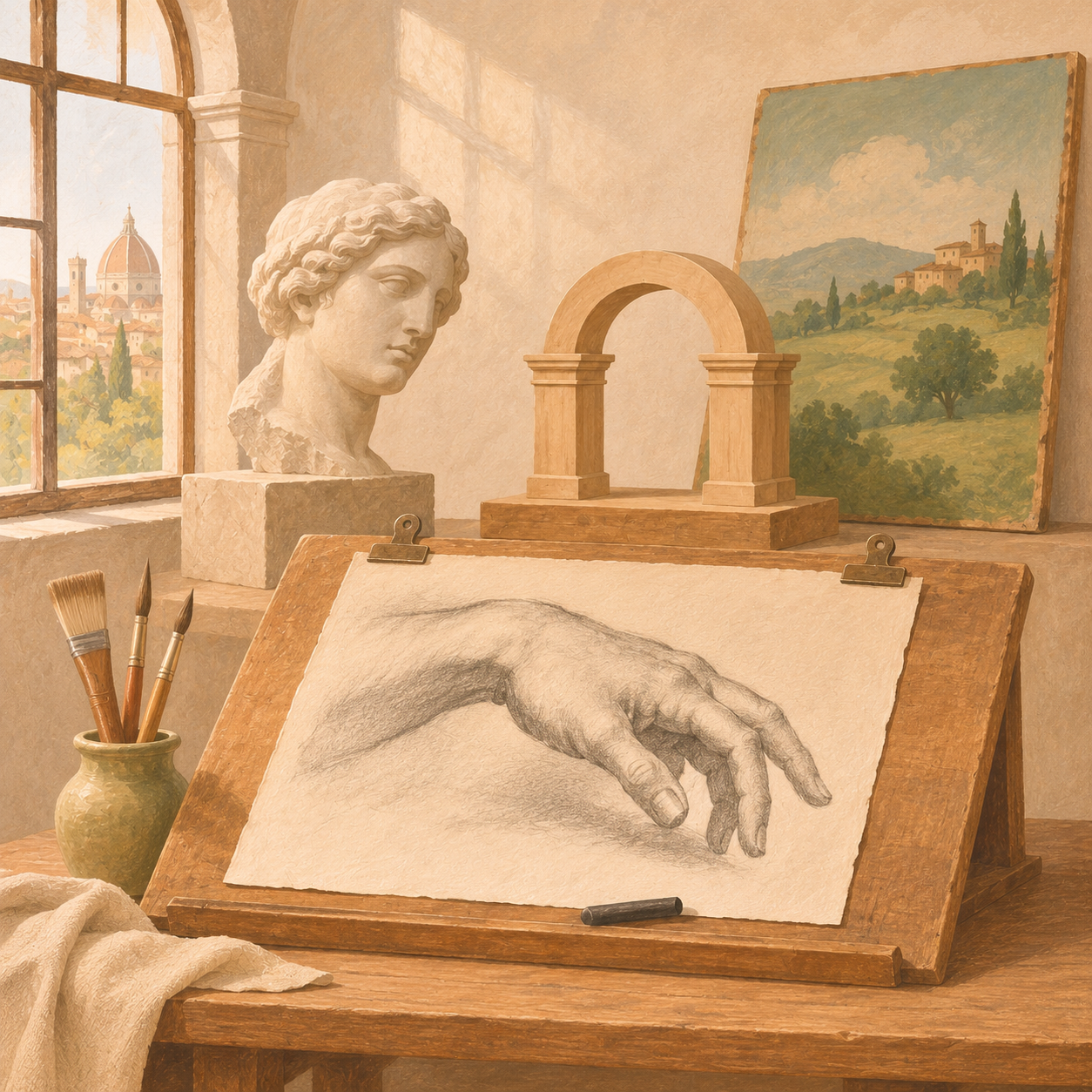
Consider an illustrative comparison. A painter draws a hand before painting it. A sculptor studies its joints before carving it. An architect sketches how parts will fit together. The finished objects differ, but each task requires choices about relationships before those choices become a finished work. This comparison explains the shared principle; it is not an exercise assigned by Vasari.
The emphasis also raises the artist’s status. If making art requires judgment and invention, the artist deserves recognition for intellectual work as well as manual skill. Reading the book with this in mind makes its detailed attention to individual achievement easier to understand.
From correct construction to convincing ease
In the preface to the third part, Vasari describes advances in rule, order, proportion, drawing, and manner. These establish sound construction. But correct construction alone does not produce the highest art.
He values a further quality of grace and freedom. A figure can have the right proportions yet look stiff. A master must make the body seem alive without making every anatomical lesson obvious. Knowledge should support the effect rather than overwhelm it.
His idea of a beautiful manner also involves selection. Artists study beautiful parts of nature and bring them together. Art therefore does more than copy an object exactly as it happens to appear.
For a viewer, this suggests two separate questions. Does the image make its forms and space clear? Does it make them feel effortless and alive? The questions can reveal differences that the single word “realistic” hides. They remain useful even when we reject Vasari’s ranking of whole periods.
Giotto and the story of natural talent
Vasari tells how Cimabue discovered the young Giotto drawing a sheep while tending a flock. The boy supposedly learned directly from nature before formal training. Cimabue recognized his ability and brought him to Florence. In Vasari’s telling, the pupil then surpassed the master’s manner.
The life of Giotto makes this anecdote serve a larger claim. Artistic renewal begins when exceptional talent looks closely at the visible world. A biography becomes a small version of the book’s whole history.
The useful distinction is between a story’s meaning and its proof. This account shows what Vasari wanted natural talent to look like. It should not become an established childhood event simply because the scene is memorable. Before using an anecdote as historical evidence, ask what independent support it has.
That reading method preserves the book’s literary force without giving every vivid detail equal authority.
Raphael: excellence has a social life
Vasari’s portrait of Raphael connects achievement with conduct toward other people. He praises Raphael’s courtesy and the harmony among those who worked with him. The artist’s example makes collaboration part of artistic excellence. The Raphael selections in this primary-source reader show how closely Vasari links character and reputation.
This broadens the book beyond the image of a solitary genius. Works depend on relationships among teachers, pupils, assistants, and patrons. The person who can sustain cooperation has a different kind of power from the person who can only execute a brilliant passage alone.
A practical implication follows, although Vasari does not frame it as a modern management lesson. When studying a major work, ask who made its production possible. An individual name can help us follow a career while concealing the labor around it.
Vasari’s moral portraits also need scrutiny. Admiration for an artist’s work can make an attractive account of the person’s character seem more certain than the evidence allows.
Michelangelo as culmination—and a clue to bias
Michelangelo embodies Vasari’s highest ideal because he excels in sculpture, painting, and architecture. The David, the Sistine ceiling, and his architectural work allow Vasari to gather the three arts into one career. The biography opens by presenting his gifts as a divine answer to earlier artists’ struggles.
The same volume’s life of Titian exposes the limits of that ideal. Vasari recounts a visit with Michelangelo to see Titian’s Danaë. He reports praise for its color, followed by criticism of Venetian training in drawing.
The contrast reveals a standard of judgment that favors the Florentine tradition. We can take Titian’s color seriously without accepting that it needs to be completed by a different school’s priorities. Vasari’s praise and criticism tell us about the works, but also about the values he brings to them.
What to keep, and what to question
The book’s strongest contribution is its attention to change. A style has a history. People learn from predecessors, adapt methods, compete for recognition, and work within particular opportunities. Looking closely at individual careers makes those processes visible.
Its larger story is more restrictive. A single path toward perfection leaves little room for art pursuing other purposes. A flat devotional image, for example, may seek clarity or sacred presence rather than bodily illusion. Judging it only by Vasari’s preferred destination can obscure what it achieves. This is a limitation of his framework, not a claim that skill and observation never matter.
His selection of lives creates another boundary. The mostly male sequence can make artistic history seem narrower than it was. Vasari does include the sculptor Properzia de’ Rossi, but an exceptional inclusion cannot provide a full account of women’s opportunities or work.
Use the Lives beside images and independent historical research. First identify what Vasari praises. Then look for the visible feature that supports his judgment. Finally, ask what his standard leaves out. This approach treats him as an unusually revealing guide whose own position also deserves examination.
Sources
- National Gallery: Giorgio Vasari and Oxford University Press: The Lives of the Artists: author, editions, and three-age structure.
- Vasari, Gaston du C. de Vere translation: Volume I, including Giotto, Volume II, second-part preface, and Volume IV, third-part preface.
- Vasari: Volume V, Properzia de’ Rossi, and Volume IX, Michelangelo and Titian.
- Vasari excerpts hosted by Winthrop University: third-part preface and Raphael selections.
- Vasari on Technique, translated by Louisa S. Maclehose, edited by G. Baldwin Brown: technical introduction and disegno.
