What It Takes to Make Artificial Intelligence
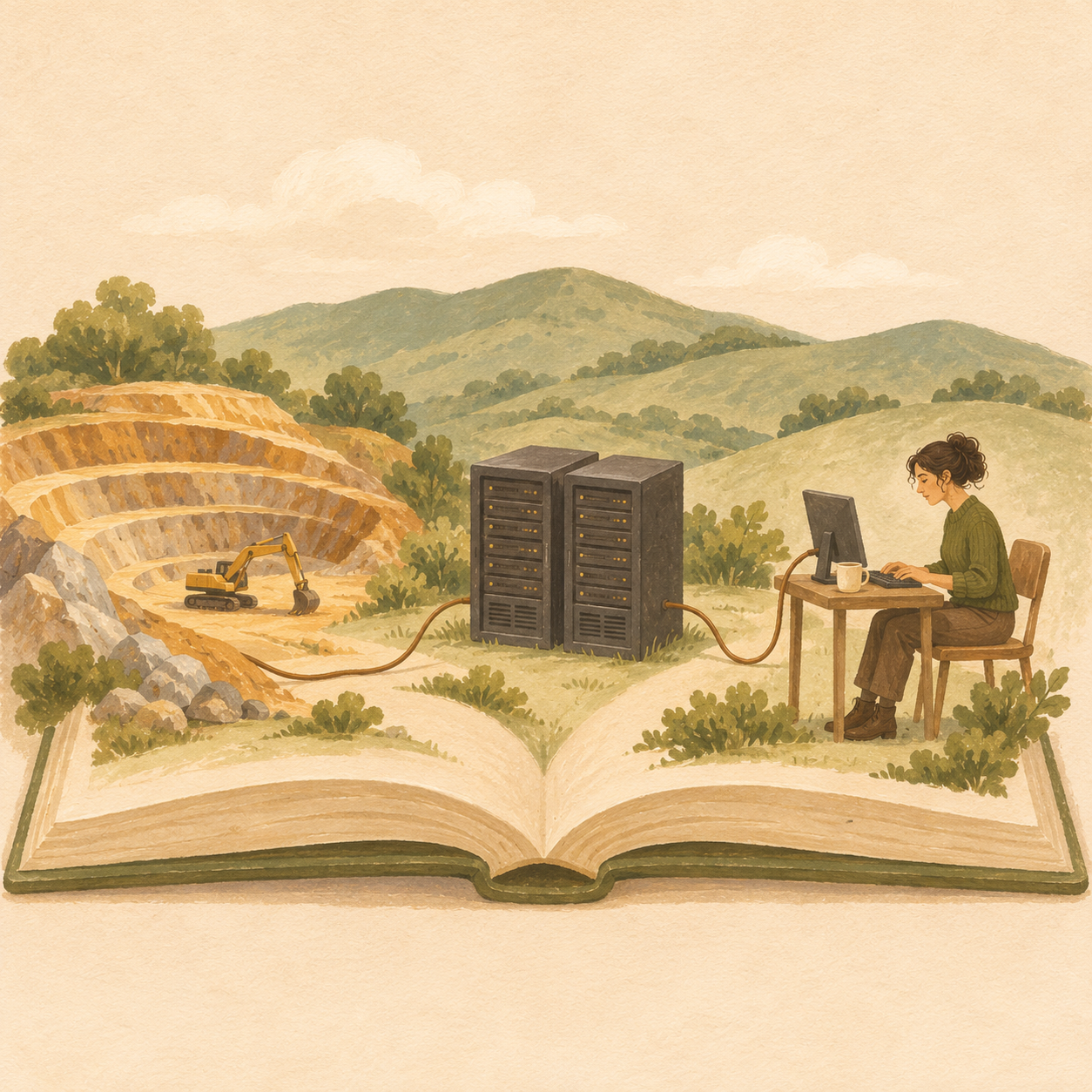
A voice assistant answers a question in seconds. The exchange seems to happen between one person and one device. Kate Crawford asks readers to widen the frame. Where did the device’s materials come from? Who prepared the data? Who owns the infrastructure? Who carries the costs of that convenient answer?
Atlas of AI: Power, Politics, and the Planetary Costs of Artificial Intelligence, first published in 2021, examines these hidden relationships. Crawford’s central argument is that AI is an extractive industry. It draws on natural resources, human work, and recorded experience. Its benefits and burdens follow unequal structures of ownership and authority. The publisher’s description establishes this material and political focus.
The book moves through earth, labor, data, classification, emotion, and the state. Together, these subjects explain how a system that appears purely technical can concentrate power.
An Atlas Changes the Scale of the Question
Crawford uses the atlas as a method. A map can show a continent, a city, or a disputed border. Each scale reveals something different. In the same way, AI looks different when viewed from a laboratory, a mine, or a workplace.
She challenges the idea that intelligence resides in an independent machine. AI depends on prior human knowledge, training practices, institutions, and physical infrastructure. Calling it artificial can conceal its dependence on nature and people. Calling it intelligent can encourage trust before anyone has examined what it actually does.
This is a critique of the assumptions surrounding AI, rather than a technical demonstration that machines cannot perform useful tasks. In her Radical AI interview, Crawford explains why defining AI narrowly also limits how society evaluates and governs it. If the object of study is only an algorithm, the mine and the worker disappear from the assessment.
Earth: Computation Has a Material History
Crawford visits Silver Peak in Nevada to examine lithium extraction. The visit connects digital services to the landscapes and materials behind computing. Batteries belong to this wider infrastructure, alongside semiconductor production, transport, electricity, and cooling. Lithium is not a substance that an algorithm itself consumes.
Her point concerns the distance between the user experience and the production system. A clean interface can depend on damaging industrial processes elsewhere. The description of a service as being in the cloud makes that distance harder to see. Crawford discusses the mine and these hidden connections in her 2021 Big Tech interview.
Her earlier project with Vladan Joler, Anatomy of an AI System, makes the same problem concrete through an Amazon Echo. It follows materials, labor, and data across the device’s production, use, and disposal. An ordinary household interaction rests on a much larger network.
The implication is to assess a service across its life cycle. Electricity during use is one cost. Manufacturing equipment and dealing with discarded hardware also belong in the account.
Labor: Automation Depends on People
AI’s apparent independence also conceals work. People collect and label training material, check outputs, and maintain services. Breaking work into small tasks can make those contributions difficult to recognize. The finished product receives the credit for intelligence while the people supporting it become less visible. Anatomy of an AI System traces these labor relationships alongside the physical supply chain.
Crawford also studies how automated systems manage people. Her account of an Amazon fulfillment center describes workers whose activity is measured against required rates. Here, the machine does not simply replace a worker. It helps set the pace and terms of work. She explains this observation in her University of Sydney book discussion.
This connects AI to older efforts to divide, time, and control labor. The question extends beyond whether automation creates or removes jobs. Who can set a target? Who can challenge it? Does increased productivity give workers more security, or give managers more control?
Data: Availability Does Not Settle Responsibility
Crawford rejects the treatment of data as neutral material waiting to be collected. Records come from particular situations. Moving them into a training set can remove the context that explains their meaning and the conditions under which people supplied them.
In the authorized excerpt “Ethics at arm’s length”, she examines research that used police records to classify gang-related crime. The records carried institutional judgments. Treating their labels as settled truth risked carrying those judgments into a new system.
She also questions the historical separation between computing research and human-subject protections. Work can affect people even when researchers never meet them. Public access to a dataset does not remove the possibility of harm through reuse, linkage, or classification.
The lesson is broader than obtaining cleaner records. Researchers must examine who produced a category, why it exists, and what happens when it becomes an automated judgment. Distance from the people represented in data does not erase responsibility toward them.
Classification: The Labels Already Contain a Worldview
A classifier learns distinctions that people have chosen. Those distinctions can encode social judgments before training begins.
Crawford and Trevor Paglen’s Excavating AI provides a representative example through ImageNet. Its structure drew on WordNet, a system for organizing words. In the historical person categories they examined, labels included judgments about character and social worth. Converting a word into a visual category assumed that a photograph could reveal that quality.
Their ImageNet Roulette project exposed these classifications to public view. It demonstrated how offensive labels could emerge from a system trained on those categories. The example concerns the broader historical dataset; it should not be confused with the narrower object-recognition competition alone.
This reveals a limit of treating fairness only as equal error rates. A system might apply an unjustified category consistently. Better performance would not make the category appropriate. Crawford asks readers to examine what a system is authorized to decide about people, as well as how accurately it assigns its labels.
Affect: A Facial Movement Is Not a Feeling
The discussion of affect examines attempts to infer emotions from facial expressions. Crawford questions the assumption that a fixed set of visible expressions reliably reveals a person’s internal state across situations.
In her contemporaneous Nature essay on emotion recognition, she warns about tools marketed for schools and workplaces despite serious scientific disagreement. Recognizing a facial movement and establishing what someone feels are different tasks.
For an illustrative example, imagine an applicant who smiles during a stressful interview. The smile might express friendliness, discomfort, or an effort to meet expectations. A system’s confident emotional label cannot settle that ambiguity. This example illustrates the distinction; it is not a reported case from the book.
Crawford’s concern is especially serious when inferred feelings affect opportunities. A numerical output can make an uncertain interpretation appear to be a measured personal fact.
State Power and the Promise of Endless Expansion
The state sections bring these issues into policing, security, and institutional authority. In her Sydney discussion, Crawford emphasizes that systems often strengthen already powerful organizations, including corporations, police, and militaries. The political question is who gains the capacity to observe and classify others, and who must live under those judgments.
The closing turn toward space extends the argument about extraction. Crawford reads technology billionaires’ space ambitions as expressions of a commitment to continued expansion. Her Big Tech interview discusses this coda through Jeff Bezos’s presentation of space as a source of further resources. The connection is ideological: seeking another frontier can displace the obligation to confront limits and unequal costs on Earth.
Applying the Argument to a Real Decision
The following questions are practical applications of Crawford’s analysis, rather than a checklist quoted from the book:
- What does the service require? Include equipment, energy, materials, and human work in the assessment.
- What do its labels mean? Check whether the proposed category measures something valid and relevant.
- Who gains authority? Identify who can monitor, judge, or restrict someone else through the system.
- Who can contest the result? Examine whether affected people have a workable route to correction or refusal.
Consider a school offered software that scores student engagement from video. A useful evaluation would ask how engagement is defined and validated. It would examine data retention, teacher workload, student consent, and alternatives. A demonstration of accurate face detection would answer only a small part of the decision.
This approach can change the purchase question itself. An institution may need better support for students rather than another way to score them. Technical improvement and institutional benefit require separate evidence.
What the Book Leaves Open
The book offers a critical map of an industry, not a full comparison of every AI application. Its cases reveal mechanisms of harm. They do not establish that every use has the same costs or that those costs always exceed its benefits. A particular deployment still needs evidence about its actual effects and feasible alternatives.
The breadth of the atlas also creates a boundary problem. Some harms arise across electronics manufacturing, industrial management, or government recordkeeping more generally. Readers should ask which costs a particular AI system adds, rather than assigning the entire cost of shared infrastructure to it.
Finally, the original book is a 2021 account. It cannot supply a current inventory of models, suppliers, or resource demands. Its lasting contribution is a way to investigate them: follow the resources, recover the hidden work, examine the categories, and ask who has the power to choose.
Sources
- Yale University Press: book identity and central argument.
- Crawford: authorized book excerpt, “Ethics at arm’s length”.
- Author discussions: Radical AI, Big Tech, and University of Sydney.
- Related research by Crawford with collaborators: Anatomy of an AI System and Excavating AI.
- Crawford: “Time to regulate AI that interprets human emotions,” Nature, 2021.

