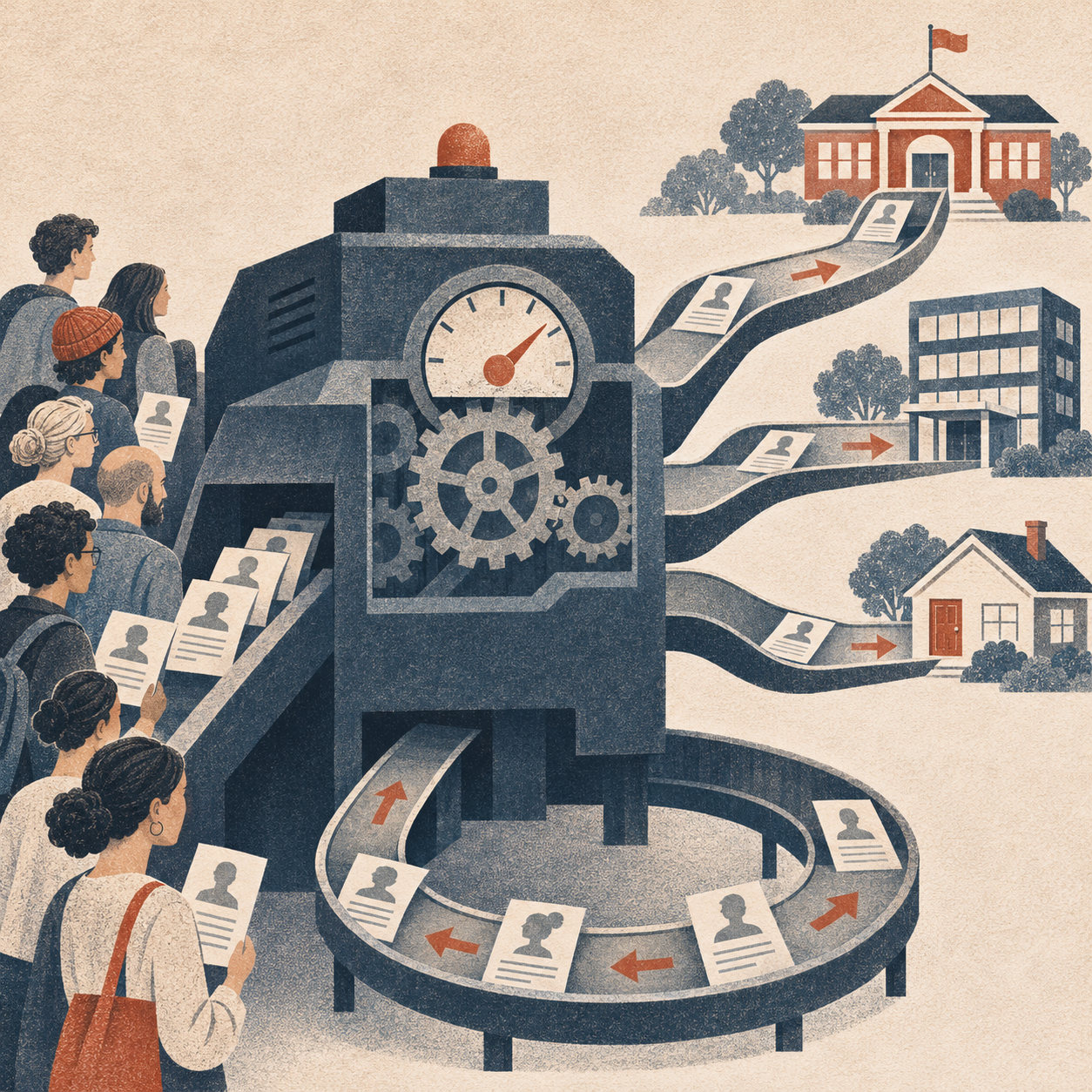
When a Score Becomes a Barrier
A school district wants better teachers. An employer wants reliable workers. A lender wants borrowers who repay. Each organization turns a difficult judgment into a score. The score looks consistent and precise. But what does it measure, whose interests does it serve, and how can someone challenge a mistake?
These questions drive Cathy O’Neil’s Weapons of Math Destruction: How Big Data Increases Inequality and Threatens Democracy, first published in 2016. Her central argument is that some mathematical models give existing inequality greater reach and authority. They turn past disadvantage into predictions that restrict future opportunity. Their mathematical form can hide the human choices behind them. The publisher’s description establishes this focus.
O’Neil writes as a mathematician who moved from academia into finance and then data science. She describes the financial crisis as a break in her faith that sophisticated mathematics necessarily supports sound decisions. Her subject extends well beyond systems called artificial intelligence. Rankings, statistical scores, and automated screening rules can all exercise power.
What Makes a Model Destructive?
O’Neil identifies three defining features of a weapon of math destruction, or WMD:
- Opacity: People cannot understand the basis of a judgment. They may not even know that a system is scoring them.
- Scale: The same method reaches many people and controls important decisions.
- Damage: Its judgments can unfairly restrict people’s lives or produce wider social harm.
These features reinforce each other. A hidden rule is difficult to contest. Repeated across institutions, it becomes difficult to escape. A person who loses access to work or education may have fewer resources to recover from the decision.
The distinction matters. A model does not become a WMD merely because it uses statistics or makes errors. O’Neil targets a combination of consequential use, inadequate scrutiny, and harmful outcomes. She explains this definition in her TechTarget interview.
Models Contain Choices About What Matters
A model is a simplified representation of a process. It includes some facts and leaves others out. Its designer also chooses what counts as success. These decisions remain human judgments even when software performs the calculation.
O’Neil uses baseball as a useful contrast. Teams have detailed performance records and repeated opportunities to compare predictions with results. When a prediction fails, new evidence can support a correction. Many social scoring systems lack this close connection between their inputs, their goals, and observable outcomes.
A central problem is the proxy: a substitute for something difficult to measure. A postal code may stand in for financial reliability. A test result may stand in for teaching quality. The substitute can contain useful information while still supporting a poor judgment about an individual. O’Neil develops these distinctions in the publisher’s opening chapter excerpt.
The practical question is therefore more specific than whether a model is accurate. Accurate at predicting what? Under which conditions? Is the predicted outcome the one the institution should pursue?
Teaching: Uncertain Measurements, Certain Consequences
The book introduces Sarah Wysocki, a Washington, D.C., teacher who received positive assessments from people familiar with her work. A poor algorithmic growth score contributed to her dismissal. The model attempted to isolate her contribution to changes in student test results.
O’Neil questions the strength of that inference. Learning depends on many factors outside a teacher’s control. Small classes and unreliable starting scores make the task harder. Wysocki suspected that inflated earlier test results had distorted the comparison. That suspicion should remain distinct from a proven explanation of her score.
The accountability problem is equally serious. Removing teachers labeled ineffective does not itself prove that the model identified them correctly. If the label becomes the evidence, the system avoids a meaningful test of its own judgment. O’Neil presents this case in the book’s introduction.
This example connects statistical uncertainty to institutional responsibility. A calculation can produce a definite number even when the evidence does not justify a definite employment decision.
College Rankings Change the Colleges They Measure
A ranking seems to describe a field from outside. Once students and administrators depend on it, it also changes that field.
O’Neil examines the influence of U.S. News college rankings. Institutions gain incentives to improve the measures that affect their position. Selectivity and reputation can become targets in themselves. A college may improve its standing without making a comparable improvement in education or access.
She also asks what the ranking omits. In the system she criticizes, affordability did not receive the importance it deserved for families making costly decisions. This is a historical account of the book’s example, rather than a description of today’s ranking formula.
In her Teaching in Higher Ed interview, O’Neil questions whether one ordered list can represent the different things students need. Her broader point is that a common measure can push diverse institutions toward the same narrow goals.
Policing: Predictions Can Help Produce Their Evidence
Recorded crime is shaped by where authorities look. If officers spend more time in one neighborhood, they can detect more minor offenses there. A model trained on those records may recommend more attention to that same neighborhood. The resulting records then appear to confirm the prediction.
O’Neil’s concern is a harmful feedback loop: an intervention changes the evidence that will justify the next intervention. More recorded activity does not automatically demonstrate more underlying offending relative to less observed places. She discusses this mechanism and the importance of distinguishing nuisance offenses from serious crime in her InfoQ interview.
Her discussion of recidivism raises a related issue. A prediction of returning to prison can influence treatment in ways that make reintegration harder. In O’Neil’s account, longer incarceration can weaken employment prospects and community ties. A risk score can therefore participate in the outcome it appears merely to forecast. She explains this argument in her EconTalk interview.
The implication is to examine the entire decision process. Testing predictions against later records is insufficient if the decisions themselves helped create those records.
Advertising, Hiring, and Credit: Disadvantage Travels
O’Neil argues that targeted advertising can exploit vulnerability. A campaign may successfully recruit students for a for-profit college while leaving those students with debt and poor prospects. Conversions measure success for the advertiser; they do not establish benefit for the person recruited. She explains this conflict in her Salon interview.
Hiring introduces another gap. Resume filters and personality tests can reject applicants before anyone considers their circumstances. An employer may value faster screening, while applicants need a fair chance to show their ability. Efficiency and fairness require separate evaluation.
Credit information can also spread beyond its original purpose. O’Neil criticizes its use in employment decisions: financial hardship can obstruct access to the work needed to recover from that hardship. Her argument concerns the chain of consequences, not just the quality of one score.
These systems are especially difficult to resist when participation is necessary. A worker cannot always refuse screening and still compete for a job. O’Neil sees this lack of bargaining power as a reason the harms fall unevenly.
From Private Scores to Public Accountability
The book extends its concern to civic life. Personalized political messages can reach separate audiences without equivalent public scrutiny. Citizens may lack a shared view of what campaigns promise or how platforms shape their information. O’Neil treats this as a threat to democratic accountability, rather than proof that a particular algorithm determines an election.
Her response combines ethical responsibility, scrutiny, and institutional change. She calls for audits, stronger accountability, and a professional commitment to avoid harm. In her subsequent 2017 essay, “Why We Need Accountable Algorithms”, she develops the case for public ethical choices and ongoing monitoring. That essay supports the discussion here; it is separate from the original book.
For a reader evaluating a scoring system, the following questions are practical implications of her argument:
- What outcome does the system optimize, and who benefits from it?
- Do its inputs measure relevant behavior or mainly reflect disadvantage?
- Can affected people inspect their records, correct errors, and contest decisions?
- Does evaluation track harm to rejected people, alongside benefits to the operator?
- Can an accountable institution change or withdraw the system?
These questions turn a general demand for fairness into decisions that someone must own.
What the Argument Establishes—and What It Leaves Open
The book offers a strong account of failure mechanisms. Its examples do not establish the total balance of benefits and harms across every use of statistical decision systems. A flawed model should be compared with realistic alternatives, including biased human judgment. Returning a decision to a person does not automatically make it fair.
Transparency also has limits. Publishing a formula cannot by itself settle whether its objective is legitimate. Nor does an explanation compensate for an institution that refuses to correct an error. These are interpretive limits of the proposed remedies, rather than reasons to abandon scrutiny.
Finally, the book’s examples belong to its period. They should guide investigation of a current system, not substitute for fresh evidence about that system. Its lasting contribution is a way to question authority: examine how a score is made, how it changes people’s options, and whether those people can hold its users responsible.
Sources
- Penguin Random House: book details and author credit; publisher’s chapter excerpt.
- Book introduction and excerpts, hosted by Simon Fraser University.
- Author interviews: EconTalk, 2016, InfoQ, 2016, and Teaching in Higher Ed, 2017.
- Author interviews: Salon, 2016 and TechTarget, 2017.
- Cathy O’Neil: “Why We Need Accountable Algorithms,” 2017, a later explanation of her accountability proposals.
