How Physics Makes the Universe Understandable
In A Brief History of Time, Stephen Hawking asks how far scientific explanation can reach. Can we explain the universe’s history? Can we explain its beginning? Why does time have a direction? The book connects these questions through the search for physical laws that work together.
Its central argument is that the universe can be studied through rational, testable models, even when its behavior defeats ordinary intuition. Yet our successful theories remain incomplete. Their failures at extreme conditions point toward a deeper account of nature.
First published in 1988, this is Hawking’s cosmology book for general readers. It is distinct from A Briefer History of Time, his later collaboration with Leonard Mlodinow. The publisher’s listing and opening excerpt confirm the sole author and the book’s broad questions.
Scientific Pictures Must Answer to Observation
Hawking begins with changing pictures of the heavens. Earth-centered models gave way to models in which Earth moves around the Sun. Kepler’s elliptical orbits improved the fit between prediction and observation. Newton then connected planetary motion and falling objects through one account of gravity.
These changes establish a reading rule for the rest of the book: an appealing picture must survive evidence. Familiarity, authority, and mathematical neatness cannot settle a physical question by themselves. The authorized opening excerpt makes this historical method explicit.
For readers, the useful habit is to ask what a model predicts and where those predictions work. A theory can remain useful within a limited range even after a broader theory replaces it. Scientific progress often changes the range of an explanation rather than making every earlier calculation worthless.
Space and Time Participate in Events
Relativity changes the setting in which physics happens. Space and time form a connected structure called spacetime. In general relativity, matter and energy affect its curvature. Freely falling objects follow paths determined by that geometry.
Curvature need not mean a visible bend into some surrounding room. Consider the surface of Earth. Routes that are locally straight can form a triangle whose angles differ from those of a triangle on flat paper. Geometry itself tells us that the surface is curved. Hawking develops this example in his later lecture on space and time.
Time also loses its role as a universal clock. Motion and gravity affect the elapsed time measured along different paths. This is a physical difference between clocks, rather than a difference in how long an experience feels.
The larger implication is that the universe’s history includes the history of spacetime. We cannot assume an unchanged stage stretching indefinitely behind every event.
Expansion Turns Cosmic Origins into a Scientific Question
The expansion of the universe gives cosmology a past to investigate. Widely separated galaxies were generally closer together earlier. Following that history backward leads toward a much hotter, denser universe.
The hot Big Bang picture gains support from the cosmic microwave background, the cooled radiation left from the early universe. The argument combines observations with a model of how matter and radiation change as space expands. Hawking revisits this evidence in The Beginning of Time.
Pushing classical general relativity far enough backward produces a deeper problem. Under the conditions of the singularity theorems, the classical account cannot extend indefinitely into the past. Its description becomes incomplete.
Hawking treats this as a reason to investigate quantum gravity. A singularity marks the failure of the classical account; it does not give us a reliable description of what happened at an infinitely dense point. Evidence for an early hot universe and an explanation of the ultimate origin are different achievements.
Quantum Physics Limits What Prediction Means
At small scales, quantum mechanics replaces exact classical trajectories with a different account of physical states. The uncertainty principle prevents position and momentum from both having arbitrarily precise values in the same state.
This limitation is deeper than a shortage of good instruments. Narrowing the range of possible positions increases the spread of possible momenta. A particle cannot simply be treated as a tiny planet whose exact orbit remains hidden from us.
Quantum theory still makes precise predictions, but many concern probabilities across repeated trials. A theory can predict a distribution successfully without determining the result of each individual measurement. Hawking explains this departure from classical determinism in Does God Play Dice.
The book’s central difficulty now becomes clearer. General relativity describes gravity through spacetime geometry. Quantum mechanics governs matter at small scales. Near the universe’s earliest conditions, both should matter. Their separate successes do not supply a complete account of their interaction.
Black Holes Bring the Two Theories Together
A black hole contains a region from which light cannot reach distant observers. Its event horizon marks the boundary of that region. Classical physics therefore suggests an object that can absorb material without emitting anything from within the horizon.
Hawking’s major result changes that conclusion. Quantum fields in the spacetime of a forming black hole lead to thermal radiation seen far away. If the outgoing energy exceeds what the hole absorbs, the hole loses mass. Smaller black holes have higher temperatures and can lose mass faster.
The popular picture of particle pairs separating near the horizon offers an aid to imagination. It is not a literal account of particles escaping from inside. Hawking’s 1975 radiation paper explicitly treats such pictures as heuristic.
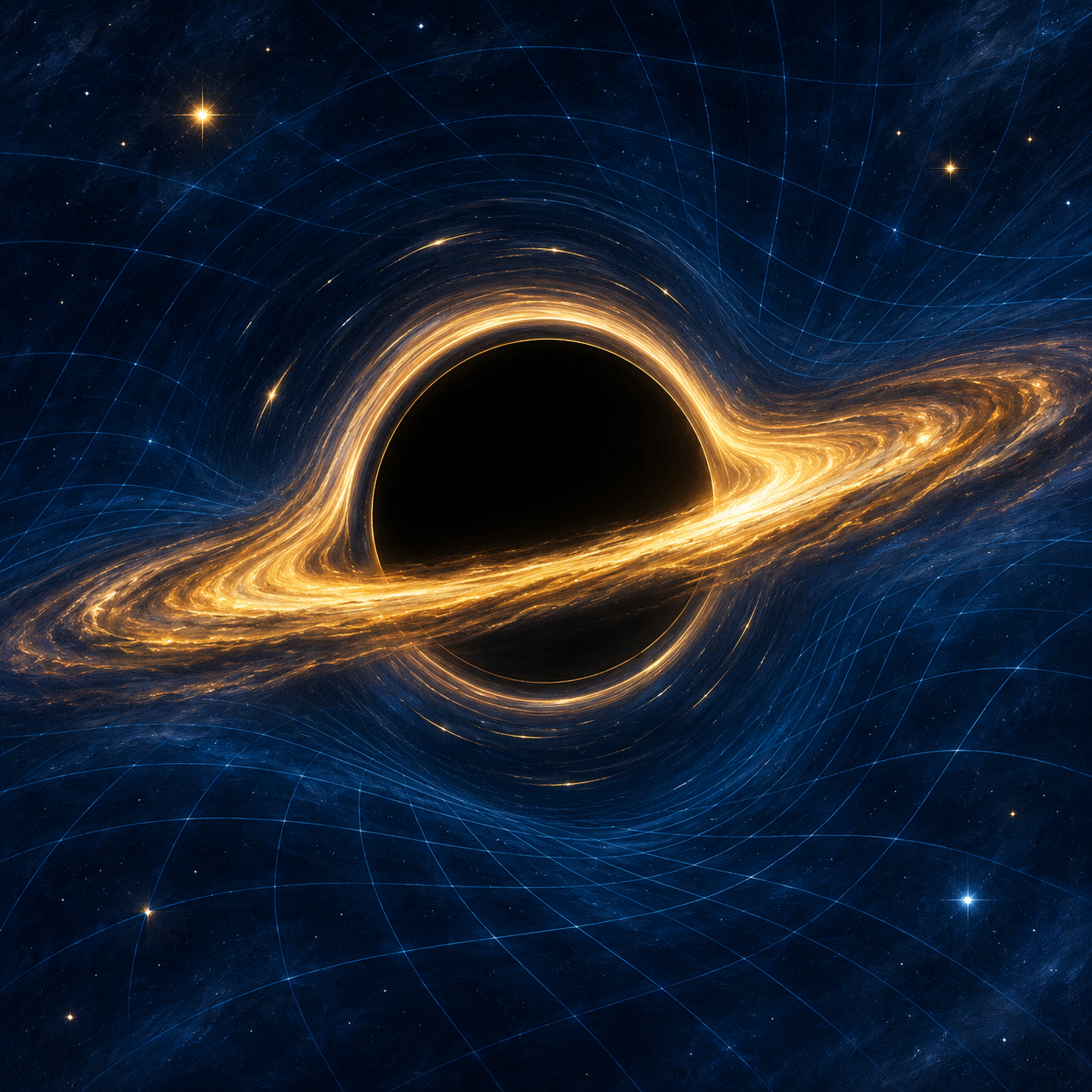
The result connects gravity, quantum theory, and thermodynamics. Black holes become a test of how these areas fit together. Radiation is a theoretical prediction here; the illustration above is conceptual art and does not depict its detection.
Why We Remember Yesterday
Hawking distinguishes three arrows of time: the direction in which entropy increases, the direction in which we remember events, and the direction in which the universe expands.
A broken cup makes the first arrow tangible. There are vastly more arrangements corresponding to scattered fragments than to one intact cup. The reverse process is not what we normally observe. Entropy describes this statistical imbalance more precisely than the everyday word “disorder.”
Hawking argues that memory formation connects our psychological arrow to the thermodynamic arrow. Explaining why the early universe had sufficiently low entropy remains a cosmological question. His proposed connection to the universe’s boundary conditions belongs to his theoretical argument, rather than a settled explanation of all temporal asymmetry. These distinctions appear in the book’s discussion of time’s arrows.
Could the Universe Have No Initial Edge?
Ordinary predictions require both laws and starting conditions. Knowing the rules for a moving ball does not tell us where it goes unless we also know how it starts. Cosmology raises the harder question of what sets the universe’s starting conditions.
Hawking presents the no-boundary proposal developed with James Hartle. It seeks a quantum description in which the universe has no sharp initial boundary requiring separately imposed data. The original research paper proposes a wave function for the universe using a sum over suitable geometries.
The book uses imaginary time, a mathematical treatment in which time behaves more like a spatial direction, to explain the idea. Earth’s surface provides an analogy: it has finite area without an edge. Near a pole, asking for a place farther in the same direction eventually stops making sense.
This analogy does not prove that our universe has that structure. The proposal attempts to explain its quantum state. It does not establish that every question about existence has been answered.
What Remains Open, and What Readers Gain
The no-boundary idea remains a research proposal. Later work by Hartle, Hawking, and Thomas Hertog examines how to define it and obtain predictions. That continuing work helps distinguish a promising framework from an experimentally established account of the beginning.
The book also reflects its scientific period. Its discussion of cosmic fate predates the discovery of accelerated expansion. NASA’s account of dark energy explains why the balance between matter and expansion cannot now be discussed in the original terms alone. Dark energy adds a major unresolved question.
Even a unified theory would not provide a practical prediction of every event. Hartle’s later discussion of theories of everything makes this limit concrete: universal laws do not replace the histories and chance events needed to explain particular systems.
My reading is that the book’s most useful outcome is a disciplined form of curiosity. Separate an observation from its explanation. Check where an analogy stops working. Ask whether a claim is a measured result, a theoretical prediction, or a proposed framework. Hawking makes enormous questions accessible while showing why some remain difficult.
Sources
- Penguin Random House: book details and authorized opening excerpt.
- Book text hosted by the University of Washington, consulted for the arrows of time.
- Hawking’s estate: Space and Time Warps, The Beginning of Time, and Does God Play Dice. These later lectures clarify related physics.
- Original research: Particle Creation by Black Holes and Wave Function of the Universe.
- Later context: the no-boundary wave function, Hartle on theories of everything, and NASA on dark energy.
