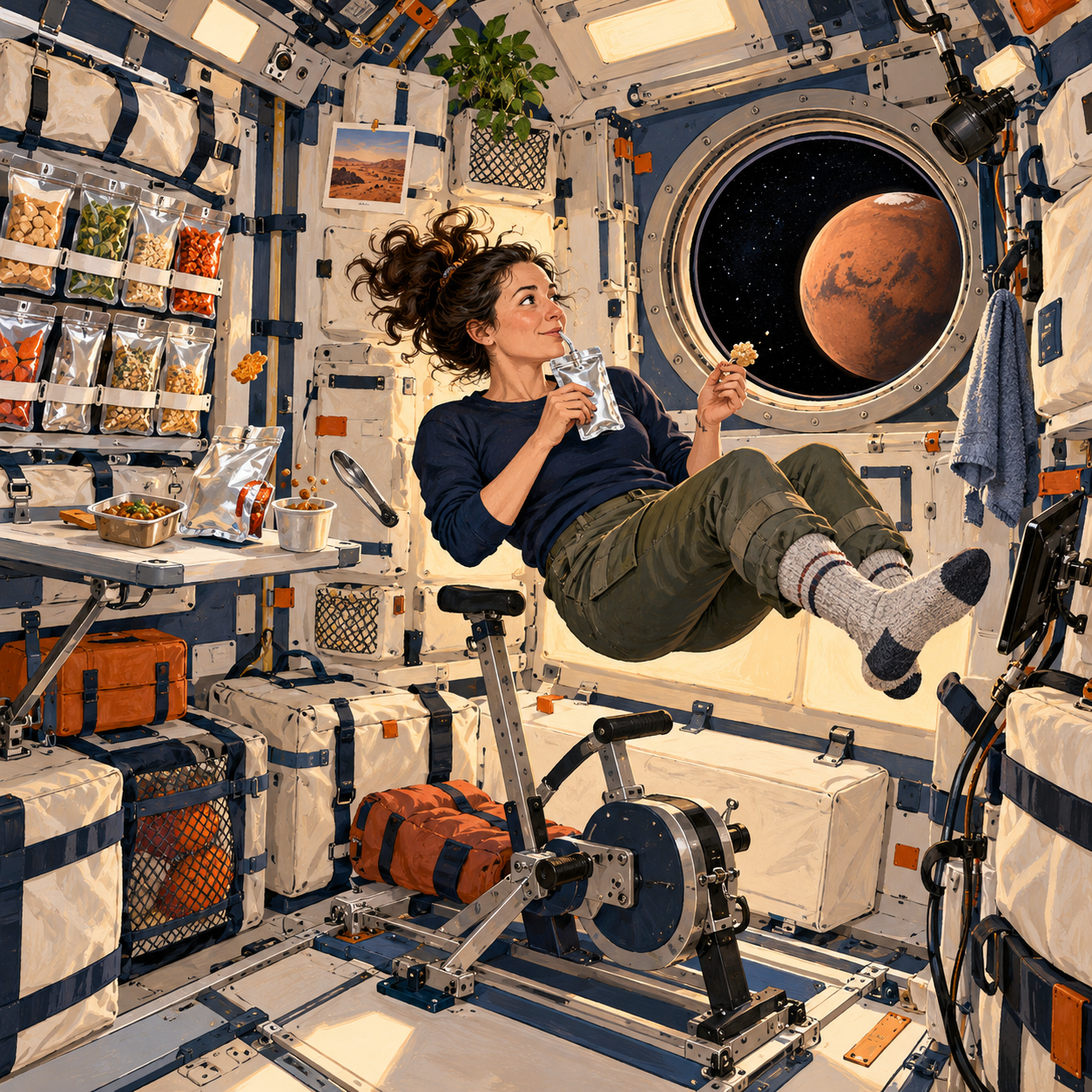
Keeping a Human Alive Beyond Earth
A spacecraft can reach its destination and still fail its crew. People need sleep, tolerable food, working toilets, and companions they can endure. Their bodies depend on conditions that a rocket cannot simply carry along. In Packing for Mars: The Curious Science of Life in the Void, Mary Roach makes these ordinary needs the center of the space story. Her guiding idea is that human spaceflight requires rebuilding the conditions of daily life around an organism adapted to Earth. The author’s book description establishes this emphasis on human limits and the experiments used to investigate them.
Published in 2010, this is the adult book, distinct from Roach’s later adaptation for children. Despite its title, it ranges across astronaut selection, early space missions, bodily functions, and research facilities on Earth. Mars supplies the demanding horizon: a journey long enough to make small inconveniences consequential. The publisher’s description and author’s contents page confirm that broader scope.
Ordinary Actions Become Engineering Problems
Roach introduces her perspective through the Apollo lunar flag. What looks like a simple symbolic gesture required decisions about support, storage, heat protection, and deployment by someone whose pressurized suit restricted movement. Even after rehearsal, the crossbar did not fully extend and planting the pole proved difficult. The example makes her method clear: follow a familiar action closely enough, and the invisible work beneath it becomes visible. See the authorized opening excerpt.
That same attention runs through the book’s less ceremonial subjects. On Earth, gravity helps position bodies and move waste. In weightlessness, engineers and astronauts must deliberately manage processes people usually perform without thinking. Roach’s humor comes from the distance between the public image of effortless competence and the labor required to accomplish something basic.
A useful interpretation is that the spacecraft and its crew form one working system. A design cannot be judged only by whether its components function; it also matters whether tired, uncomfortable people can use them repeatedly. Roach’s questions make that relationship concrete without requiring the reader to know rocket science.
The Right Crew Must Tolerate Repetition
The opening chapter follows astronaut selection in Japan. Candidates live under observation and fold paper cranes, a task that initially seems far removed from space exploration. The evaluators are interested in how accuracy and behavior hold up under pressure. Meticulous, repetitive work can reveal qualities that impressive credentials alone cannot. This episode appears in the book’s publisher-distributed reading preview.
Roach broadens this into a question about temperament. Living in a confined spacecraft demands patience with monotony and with other people. In her NPR interview, she describes boredom, disturbed sleep, and the practical consequences of a crewmate’s snoring. The romance of the destination does not make every hour of the journey interesting.
The implication is more subtle than a recommendation to select agreeable people. A crew needs technical competence that survives irritation, fatigue, and limited privacy. My reading is that Roach moves heroism into everyday conduct: maintaining standards and treating colleagues decently when there is no audience and no immediate escape. For anyone designing a remote workplace or expedition, that is a useful way to think about reliability.
Weightlessness Is Both Delight and Disruption
Roach participates in a parabolic research flight, experiencing short intervals of weightlessness. Her account conveys the pleasure of floating as well as the bodily confusion that can accompany it. In an interview about the book, she describes wanting to repeat the experience. The book’s curiosity includes exhilaration alongside discomfort.
Its investigations of motion sickness, prolonged bed rest, and physical adaptation show why feeling light does not mean the body has less work to do. The contents include separate treatments of space sickness and the consequences of remaining in bed, while Roach explains in a research interview that bed-rest studies helped inspire the project.
The distinction between adaptation and readiness matters here. A body can adjust to reduced physical demands in ways that make a later return to gravity difficult. Current NASA research still identifies loss of musculoskeletal fitness and altered balance and movement as risks, and studies exercise and other countermeasures. That is present-day context, rather than a claim that every estimate discussed in 2010 remains current. See NASA’s human spaceflight risk overview.
Food, Hygiene, and Toilets Belong at the Center
The book devotes substantial attention to eating, washing, and elimination. These are subjects people readily laugh about, but their engineering importance is serious. A toilet must reliably contain waste in an environment where it will not simply fall away. Roach explains in her Rumpus interview that this familiar question offers an especially clear demonstration of how gravity shapes daily life.
She also examines the unpleasant intimacy of early missions and the ingenuity of resource conservation. Her Lightspeed interview discusses Gemini hygiene and speculative proposals for edible clothing and reusing waste as shielding material. Such proposals should be understood as ideas she investigates, rather than descriptions of standard astronaut equipment.
Food raises a similar distinction between a technically adequate provision and a livable routine. Roach’s chapter on aerospace test kitchens sits beside her accounts of hygiene and waste because these problems belong to the same daily cycle. Her WHYY interview introduction identifies food engineering and personal hygiene among the book’s central concerns.
The broader lesson I draw is that comfort deserves careful definition. Some comforts are optional; others help people keep eating, sleeping, cooperating, and doing their work. A plan that treats every unpleasantness as something disciplined astronauts should simply endure may miss how discomfort accumulates. Roach makes the humble maintenance of a person worthy of sustained scientific attention.
Learning About Space While Staying on Earth
Many of the book’s most revealing settings are simulations and test facilities. These include a toilet trainer, bed-rest research, and a capsule crash test involving a donated human body. Roach’s official description presents these earthly investigations as a way to approach the experience of space before leaving the ground.
The tests also suggest an important limit on knowledge. A bed-rest study can investigate the effects of unloading the body without recreating an entire mission. A confinement experiment can expose interpersonal problems while leaving participants within reach of ordinary rescue. This is a methodological interpretation of the examples: every simulation has to be assessed according to the particular question it can answer.
The historical chapters about Ham and Enos, the chimpanzees used in early spaceflight research, add another dimension. Roach resists reducing these animals to amusing footnotes. In the Rumpus conversation, she describes tracing and challenging an exaggerated story about Enos. The episode highlights a second kind of testing: checking whether an entertaining account survives contact with its sources.
What the Book Leaves Open
Roach’s attention to fragile bodies and elaborate workarounds leads toward the question named in her final chapter: whether Mars is worth the effort. The book makes the human costs legible without providing a complete economic or ethical decision procedure for exploration. A reader can appreciate its ingenuity and still ask whether a particular mission justifies its risks and expense. The contents page makes that final question explicit.
Its strengths also define its limitations. This is a work of reported popular science, organized around revealing encounters and unusual details. It does not provide a comprehensive spacecraft design, a balanced inventory of every medical hazard, or a current mission plan. The memorable bodily problems can occupy more attention than less visible threats.
For perspective, NASA now groups human spaceflight hazards around radiation, isolation and confinement, distance from Earth, gravity fields, and hostile or closed environments. That framework is useful alongside Roach’s narrative because it shows how her vivid subjects fit into a larger research agenda. It also cautions against treating experience in Earth orbit as a complete demonstration of readiness for Mars. See NASA’s account of the human body in space.
The book’s lasting contribution is a change in what readers notice. Behind an astronaut’s apparently simple action are designers, researchers, test subjects, maintenance routines, and bodily compromises. Roach gives those efforts a human scale. Ambitious exploration becomes easier to understand when we ask how someone will spend an ordinary day inside it.
Sources
- Mary Roach: book overview and contents, with the full chapter list.
- W. W. Norton: publisher’s book listing.
- Authorized opening excerpt, NPR via VPM and reading preview on Everand.
- Author interviews: NPR via NCPR, The Rumpus, and Lightspeed.
- Current context: NASA’s human spaceflight risks and the human body in space.