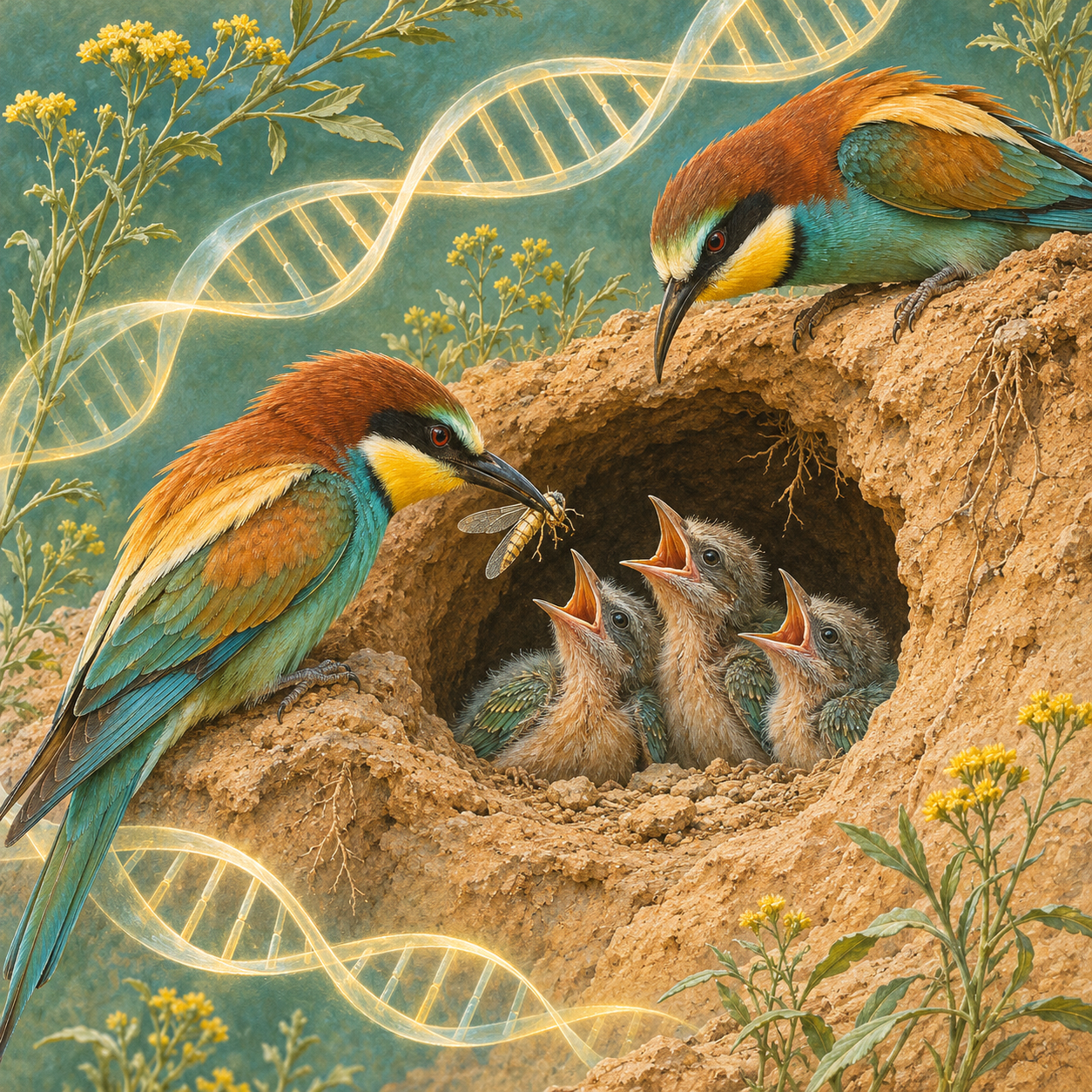
How Gene Survival Can Produce Cooperation
An animal risks danger to protect its young. Another competes fiercely with its relatives. How can natural selection produce both care and conflict?
Richard Dawkins’s The Selfish Gene, first published in 1976, approaches these questions through inherited information. Bodies live and die. Copies of genes can persist through many generations. Dawkins asks readers to explain adaptations by considering which inherited variants leave more copies. The Oxford University Press description identifies this gene-centered view as the book’s central argument.
The title creates a common misunderstanding. Genes have no intentions or moral character. “Selfish” describes a pattern of propagation. A variant can spread through behavior that helps another animal. In an interview with PBS, Dawkins explicitly distinguishes gene selfishness from individual selfishness. Much of the book explains how cooperation becomes possible within this framework.
Genes Persist Through Changing Bodies
A replicator is something whose structure can be copied. In biological evolution, genetic sequences carry inherited information. Copying introduces variation, and some variants contribute to their own transmission more effectively than others. Repeated across generations, differences in transmission can change a population.
An organism provides the working system through which many genetic effects occur. Its genes function together, within cells and environments. Calling genes replicators does not mean that DNA copies itself without cellular machinery. Nor does it mean that one gene independently builds a whole behavior.
The distinction becomes especially useful when genetic interests diverge. A genetic element can sometimes spread at a cost to the organism carrying it. Conversely, many genes spread because their effects help the whole organism survive and reproduce. The research review on selfish genetic elements examines this relationship between genetic cooperation and conflict.
The useful question is therefore specific: compared with an alternative inherited variant, under what conditions would this variant become more common? Describing something as beneficial to life in general does not answer that question.
Helping Relatives Can Preserve Copies of Genes
An animal’s own offspring are one route by which inherited variants continue. Relatives provide another route because they may carry copies inherited from common ancestors.
This is the basis of kin selection. A costly helping behavior can spread when its reproductive benefit to relatives, weighted by relatedness, exceeds its reproductive cost to the helper. The familiar shorthand is rB > C. Relatedness is represented by r, benefit by B, and cost by C. These costs concern reproductive consequences, rather than effort alone.
For an illustrative case, consider a bird that helps raise close relatives instead of attempting to breed alone. Helping could be favored if it produces enough additional surviving relatives, after accounting for its lost breeding opportunities. Relatedness alone cannot settle the result. Food, nest access, and the actual effect of help also matter.
Dawkins makes accessible the logic developed in W. D. Hamilton’s work on inclusive fitness. An animal need not recognize DNA or calculate an equation. Selection can favor behavioral responses to cues that reliably track these conditions.
Families Combine Shared Interests and Conflict
Kinship creates overlapping interests. It does not make every family member’s evolutionary interests identical.
A parent must divide limited resources among present and possible future offspring. An offspring receives the whole direct benefit of extra food for itself. It receives only an indirect genetic benefit when that food supports a sibling. The amount of care favored from one perspective can therefore differ from the amount favored from the other.
Weaning makes the disagreement concrete. Continued feeding can benefit a young mammal while reducing the mother’s ability to support other offspring. There can be a period when further feeding favors the young animal’s genetic interests but no longer favors the mother’s allocation across offspring. This reasoning comes from Robert Trivers’s theory of parent–offspring conflict.
The explanation does not require a young animal to plan exploitation. Selection can shape begging, resistance, and parental responses without conscious calculation. Care and conflict can coexist because family members share some interests and differ over others. This is an account of possible evolutionary pressures, rather than a diagnosis of every disagreement in a human family.
Reproduction Involves Trade-offs Between Partners
Parents can also differ over how much care each should provide. Both may benefit from surviving offspring. Each may also gain from leaving more of the work to the other, if that frees resources for further reproduction.
Parental investment includes resources devoted to an offspring that reduce the parent’s ability to invest elsewhere. Producing eggs, guarding a nest, and feeding young can all contribute. The relevant quantity is the opportunity lost, rather than the visible size of the task.
Drawing on Trivers’s account of parental investment and sexual selection, Dawkins connects unequal investment with competition for mates and mate choice. These are conditional arguments. Which parent cares, and which sex competes more intensely, depends on the species and its breeding conditions. The framework calls for ecological evidence before making claims about a particular population.
The Best Strategy Depends on Other Animals
Natural selection does not always favor maximum aggression. Fighting can secure a resource, but injury can erase that advantage.
Dawkins uses evolutionary game theory to explain such trade-offs. In the hawk–dove model, “hawk” and “dove” name strategies rather than actual bird species. Hawks escalate contests. Doves avoid serious fighting. An aggressive strategy can prosper among opponents that retreat. When escalation becomes common, the costs of fighting can make restraint more successful.
An evolutionarily stable strategy can resist invasion by a rare alternative under the model’s conditions. Stability concerns relative success in a population. It does not imply kindness, perfect design, or the best outcome for everyone.
The foundational paper by John Maynard Smith and George Price showed how limited conflict could arise through advantages to individuals without assuming that animals restrain themselves to protect their species.
The broader lesson is to examine the surrounding population. A behavior that succeeds when rare may fail when common. Its value depends on what others do and on the costs of their encounters.
Repeated Encounters Can Support Cooperation
Helping need not depend on close kinship. Repeated encounters can make present cooperation worthwhile because it affects future treatment.
Later editions develop this through the repeated prisoner’s dilemma. Two participants can both gain from cooperation, while each faces an immediate temptation to exploit the other. If encounters continue, exploitation can trigger responses that reduce its long-term return.
Dawkins discusses Robert Axelrod’s computer tournaments and the simple Tit for Tat strategy. It cooperates first, then repeats the partner’s previous action. It can sustain mutual cooperation while responding to defection. Axelrod and Hamilton’s original paper analyzes conditions under which reciprocal cooperation can arise and resist invasion.
This is a model result, rather than a universal instruction for relationships. Outcomes depend on future encounters, available strategies, and the costs and benefits of each action. As a practical interpretation, cooperation deserves attention to its supporting conditions: reliable repeated contact and responses that discourage exploitation. A model cannot establish that one response will work in every social setting.
Memes Extend the Question Beyond DNA
Dawkins introduces memes as culturally transmitted units, such as tunes or ideas. They spread through learning and imitation. Their success in transmission need not match their truth or their benefit to people.
This is an extension of the replicator argument. It invites readers to ask what makes cultural material easy to retain and pass on. It remains an analogy: people interpret and modify ideas, and cultural units are harder to define than DNA sequences. Popularity alone does not demonstrate a complete evolutionary explanation.
Genetic Effects Can Reach Outside a Body
Later editions also introduce the extended phenotype. A gene’s effects need not stop at an organism’s skin. A caddis larva’s protective case illustrates how inherited influences on building behavior can affect an external structure. Selection can act through the structure’s consequences for survival and reproduction. These extensions appear in the book’s later-edition text.
What This Perspective Explains—and Its Limits
The book offers a powerful method for testing explanations of adaptation. Identify inherited variation, trace its effects, and ask how those effects change transmission. A plausible story still needs evidence about mechanisms and reproductive consequences.
The gene-centered perspective also belongs within a wider debate about levels of selection. Later multilevel-selection modeling shows how cooperation can be favored through differences between groups even when competition within groups favors noncooperators. This does not make every appeal to group benefit valid. It requires an explicit account of group formation, reproduction, and competition.
Finally, an evolutionary explanation does not establish an ethical rule. Dawkins rejects that inference in his PBS interview. Genetic influences are also not a claim that experience and learning cannot change behavior.
My main takeaway is a habit of explanation: distinguish the interests of genes, individuals, relatives, and groups. Then identify the conditions that connect them. That habit makes both cooperation and conflict easier to investigate, while leaving moral choices to moral reasoning.
Sources
- Oxford University Press: book identity, overview, and later-edition contents; Dawkins’s book text, hosted by Loyola Marymount University.
- PBS: Dawkins on altruism, genetic influence, and morality.
- Hamilton: inclusive fitness; Trivers: parent–offspring conflict and parental investment.
- Maynard Smith and Price: animal conflict; Axelrod and Hamilton: reciprocal cooperation.
- Later context: selfish genetic elements and the gene-centered view; Traulsen and Nowak: multilevel selection.
