Life’s History Includes Both Branches and Connections
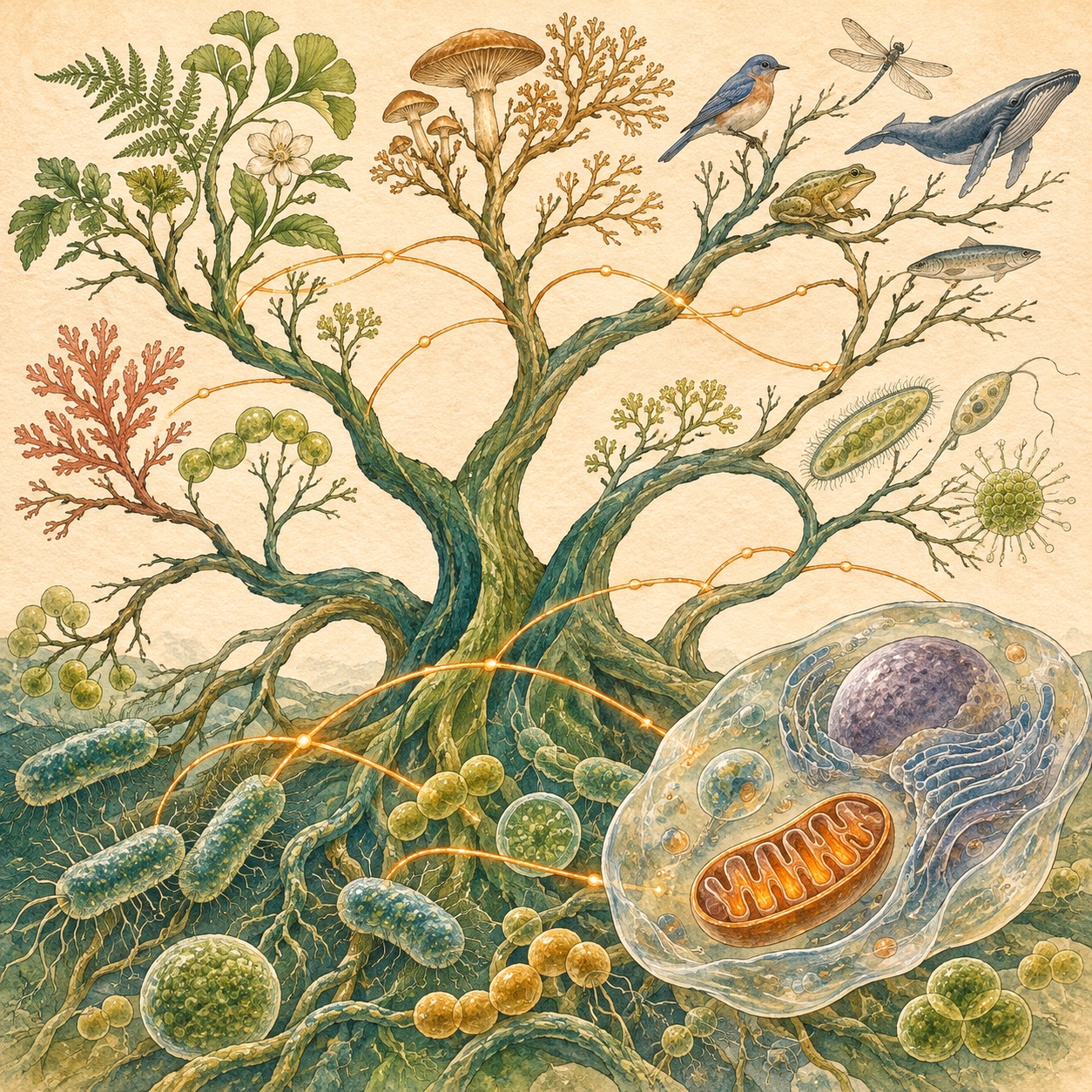
A family tree traces inheritance from parents to offspring. Extend that pattern across species, and evolution appears as a great branching tree. Each lineage divides. Its descendants carry the history of that branch.
David Quammen’s The Tangled Tree: A Radical New History of Life explains why this picture is incomplete. Genes can also move between separate lineages. Cells can become lasting parts of other cells. An organism can therefore contain genetic material with several different histories.
Quammen follows the scientists who uncovered these connections. His central argument is that molecular evidence changes both the shape of life’s history and our place within it. Humans belong to branching lineages, but our cells also preserve ancient biological mergers. The publisher’s description identifies horizontal gene transfer as a central thread.
Reading Ancestry in Molecules
Visible features help scientists compare animals and plants. They provide fewer clues for many microbes. Two cells can look similar under a microscope while having deeply different evolutionary histories.
Molecular comparisons offered another route. DNA and RNA contain sequences of chemical units. Inherited changes in those sequences can help researchers infer relationships. Molecular phylogenetics uses such evidence to reconstruct evolutionary ancestry.
Carl Woese made ribosomal RNA central to this work. Ribosomes build proteins, and all cellular life depends on them. Their RNA offered a basis for comparing organisms across enormous evolutionary distances.
Woese and his colleagues had to assemble these comparisons through painstaking laboratory work. The important change was conceptual as well as technical: organisms could be grouped by molecular evidence rather than appearance alone. Quammen presents Woese’s research as a major turning point in the investigation of deep ancestry.
Archaea Redraw the Map
Woese and George Fox found that methane-producing microbes did not fit among ordinary bacteria. Their ribosomal RNA indicated a separate, deeply divergent lineage. Their 1977 paper helped establish the organisms now called archaea.
This discovery challenged the simple division between cells with a nucleus and cells without one. Bacteria and archaea both lack a membrane-bound nucleus. That shared feature does not make them one close evolutionary group.
Woese’s work eventually supported a three-domain framework: Bacteria, Archaea, and Eukarya. Eukarya includes animals, plants, fungi, and other organisms whose cells have nuclei. Humans occupy one small part of that larger map.
The discovery also illustrates a recurring problem in classification. A category can collect organisms that share a visible feature without capturing their deepest relationships. A new measuring method can reveal differences that the old method could not detect.
Genes Can Move Sideways
Vertical inheritance passes genetic material from a parent to its offspring. Horizontal gene transfer moves genetic material between organisms outside that parent–offspring route. It can cross species boundaries.
This is more than hybridization between close relatives. A microbe can acquire a useful gene from another lineage without the two organisms producing a hybrid offspring.
Bacteria have several routes for such exchange. They can take up DNA released into their surroundings. Viruses that infect bacteria can carry DNA between cells. Cells can also transfer DNA through direct contact, often using plasmids: small DNA molecules separate from the main chromosome. These mechanisms are described in the NCBI-hosted chapter on bacterial genetics.
Transfer does not guarantee lasting evolutionary change. The incoming material must survive and persist. If it becomes established, however, descendants can inherit it vertically. A sideways acquisition can become part of a lineage’s continuing family history.
Why One Gene Cannot Tell Every Story
Imagine two microbial lineages that separated long ago. Later, one receives a gene from the other. Most of its genome still reflects its earlier ancestry. The transferred gene records a more recent connection.
This illustrative case explains why different genes can produce different evolutionary trees. Researchers may be tracking different histories within the same organism. A disagreement among trees is not automatically a laboratory mistake.
Ford Doolittle is an important figure in Quammen’s account of this problem. His 1999 analysis argues that genomes assembled from multiple sources challenge the idea of one universal hierarchy that captures every relationship.
The implication is precise. A tree can represent the history of a particular gene or many inherited cellular features. It may fail to represent every part of a genome at once. For questions involving extensive transfer, a network can show connections that a strictly branching picture leaves out.
Margulis and the Merger Within the Cell
Lynn Margulis developed another challenge to a history made only of splitting branches. Endosymbiosis occurs when one organism lives within another. Her evolutionary argument was that some internal cell structures began as separate organisms and became permanent partners.
Mitochondria, which help cells obtain usable energy, descend from bacteria. Chloroplasts, which carry out photosynthesis in plants and algae, also have bacterial origins. Their incorporation made earlier partnerships part of the structure of later cells.
Margulis’s 1967 paper, published under the name Lynn Sagan, set out a testable account of cell origins. Her wider proposal also included a symbiotic origin for structures associated with flagella. That part did not gain the same support as the bacterial origins of mitochondria and chloroplasts.
Endosymbiosis and gene transfer are connected but distinct processes. One incorporates a cellular partner. The other transfers genetic material. Both show how evolutionary lineages can contribute to a shared biological system.
Antibiotic Resistance Makes the Idea Concrete
The consequences reach far beyond ancient history. Quammen discusses Tsutomu Watanabe’s work on transferable drug resistance. Bacteria could acquire resistance from other bacteria rather than develop every resistance trait independently.
Plasmids can carry several resistance genes together. A recipient may therefore gain a package of traits. Watanabe reviewed this phenomenon in “Infective Heredity of Multiple Drug Resistance in Bacteria”.
Mutation, transfer, and selection have different roles. Mutation can generate variation. Transfer can move existing genetic capabilities into another organism. Antibiotic exposure can then favor bacteria that carry resistance. Horizontal transfer expands the routes by which variation spreads; natural selection still affects which variants persist.
A practical implication is that tracking only a bacterial species can miss part of the problem. Resistance genes and the elements that carry them also have histories of movement. Evolutionary relationships can help explain an immediate public-health challenge.
Humans Carry Evidence of Ancient Encounters
Quammen extends the argument to human identity. Our evolutionary history includes the bacterial ancestry of mitochondria and genetic material left by ancient viral infections. His account of the book emphasizes these mixed origins.
For a viral sequence to enter a continuing human lineage, it must reach genetic material that can pass to descendants. An ordinary infection does not automatically become hereditary. Once an insertion becomes established, later generations can receive it through ordinary reproduction.
Some inherited viral material has acquired useful functions. Research on syncytin identified a protein derived from a retroviral envelope gene that helps cells fuse during placental development. The original study supplies a concrete example of biological reuse.
This does not mean that humans are simply viruses or bacteria. It means that familiar structures and functions can have unexpected origins. Present biological roles do not always reveal the history of the components that perform them.
Reading the Scientific Revolution Carefully
Quammen builds his history around researchers, including their disagreements and competing interpretations. That makes difficult ideas easier to follow. It also invites a useful distinction: a scientist can make a major discovery without being right about every wider claim.
The same care applies to the tree metaphor. Quammen explains in an author interview that branching remains important. His argument adds significant connections to that pattern. It does not discard common descent or natural selection.
The book appeared in 2018, and the deepest relationships remain active research questions. As a later update, a 2025 study of Asgard archaea places eukaryotes within that archaeal group. This supports a two-domain account of deep cellular ancestry rather than three equally separate founding branches. The exact placement of eukaryotes within archaea continues to be refined.
My main takeaway is to ask what history a biological claim describes. Is it the history of a species, a cell structure, or a particular gene? Those histories can overlap without being identical. Quammen’s achievement is to make those differences visible while showing how closely they connect all living things.
Sources
- Simon & Schuster: book identity, author credit, and overview; David Quammen: the author’s book page.
- Living on Earth: interview with Quammen about the book.
- Woese and Fox: original molecular classification research; Doolittle: the universal-tree problem.
- Margulis, writing as Sagan: original endosymbiosis paper; Watanabe: transferable drug resistance.
- Mi and colleagues: original syncytin study.
- Nature, 2025: later evidence on eukaryotic origins within Asgard archaea. This updates the context beyond the book.