Our Bodies Carry the History of Other Animals
A human hand can hold a pencil. A bat’s wing supports flight. A fish’s fin moves through water. Their uses differ, but their structures can reveal shared ancestry.
In Your Inner Fish: A Journey into the 3.5-Billion-Year History of the Human Body, paleontologist and anatomist Neil Shubin asks why our bodies have their particular form. His answer is historical. Evolution modifies inherited structures and developmental systems. It does not start each species with a fresh design. The publisher’s overview identifies the book’s central connection: human anatomy becomes clearer when we compare it with fossils and the DNA of other animals.
Shubin moves between field expeditions, anatomy, and laboratory experiments. Fish provide his starting point, but the story reaches beyond them. Our skeleton preserves one part of our history. The machinery inside our cells preserves a much older part.
Finding Fossils Begins with a Testable Question
The search for Tiktaalik shows how scientists investigate an event that nobody witnessed. Shubin and his colleagues wanted evidence from near the transition between fish and animals with limbs.
They needed rocks of the right age. Those rocks also had to preserve a suitable ancient environment and lie exposed where people could search them. Geological maps helped narrow the possibilities. The Canadian Arctic offered promising deposits from ancient streams.
In the book’s opening excerpt, Shubin explains the mixture of prediction and chance. Scientific knowledge can guide a team to a promising region. It cannot guarantee that an exposed piece of bone will catch someone’s eye.
The team found Tiktaalik fossils on Ellesmere Island in 2004. The discovery was announced in 2006. This was collaborative work, involving researchers, fossil preparators, and knowledge of local geology. The story gives the book a second theme: science depends on practical skill and persistence as well as ideas.
A Fin Can Contain the Beginnings of a Limb
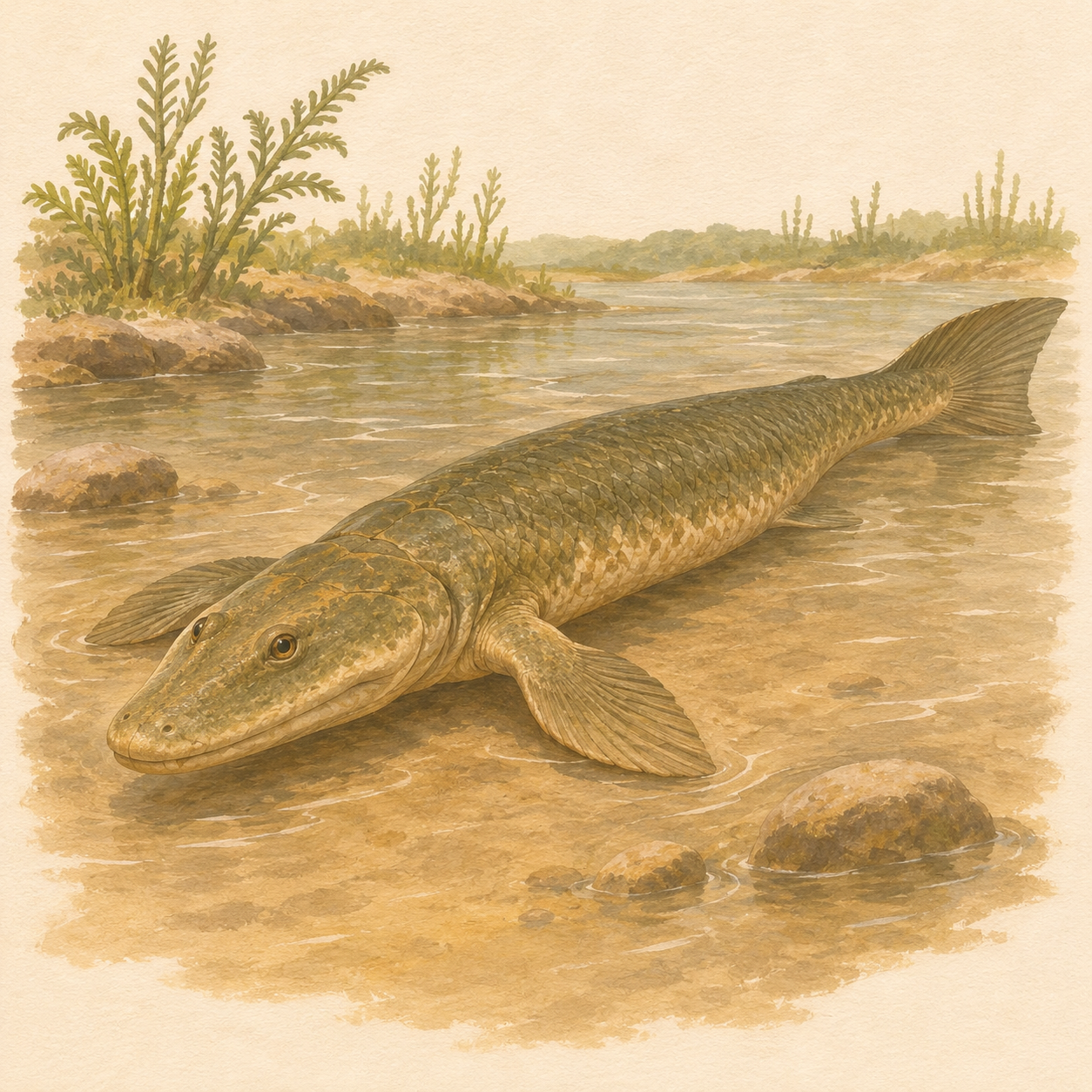
Tiktaalik lived about 375 million years ago. It combined scales and fin rays with a flattened head, a mobile neck, and a strong internal fin skeleton. Its anatomy crossed categories that seem separate when we look only at living animals.
The research team’s discovery announcement describes bones corresponding to an upper arm, forearm, and primitive wrist region. Their joints could help support the animal against a surface. Tiktaalik retained fins; it did not have a human hand hidden under its skin.
Shubin places this finding within a wider anatomical pattern. Human arms, bird wings, and many other vertebrate limbs share a basic arrangement: one large upper bone, two lower bones, then smaller bones toward the end. Different lineages modify that arrangement for different tasks. The similarity concerns the relationships between parts, rather than a vague resemblance in shape.
The important shift is that features useful on land could develop while animals still lived mainly in water. Supporting a body in shallow water could be useful before walking on dry ground became a regular activity. Evolution need not anticipate a future task.
Shared Genes Help Explain Shared Patterns
Fossils show structures from the past. Embryology asks how structures form. Genetics helps explain the signals that guide their formation.
Shubin introduces experiments on developing limbs to connect these forms of evidence. Cells in a growing limb bud respond to signals that help establish where different parts will develop. Sonic hedgehog is one important signaling gene in this process. Related signaling systems operate across very different animals.
An earlier scientific account by Shubin and colleagues compares developmental signals in chick and fly appendages. The comparison does not make a fly’s wing the anatomical equivalent of a human arm. It shows that evolution can reuse old developmental machinery to produce different structures.
A useful distinction follows. Homology describes a feature inherited from a corresponding feature in a common ancestor. Deep homology concerns shared developmental machinery, including machinery used to build structures that evolved separately. Shubin, Cliff Tabin, and Sean Carroll explain this distinction in their 2009 research review.
Genes therefore work less like separate instructions for finished objects and more like interacting parts of a developmental system. Where and when a signal operates can matter as much as its presence.
Teeth Connect Feeding with a Wider History of Skin
Teeth are especially useful fossils because hard tissues often survive when softer parts disappear. Their shape, arrangement, and wear can help researchers infer how an animal processed food.
Shubin follows the development of precise tooth contact in ancient relatives of mammals. Small cusps and worn surfaces can reveal a major functional change: upper and lower teeth meeting in an organized way. A tiny jaw can therefore provide evidence about feeding that a much larger fragment cannot.
He then changes scale, from fossils to embryos. Teeth form through exchanges between neighboring tissues. Related interactions also help build hair, feathers, and glands. These organs look different and perform different jobs, yet their development draws on shared processes. Shubin revisits these connections in the companion series transcript.
The lesson is broader than teeth. Evolution can change what a developmental process produces while preserving parts of the process itself. Surface appearance alone can conceal a deep connection.
The Head Becomes Clearer When We Watch It Develop
Adult anatomy can look bewildering. Nerves and muscles follow routes that are difficult to understand from their present function alone. Shubin uses embryos to reveal an underlying order.
Early vertebrate heads develop a series of structures called pharyngeal arches. In fish, parts of this system support the gill region. In humans, corresponding embryonic structures contribute to parts of the jaw, ear, throat, and neck. A human embryo does not pass through a stage as a working fish. The comparison concerns inherited patterns of development.
Hearing offers another example of structures changing jobs. Bones associated with the jaws of ancient vertebrates contributed to the small middle-ear bones of mammals. Fossils and development together help trace that transformation. Shubin explains it in the companion film’s account of jaw bones becoming ear bones.
These connections replace an isolated list of body parts with a historical explanation. A structure’s current use does not tell us everything about its origin.
Senses and Cells Extend the Story Beyond Fish
Shubin applies the same reasoning to smell and vision. Genes involved in sensory systems can be copied, changed, or lose their former function. Genetic losses can preserve evidence of history just as new capabilities can.
Eyes also illustrate the distinction between a whole organ and the machinery that builds it. Shared developmental regulators do not prove that every kind of eye descended unchanged from one complex ancestral eye. Old genetic systems can contribute to new arrangements. This is a central point of the research on deep homology.
The book reaches further back when it considers how cells cooperate to make a body. Cells must attach, communicate, and take on different roles. Complex animals depend on these basic capacities. In an interview about the book, Shubin explains why the fish metaphor is only one entry point. To understand different parts of ourselves, we must examine different depths of our ancestry, including the molecular machinery inherited from microbial life.
What This History Explains—and What It Cannot
Shubin’s account also explains why a functioning body can contain awkward arrangements. Evolution works with inherited materials. Changes in posture, movement, and reproduction can create new demands on old structures. His discussion of hernias and other vulnerabilities makes this historical constraint concrete. The publisher’s description frames illness as one of the questions the book explores.
These examples are explanations of vulnerability, rather than complete explanations of an individual’s illness. An evolutionary account alone cannot identify every immediate cause or establish a treatment.
The fossil record also leaves uncertainty. A transitional animal need not be our direct ancestor. It can reveal features of a close branch near an important evolutionary split. The companion teaching guide stresses that most related species fall outside our direct lineage.
Research has continued since the book appeared in 2008. A 2020 report on CT studies of Tiktaalik’s fins adds evidence about how the fin rays and internal skeleton worked together. This supports a more detailed account of support and movement, while actual behavior still requires inference from anatomy.
My main takeaway is a method for understanding bodies: ask what a structure does, how it develops, and what its relatives reveal. Agreement between these kinds of evidence makes a historical explanation stronger. Shubin’s achievement is to make that method visible in familiar parts of ourselves.
Sources
- Penguin Random House: book identity and overview, and authorized opening excerpt.
- University of Chicago research team: Tiktaalik discovery announcement.
- Neil Shubin: interview about the book and its argument.
- Shubin and colleagues: shared appendage-development signals, and 2009 review of deep homology.
- PBS: companion series and HHMI-hosted transcripts for episode one and episode two. These support the explanation; the television adaptation is distinct from the book.
- University of Chicago: later research on Tiktaalik’s fins.

