
Understanding Inventive Problem Solving (TRIZ)
Genrich Altshuller’s “The Innovation Algorithm” isn’t a self-help book in the traditional sense. Instead, it introduces TRIZ (Teoriya Resheniya Izobretatelskikh Zadatch – Theory of Inventive Problem Solving), a powerful problem-solving methodology developed by Altshuller based on his analysis of millions of patents. The core idea is to move beyond incremental improvements and achieve truly innovative solutions. The book provides a framework for systematically tackling complex problems, leading to more creative and effective outcomes applicable far beyond engineering.
Identifying Contradictions
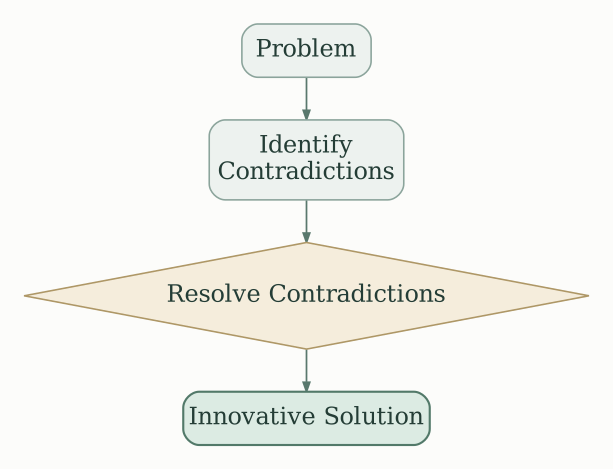
TRIZ emphasizes the importance of identifying contradictions as the key to innovation. These aren’t simple disagreements but rather conflicts between desirable system characteristics. For example, a car needs to be strong (for safety) but also lightweight (for fuel efficiency). These contradictory requirements often hinder progress. The algorithm helps pinpoint these core contradictions, which then become the focus for innovative solutions.
The Substance-Field Model
The Substance-Field (S-Field) model is a tool in TRIZ. It allows for a systematic representation of a problem. Substances are the objects or elements involved, and fields are the interactions or influences between them. By mapping the problem into an S-Field model, one can visualize the relationships, identify the root cause of the contradiction, and look at potential solutions.

40 Inventive Principles
Central to TRIZ are 40 inventive principles, derived from the analysis of successful inventions. These are not rigid rules, but rather heuristics that guide the problem-solving process. They offer a structured approach to resolving contradictions, suggesting various avenues for innovative solutions. Examples include segmentation (dividing an object into independent parts), nesting (placing one object inside another), and dynamism (changing parameters during operation). Understanding and applying these principles is fundamental to using TRIZ effectively.
Evolution of Technical Systems
TRIZ suggests that technical systems evolve according to predictable patterns. Understanding these patterns can help anticipate future trends and design more adaptable systems. This evolutionary perspective enhances foresight and allows for the creation of solutions that are not only innovative but also sustainable and future-proof.
Separation Principles
Many innovative solutions involve separating conflicting requirements. Altshuller highlights many separation principles, such as separation in space, time, or by condition. For instance, separating a function into different parts or performing actions at different times can resolve contradictions that would be insurmountable otherwise.
Levels of Inventiveness
TRIZ classifies inventive problems based on their complexity and the degree of novelty required for their solution. Understanding the level of inventiveness helps determine the appropriate problem-solving approach. Simple problems might require only minor modifications, while highly inventive problems necessitate a more systematic application of TRIZ principles and tools.
Improving Problem Solving Skills: Actionable Insights
The practical application of TRIZ offers many actionable improvements for problem-solving skills.
- Systematic Approach: TRIZ moves away from intuitive, trial-and-error approaches towards a more systematic and structured problem-solving methodology. This leads to a higher likelihood of finding effective solutions.
- Focus on Contradictions: Explicitly identifying and addressing the core contradictions within a problem often reveals the path to innovative solutions.
- Creative Thinking: TRIZ principles stimulate creative thinking by providing a framework for generating new ideas and approaches.
- Pattern Recognition: Understanding the evolutionary patterns of technical systems allows for a more insightful approach to problem-solving and prediction of future challenges.
- Collaboration & Communication: The S-Field model and other TRIZ tools improve communication and collaboration within teams by providing a shared language and framework for discussing complex problems.
Applying TRIZ to Daily Life
While initially developed for engineering, TRIZ’s principles are applicable to a wide range of problems in personal and professional life. Consider these examples:
- Personal Productivity: Identify contradictions between the desire for efficiency and the need for thoroughness. Applying TRIZ principles could lead to better time management techniques and more efficient workflows.
- Conflict Resolution: Analyze conflicts as contradictions between opposing viewpoints. Using separation principles might lead to solutions that satisfy all parties involved.
- Creative Writing: Use TRIZ to overcome writer’s block by identifying contradictions in a plot or character development and using inventive principles to generate new ideas.
- Business Innovation: TRIZ is a powerful tool for generating innovative products, services, and business models by systematically addressing contradictions and leveraging inventive principles.
Beyond the Algorithm: The Human Element
While “The Innovation Algorithm” presents a structured methodology, the human element is important. Creativity and intuition remain essential components of the problem-solving process. TRIZ serves as a powerful tool to improve these abilities, not replace them. The algorithm provides the structure; human ingenuity fills in the gaps and brings the solutions to life.
The Innovation Algorithm offers a unique approach to problem-solving. By identifying and resolving contradictions using systematic tools and principles, individuals and teams can achieve breakthroughs that move beyond incremental improvements. While initially focused on technical innovation, TRIZ’s applicability extends far beyond engineering, providing a versatile framework for solving problems and fostering creativity in various aspects of life. Its power lies in its structured approach to unleashing the potential for truly inventive solutions. The book’s value lies not just in the algorithm itself, but also in the mindset shift it encourages, fostering a more systematic and innovative approach to tackling challenges.


