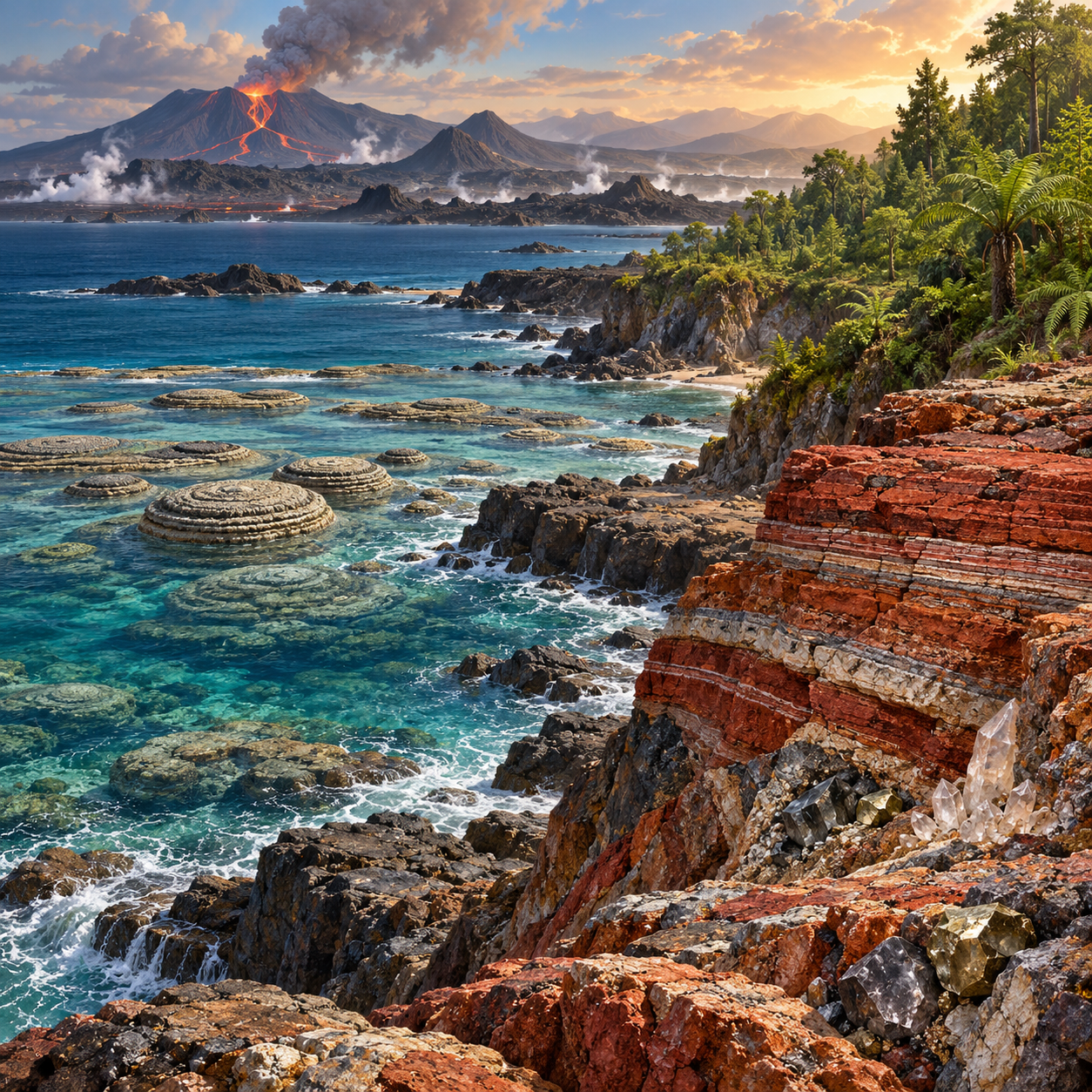
How Rocks and Life Built a Changing Planet
Earth did not form with its present landscapes, atmosphere, or mineral wealth. These developed through a long sequence of changes. Each change created conditions that made later changes possible.
This is the central argument of Robert M. Hazen’s The Story of Earth: The First 4.5 Billion Years, from Stardust to Living Planet. Rocks helped make life possible. Life then transformed rocks, water, and air. Hazen calls this relationship the coevolution of the geosphere and biosphere. His subject is the history of their interaction, from planetary formation to the future of habitability. The publisher’s description identifies this connection as the book’s organizing idea.
Minerals Have a History
A mineral has a particular chemical composition and an ordered crystal structure. A rock usually contains several minerals. Hazen asks a historical question about these materials: which minerals could exist at a particular stage in a planet’s development?
Here, mineral evolution means changes in mineral diversity and distribution through time. It does not mean that crystals reproduce or undergo biological natural selection. A planet’s changing conditions open new chemical possibilities.
Hazen and John M. Ferry explain this historical framework in “Mineralogy in the Fourth Dimension”.
From Stardust to Black and Blue Earth
The story starts before Earth. Earlier stars produced the heavier elements needed for rocky worlds. As material cooled around stars, some atoms joined into tiny crystals. The young solar system inherited this material.
Dust gathered into larger bodies. Collisions, heat, and reactions with water altered their minerals. Earth grew through this process of accumulation. Its molten materials separated, with dense metal collecting in the core and rocky material forming the mantle. Cooling lava produced a dark basalt crust: Hazen’s black Earth.
The Moon-forming impact marks a major disruption in this early history. Hazen presents the giant-impact account, in which a large body struck the young Earth. NASA’s account of lunar formation explains why this remains the leading explanation. Lunar samples show evidence of intense heating and close chemical links with Earth. However, the impact’s exact conditions and the steps by which the Moon assembled remain research questions.
As Earth cooled, liquid water became a lasting part of its surface. Water changed the range of possible reactions. It dissolved some materials, moved their ingredients, and helped form new minerals. Oceans were therefore active chemical environments. Hazen’s earlier account of mineral evolution connects these processes to the growing diversity of the crust.
Gray Earth: Continents and Chemical Sorting
Granite represents another important change. Partial melting of earlier rocks produced melts with different compositions. Repeated melting and cooling separated elements that had once been mixed together. Silica-rich rocks became important parts of the continents.
An element may be too scattered to form its own mineral crystals. Geological processing must first concentrate it.
The last liquids remaining as granite crystallizes can concentrate unusual elements. These liquids help form pegmatites, rocks that can contain distinctive minerals. Plate tectonics adds further possibilities by moving rocks into new pressure, temperature, and chemical conditions. Hazen and Ferry’s research overview describes these mechanisms.
Living Earth: A Chemical Opportunity, Still an Unsolved Transition
Hazen connects life’s beginnings to the opportunities supplied by minerals. Making simple organic molecules is only part of the problem. Those molecules must also become concentrated and organized into systems that can sustain themselves and reproduce.
Mineral surfaces offer possible help. Molecules can attach to a crystal surface instead of remaining scattered in water. Surface structures may favor some molecules or arrangements over others. Hazen’s mineral-surface research examines such interactions experimentally and through atomic-scale models.
These results support possible steps in chemical evolution. They do not establish a complete historical route from nonliving chemistry to the first cells. A reaction that works in a laboratory must also fit the conditions and materials of early Earth. The distinction matters: a plausible mechanism is evidence for a possibility, rather than proof that this was the path life took.
Red Earth: Microbes Change the Rules
Once life existed, the relationship became reciprocal. Organisms altered the environments that supported them. Oxygen-producing photosynthesis became especially important because oxygen changed the chemical behavior of many elements.
Think of rust as a familiar example of oxidation. Related changes on a planetary scale allowed many additional mineral combinations to form. Hazen argues that much of Earth’s mineral diversity depends indirectly on biological changes to the atmosphere and oceans. This concerns the number of mineral species, rather than the fraction of Earth’s rock mass made by organisms.
Hazen’s mineral-evolution outline also describes the so-called boring billion. A quieter interval in the visible fossil story could still contain substantial chemical and mineral change.
White Earth: Feedback Can Drive Extreme Change
Hazen’s Snowball Earth discussion brings climate into the same connected history. Ice reflects more sunlight than open water. Expanding ice can therefore cause further cooling, which permits still more ice to form.
Carbon dioxide provides another connection. Continental weathering can consume atmospheric carbon dioxide. Volcanism supplies it. A climate and geochemical modeling study shows how continental breakup and increased weathering could help drive a transition toward severe glaciation. In the snowball escape scenario, continued volcanic emissions eventually strengthen greenhouse warming enough to help melt the ice.
The extent of ancient ice cover needs careful treatment. NASA GISS describes modeling work in which severe cold still leaves open ocean. A completely frozen planet and a largely frozen planet are different claims. The book’s wider lesson survives this uncertainty: gradual changes in connected processes can produce large shifts in the whole system.
Green Earth: Organisms Become Landscape Builders
The spread of life onto land deepened the connection between biology and geology. Roots helped break down rock. Developing soils supported more vegetation. Plants then changed water movement and erosion, creating further opportunities for life.
Organisms also used minerals directly in shells, teeth, and bones. Biology could redistribute existing materials as well as expand the conditions under which minerals formed. Hazen develops these connections in his later essay, “Mineral Fodder”.
Humans belong within this history. Mining, farming, forest clearing, and fossil-fuel use change material flows through the planet. A useful implication is to examine an intervention through several connected systems. A change in land cover can affect soil, water, erosion, and carbon together.
What the Book Explains, and What It Leaves Open
Hazen’s strongest contribution is a way to connect scientific fields that readers often encounter separately. A mineral specimen, a microbial community, and an atmosphere can be parts of the same historical explanation.
The framework has limits. Hazen’s own research outline identifies the start of plate tectonics as unresolved. The origin of life remains an open problem. His stages provide a useful structure, but their boundaries are not perfectly sharp. Nor does Earth establish a required sequence that every habitable planet must follow.
The book appeared in 2012. Its narrative should therefore be read as a synthesis from that period, rather than a final inventory of discoveries. Carnegie’s profile of Hazen places the book within an ongoing research program.
My main takeaway is that habitability is something a planet develops and changes. Earth’s long survival does not guarantee stable conditions for any particular species. Understanding the processes that sustain our environment requires attention to both living organisms and the rocks beneath them.
Sources
- Penguin Random House: book identity, author credit, and central thesis.
- Smithsonian Libraries: edition record and contents.
- Hazen: mineral-evolution research outline, supplemented by his linked research papers above.
- Hazen: “Mineral Fodder,” a later explanation of rocks and life’s shared history.
- NASA’s lunar-formation account and NASA GISS’s glaciation discussion, linked above, provide context for the scientific uncertainties.