Understanding capitalism through the people who tried to explain it
Why does a society produce great wealth yet leave people poor? How can millions of separate decisions sustain an economy? Why does growth bring conflict and disruption?
Robert L. Heilbroner follows the thinkers who made these questions their life’s work. The Worldly Philosophers: The Lives, Times and Ideas of the Great Economic Thinkers combines biography, history, and economic explanation. This summary follows the revised seventh edition. Its connecting argument is that the great economists developed different visions of how capitalism works and where it might lead. The publisher’s account confirms this focus.
Heilbroner makes their disagreements intelligible by placing them in their times. A theory about land scarcity answers a different problem from a theory about idle factories. Each thinker selects certain forces as central. Understanding that selection helps us see both the theory’s power and its limits.
The market system had to be made
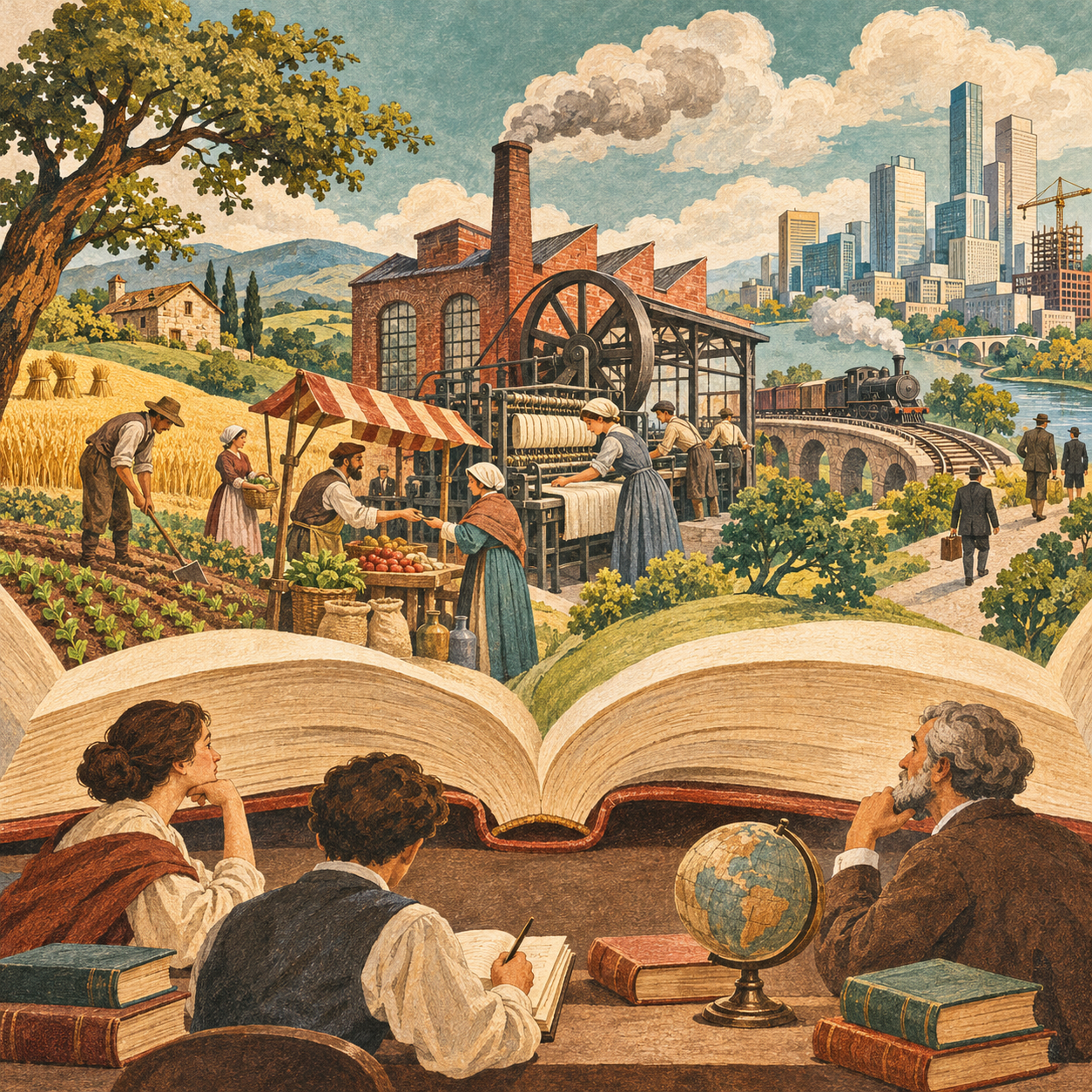
Heilbroner begins before modern economics. Every society must organize work and distribute its output. Tradition can assign occupations and obligations. Authority can direct labor and resources. A market system coordinates much of this activity through buying, selling, and the pursuit of income.
His historical claim concerns the rise of a society organized around markets. Trade existed much earlier. The larger change came as land, labor, and productive resources increasingly became things people could buy, hire, and use for profit. This change disrupted established duties and ways of life.
Economics emerged as an attempt to explain the resulting order. How could a society function when no single authority assigned everyone a task? The historical starting point matters throughout the book: capitalism is a particular social arrangement whose institutions and behavior require explanation. It cannot simply be assumed to describe all human life. The book’s edition record and contents place this economic revolution before the individual thinkers.
Adam Smith: order through exchange and competition
Smith explains how people pursuing their own interests can contribute to a wider system of provision. A producer needs customers. Competition limits the ability to charge whatever price the producer wants. Prices and profits help direct effort toward goods people will buy.
This coordination depends on conditions. Self-interest alone does not guarantee a good outcome. Competition must constrain it. Reading Smith as permission for every business practice misses the mechanism that makes his argument work.
Smith also explains rising productivity through the division of labor. In his pin-making example, workers specialize in separate operations. Repetition develops skill, reduces time lost between tasks, and encourages better tools. The resulting output exceeds what isolated workers could produce.
Specialization also creates dependence. A worker can focus on one task because other people supply food, clothing, and tools. Market coordination and productive growth therefore reinforce each other. Smith’s discussion of the division of labor supplies the concrete foundation for this part of Heilbroner’s story.
Malthus and Ricardo: growth does not benefit everyone equally
Thomas Robert Malthus challenges confidence in continuing improvement. His population argument holds that unchecked population can grow faster than subsistence. Material gains may then support more people without producing a lasting rise in living standards. His original essay makes this conditional relationship explicit.
The argument makes poverty appear rooted in pressure on resources. That has serious implications for how people judge relief and reform. It is a historical theory to examine, rather than a universal forecast this summary endorses.
David Ricardo shifts attention to distribution among workers, capital owners, and landlords. As cultivation extends to less productive land, better land earns a differential rent. A landlord can gain because land is scarce, even without improving it. Higher food costs can also squeeze industrial profits under Ricardo’s assumptions.
Growth can therefore create conflicts between classes. More national wealth does not establish that every group gains together. Ricardo states this distribution problem directly in the preface to his Principles. Heilbroner uses this darker outlook to unsettle any easy identification of economic progress with shared prosperity.
The reformers: institutions can change
The utopian socialists approach industrial misery as a problem of social organization. Robert Owen gives this ambition a practical setting. At New Lanark, he combined industrial management with improvements in education and workers’ living conditions. His later New Harmony experiment had a more troubled outcome. The New Lanark Trust’s account helps distinguish the two projects.
For Heilbroner, figures such as Owen, Charles Fourier, and Henri de Saint-Simon widen the debate. Instead of only explaining competition, they imagine alternative arrangements for work and cooperation. Their proposals also expose the distance between designing an attractive community and sustaining one.
John Stuart Mill provides another opening for reform. He distinguishes the conditions of production from the institutions that govern distribution. Producing goods requires labor, resources, and knowledge. Rules about ownership and the division of the product are subject to human choice.
Mill’s discussion of property and distribution does not make every reform costless. It establishes room for deliberate institutional change. Existing inequalities need not all be treated as unavoidable natural laws.
Karl Marx: capitalism generates its own conflicts
Marx treats capitalism as a historical system driven by accumulation and class relations. Workers sell their capacity to work. Capital owners control production and own its output.
Within Marx’s theory, surplus value arises because the value created during work exceeds the value paid for labor-power. Exploitation therefore need not depend on an employer breaking a contract. It can occur through ordinary transactions within the system. Marx develops this distinction in Capital, volume one.
Competition presses firms to accumulate, introduce machinery, and reduce costs. Decisions that help an individual firm survive can contribute to instability across the economy. Heilbroner presents Marx’s account as an explanation of movement: expansion changes the conditions that made expansion possible.
The historical prediction of capitalism’s eventual overthrow must be distinguished from the analysis of its pressures. A reader can examine concentration, insecurity, and conflict without accepting an inevitable revolutionary outcome. Heilbroner’s larger project values these thinkers for the questions they reveal, even when their forecasts fail.
Victorian economics and Veblen: what does the accepted picture leave out?
Heilbroner places the growing technical refinement of economics beside critics who questioned its social vision. Alfred Marshall represents the effort to explain market behavior with greater precision. Henry George and John A. Hobson bring attention back to poverty, ownership, and failures in the distribution of purchasing power. The contrast asks which problems become central and which move outside respectable debate.
Thorstein Veblen then attacks the assumption that consumption mainly serves practical needs. Conspicuous consumption uses visible spending to establish status. People buy partly with an audience in mind. Veblen’s The Theory of the Leisure Class examines how social comparison shapes standards of respectable living.
An illustrative example is choosing an expensive object partly because others recognize its price. Its social function helps explain the purchase alongside its physical use. This example applies Veblen’s lens; it is not a case reported by Heilbroner.
Keynes: an economy can settle below full employment
John Maynard Keynes confronts a different failure: resources and willing workers can remain unused because spending is insufficient.
Employment depends on expected demand. Household consumption does not automatically absorb everything an economy could produce. Business investment must help fill the gap, but investment depends on uncertain expectations. Firms may withhold spending when they doubt future sales.
This creates a collective problem. If many households reduce spending, businesses lose revenue. They may cut jobs and investment, reducing income further. Individual caution can deepen the general slump. Keynes’s principle of effective demand explains why full employment is a special outcome rather than an automatic resting point.
Heilbroner presents public intervention as a way to sustain a capitalist economy that cannot reliably restore employment by itself. This does not imply that every spending proposal works equally well. The key change is analytical: prolonged unemployment can arise from the system’s demand conditions, rather than workers’ unwillingness to work.
Schumpeter and the purpose of economics
Joseph Schumpeter makes innovation central. Entrepreneurs introduce new products, methods, and forms of organization. These changes open opportunities while undermining established businesses. Creative destruction describes this continuing transformation. Schumpeter’s Capitalism, Socialism and Democracy develops this account.
His unsettling further argument is that capitalism’s success can weaken the social foundations that support it. Large organizations can absorb entrepreneurial functions, while the surrounding culture becomes less committed to the system. Economic dynamism does not guarantee political survival.
Heilbroner’s final concern reaches beyond any one prediction. Economics needs an explicit understanding of the society it studies. Mathematical precision cannot by itself decide which institutions are desirable or whose welfare should guide policy. William Milberg’s account at the Heilbroner Center explains this connection between social vision, politics, and economic analysis.
Reading the book critically
The book offers a selective history centered on prominent European and American men. Biography makes ideas memorable, but it can understate collective research, excluded voices, and developments elsewhere. Its accounts introduce theories without fully testing them against evidence. The seventh edition also reflects a debate from the late twentieth century.
My practical reading is to use these thinkers as sources of questions. For a proposed factory closure, ask about productive efficiency, the distribution of losses, demand conditions, and institutional choices. These questions come from different theories; combining them does not prove a policy answer.
The book’s durable contribution is this habit of inquiry. Ask what an economic argument assumes, what historical problem it addresses, and what evidence could challenge it. A compelling vision helps us see. It still needs to be tested.
Sources
- Simon & Schuster: book details and seventh-edition thesis.
- Google Books: edition record and preview.
- Free Library of Philadelphia: 1999 edition contents.
- Robert L. Heilbroner Center: William Milberg on Heilbroner’s approach.
- Primary texts by Smith, Malthus, Ricardo, Mill, Marx, Veblen, Keynes, and Schumpeter are linked beside the concepts they support. The New Lanark Trust supplies historical context for Owen’s experiments.