Learning Means Building Knowledge You Can Use
A student can repeat an explanation and still misunderstand it. A class can complete many exercises and struggle when a problem looks different. How People Learn asks what these gaps reveal about learning and how education should respond.
John D. Bransford, Ann L. Brown, and Rodney R. Cocking edited this National Research Council report. Its full title is How People Learn: Brain, Mind, Experience, and School. The original appeared in 1999. A 2000 expanded edition connected its findings more closely to educational practice. This summary covers the original report’s central ideas, using the publisher’s accessible expanded text to examine them. The publisher’s original-edition record explains this relationship.
The report’s central argument is that education should build usable understanding. It brings cognitive, developmental, social, and brain research into a shared account of learning. Three themes guide its recommendations: engage existing knowledge, organize facts around important concepts, and teach learners to monitor their understanding.
Begin with the Learner’s Existing Explanation
Students interpret instruction through ideas they already hold. Those ideas can help them understand a lesson. They can also change its meaning in ways the teacher never intended. A student may learn the expected answer for a test while keeping an older explanation for everyday life.
Teaching therefore needs to reveal students’ thinking. Predictions, explanations, and discussion provide better evidence than asking whether everyone understands. A wrong answer can expose a model of the world that needs careful revision. The report develops this principle in its opening chapter.
This view gives teachers an active role. They must connect new knowledge to existing ideas and help students examine conflicts. It does not imply that learners should discover everything without guidance. Explanation and demonstration remain useful. Their success depends partly on how learners interpret them.
Experts Organize Knowledge Around Meaning
Experts know more than beginners, but quantity alone does not explain their performance. Their knowledge has a useful structure. They notice patterns, retrieve related ideas, and recognize the conditions under which a method applies.
The report describes studies in which people sorted physics problems. Beginners often grouped problems by visible objects, such as inclined planes. Experts grouped them by the underlying principle needed for a solution, such as conservation of energy. Similar-looking problems can require different methods. Different-looking problems can share a solution principle. See the chapter on expertise.
This is why factual knowledge and conceptual understanding need each other. Facts give a concept substance. Concepts make facts easier to organize and use. A curriculum made of disconnected details weakens both.
Expert performance also does not guarantee expert teaching. A fluent practitioner may overlook steps that a beginner must work through consciously. Teaching requires understanding the subject and the learner’s route into it. The goal includes adaptive expertise: being able to reconsider an approach when familiar routines no longer fit.
Transfer Requires More Than Repetition
Transfer means using learning in a new context. It is a central test of whether education has produced flexible understanding. Performance on familiar exercises may conceal difficulty with this larger task.
The report recounts an early study of children throwing darts at an underwater target. One group received an explanation of how light bends through water. Another practiced without that explanation. Their performance was similar in the practice setting. When the target’s depth changed, the group taught the principle adapted better. This is an example reported in the book, not a new experiment or a guarantee about every lesson. See Learning and Transfer.
Transfer depends on adequate initial learning, meaningful practice, and opportunities to compare contexts. Teaching one example in depth can establish understanding. Varied examples then help students recognize what remains constant when surface details change.
The report also warns against judging learning only through immediate, unaided performance. Prior study may prepare someone to learn from new information, even when it does not produce an instant solution. Assessment should sometimes examine that capacity to keep learning.
Children Are Active Thinkers
The developmental research challenges the idea that young children simply wait to receive knowledge. Infants detect patterns and differences before they can explain them in language. Children build expectations, try strategies, and revise their approaches.
Their competence is uneven. A child may reason well about a familiar subject and struggle with an unfamiliar task. Limited knowledge or difficulty with a test format can hide an ability that appears under different conditions.
Adults help by directing attention, linking new experiences to familiar ones, and adjusting the difficulty of a task. The chapter on children’s learning presents development as an interaction between the child and the learning environment.
That chapter also treats metacognition as a developing ability: understanding and directing one’s own learning. Learners need practice setting goals, checking progress, and changing strategies. A useful teaching move is to make these decisions audible while working through a task. Students can then practice the same checks with support and gradually take responsibility for them.
Design the Whole Learning Environment
The report describes four complementary perspectives on a learning environment. They concern the same classroom, rather than four competing teaching styles:
- Learner centered: Attend to students’ knowledge, beliefs, language, and cultural experience.
- Knowledge centered: Build accurate understanding of important subject matter and how ideas connect.
- Assessment centered: Make thinking visible and provide feedback that supports improvement.
- Community centered: Establish expectations that support inquiry, explanation, and learning with others.
Assessment has a particularly important role. Formative assessment supplies information during learning so that teachers and students can adjust. Summative assessment evaluates achievement after a period of instruction. Both should reflect the learning goals. If teaching values reasoning but tests reward only recall, the parts of the environment work against each other.
Community includes classroom relationships and connections with families and other settings. Students need conditions in which they can expose uncertainty and examine errors. Participation also depends on whether classroom practices recognize the knowledge and language students bring. These connections are developed in The Design of Learning Environments.
Effective Teaching Combines Guidance with Inquiry
The report’s classroom accounts show why successful teaching cannot be reduced to one method. Teachers need subject knowledge, knowledge of common learning difficulties, and judgment about when to explain, question, demonstrate, or let students investigate.
One account follows teacher Barb Johnson, who uses students’ questions to guide investigations across subjects. A question about living to an old age leads into topics including genetics, history, and probability. The important feature is her ability to connect students’ interests to substantial disciplinary knowledge.
The report explicitly cautions that copying this classroom’s general activities would be insufficient without the knowledge needed to guide them. Inquiry needs intellectual direction. Its teaching examples in history, mathematics, and science illustrate that demand.
Teachers Need Conditions for Learning Too
Teachers bring prior knowledge, practical concerns, and different levels of experience to professional development. A standard workshop can miss these differences just as a standard lesson can miss students’ needs.
The report applies its learning-environment framework to teacher learning. Teachers need opportunities to study subject matter, examine student thinking, try approaches, and discuss evidence with colleagues. Feedback and a professional community support this work.
One implication is organizational: improving instruction requires time and support for teachers to learn. Giving them a new set of recommendations does not by itself create those conditions.
Brain Research and Technology Need Careful Interpretation
The report explains that experience can change the brain’s structure and organization. Learning continues beyond early development, although some experiences have especially strong effects during sensitive periods.
It also warns against jumping from brain findings to specific classroom prescriptions. Evidence of biological change does not establish which teaching activity will work best. The Mind and Brain chapter asks educators to distinguish findings ready for practical use from claims that run ahead of the evidence.
Technology receives a similar treatment. Simulations can make otherwise hidden processes visible. Communication tools can connect students with experts. Interactive environments can support practice and feedback. These possibilities depend on instructional design and teacher support. The report’s technology chapter evaluates tools through what they enable learners to do. Its examples belong to its period; they should not serve as current product recommendations.
Applying the Ideas with Care
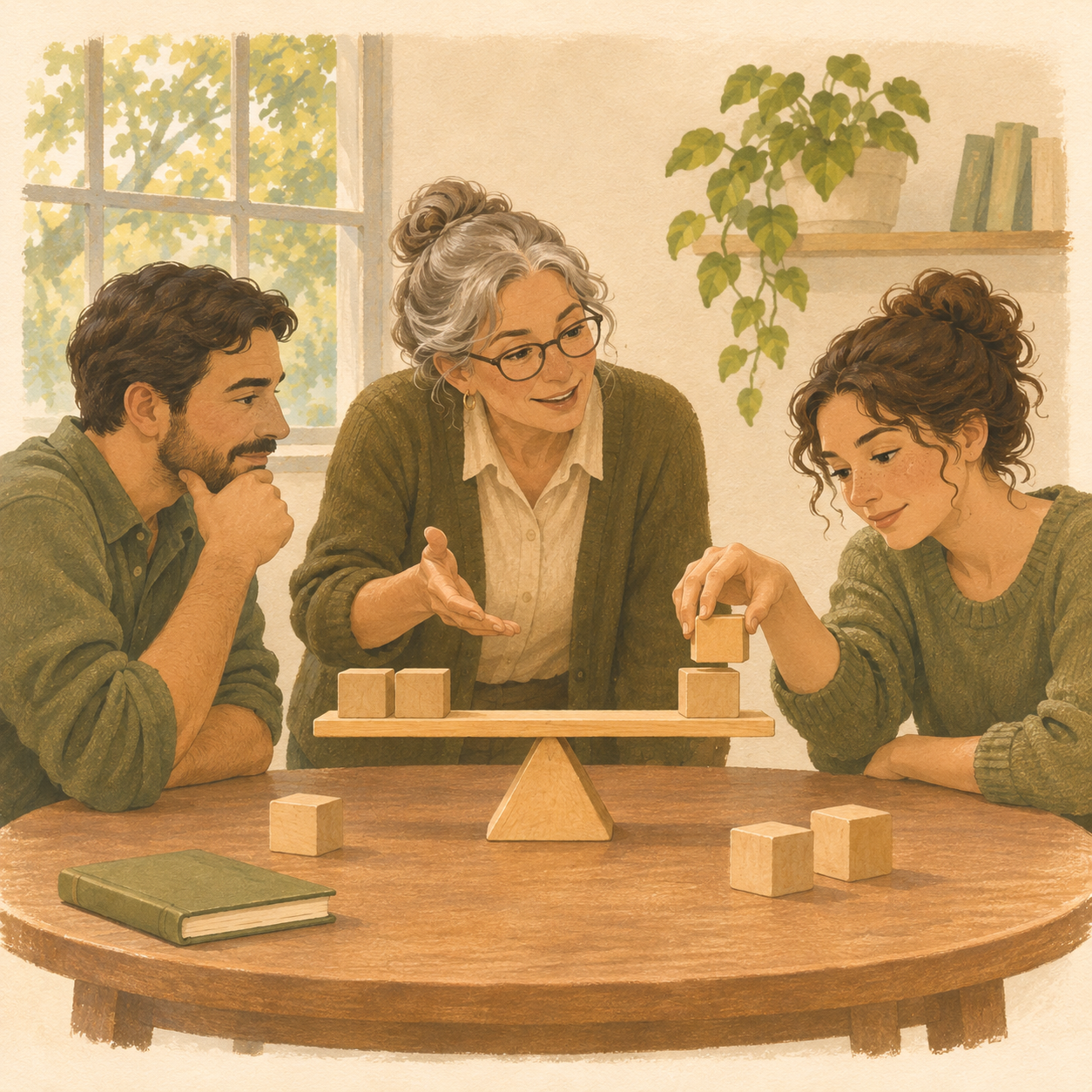
Consider a lesson about balance. This is an illustration created for this summary, not a documented lesson from the report. Ask learners to predict which side of a beam will fall and explain why. Compare their predictions with a demonstration. Introduce the role of both weight and distance from the support. Then change the arrangement and ask for a new explanation.
The teacher can distinguish an accurate prediction based on a sound principle from a lucky guess. Learners can compare their first explanation with their later one. The activity becomes useful when those explanations guide the next teaching decision.
The framework still leaves difficult choices unresolved. It cannot specify the best lesson length, sequence, or amount of guidance for every group. Demonstrations, discussion, and practice need to suit the subject and the learners.
The report is also a historical synthesis, not a current systematic review. The later How People Learn II, published in 2018, expands attention to culture, learning across the lifespan, and settings beyond school. Those developments matter when applying the earlier report outside its main school context. Readers should treat its principles as questions for investigating learning and evaluating instruction, with results checked against actual student understanding.
