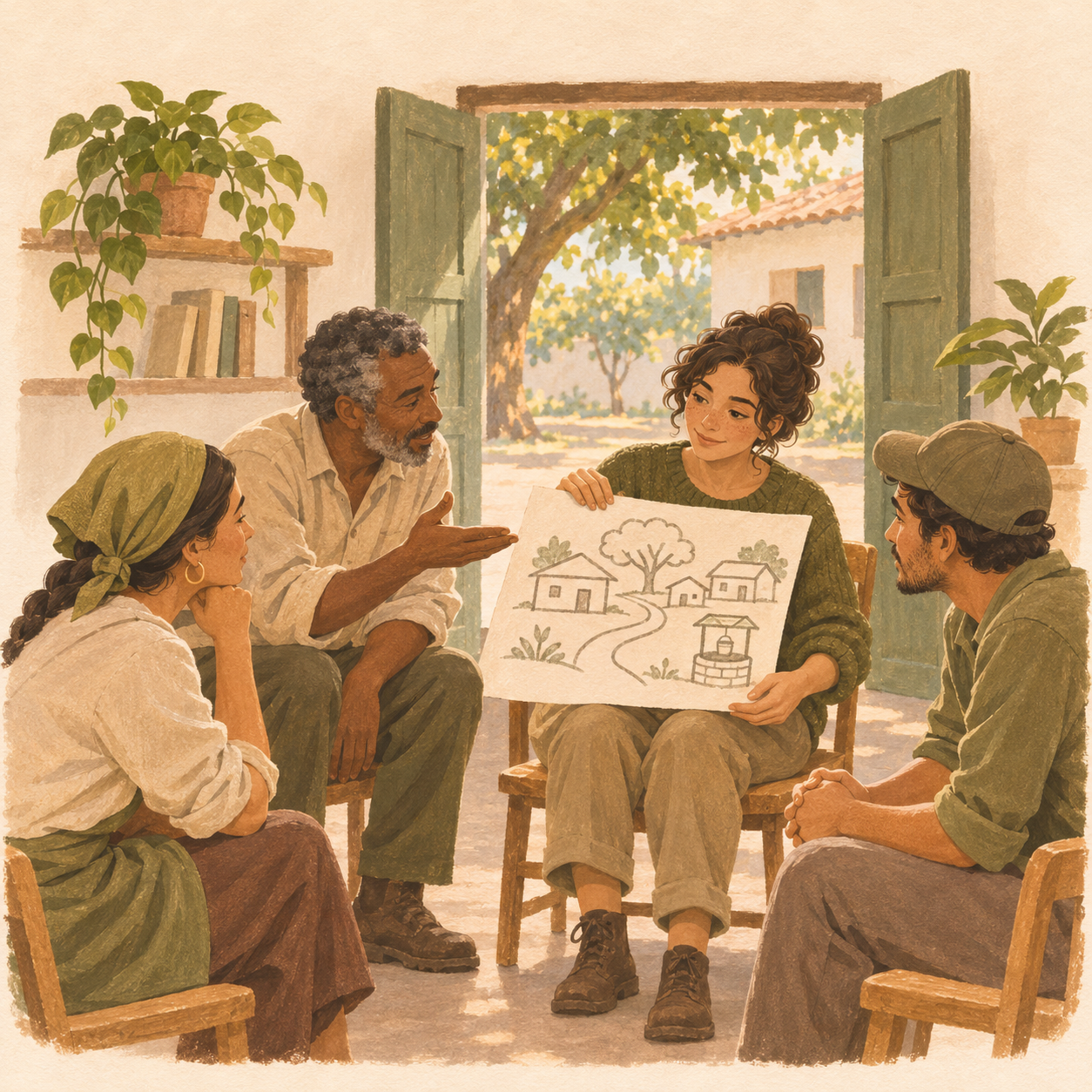
Education Can Teach Obedience or Build Freedom
Who decides what learners need to know? Who may question an explanation? Who has the power to change the conditions being studied? Pedagogy of the Oppressed makes these questions central to education.
Paulo Freire argues that teaching can reinforce domination or help people become active participants in changing their world. His concern extends beyond classroom engagement. It includes whose knowledge counts and whose decisions shape collective life. The book joins educational practice to a political argument about liberation.
This summary covers Freire’s four core chapters. Bloomsbury’s edition record confirms the title, sole author, and chapter structure. Contributors to later forewords and afterwords are not coauthors of the original work. The examples identified as illustrations below were created for this summary.
Oppression Damages People’s Capacity to Act
Freire begins with humanization: becoming more fully able to think, create, choose, and participate with others. Oppression obstructs this possibility by treating people as objects to manage. It also damages the humanity of those who dominate, though their positions and responsibilities differ.
Domination can become internal. People may absorb the judgment that they are incapable or inferior. They may also imagine freedom as gaining the oppressor’s position. Freire argues that replacing the people in command does not establish liberation if the relationship of domination survives.
His idea of fear of freedom describes another difficulty. Taking responsibility can seem dangerous when obedience has become familiar and resistance brings real risks. He does not present liberation as a gift that enlightened outsiders can deliver. Those experiencing oppression must participate in understanding and changing it.
He also challenges generosity that relieves suffering while preserving its causes. For him, solidarity requires changing the relationship that makes others dependent, rather than securing the helper’s role as benefactor. These arguments form Chapter 1.
The Banking Model Makes Knowledge a Deposit
In banking education, the teacher owns knowledge and deposits it in students. Learners receive, remember, and repeat. They have little authority to investigate what they are told or connect it to their circumstances.
Freire’s objection concerns the relationship as well as the method. When the teacher defines reality and the learner merely accepts it, education rehearses obedience. A changing social world can appear fixed and beyond challenge.
His alternative is problem-posing education. Teachers and learners investigate a shared object of knowledge. Students contribute experience and questions. Teachers reconsider their understanding through that encounter. Both remain learners because neither possesses complete knowledge.
This does not make every claim equally sound. The shared task is to understand something beyond either person’s opinion. Authority must support inquiry and freedom instead of closing discussion through status alone. Freire develops the contrast in Chapter 2.
As an illustrative classroom contrast, a lesson about housing could require students only to repeat official categories. Another lesson could use those categories to investigate overcrowding, rents, and local decisions. The difference lies in whether knowledge becomes available for examination and use.
Dialogue Begins Before the Lesson
Freire treats dialogue as joint inquiry into the world. It requires humility, care, hope, and confidence in people’s ability to understand. A conversation designed to steer everyone toward a concealed answer fails this standard.
The curriculum itself must be open to inquiry. Generative themes are meaningful concerns and tensions in people’s lives that open onto wider questions. Educators investigate them with participants rather than choosing everything in advance.
Freire calls a representation of a recognizable situation a codification. A picture, scene, or other representation lets people examine familiar experience from some distance. Decoding means discussing its relationships and implications. The representation should raise a problem instead of supplying the approved solution.
Praxis joins reflection with action directed toward changing the world. Reflection without action becomes empty talk. Action without critical reflection loses its direction. These are mutually informing dimensions, rather than a rigid schedule with thinking completed before doing begins. This account comes from Chapter 3.
Critical Consciousness Connects Experience and Structure
Freire’s term conscientização, often rendered as critical consciousness, concerns understanding social conditions and one’s capacity to act within them. His work grew from adult literacy education and the conditions of poverty and exclusion in Brazil. The Internet Encyclopedia of Philosophy’s account explains these roots and the relationship between literacy, awareness, and agency.
An application helps make the distinction concrete. Imagine adults examining a drawing of a neighborhood water point. This is an illustrative example, not an episode reported in the book.
Participants might first describe the long queues. They could then ask who maintains the supply, how repairs are allocated, and whose complaints receive attention. Reading a notice or comparing maintenance records would become part of investigating a shared concern. A facilitator could teach unfamiliar words and help distinguish an observation from a possible explanation.
The group might discover a broken pump, an unfair allocation rule, or missing information. These explanations call for different responses. Careful inquiry should allow the evidence to change the group’s initial view. Recognizing injustice alone would not establish which explanation is correct.
Liberation Must Not Reproduce Domination
The final chapter applies the educational argument to political leadership. Freire opposes antidialogical action, which makes people instruments of someone else’s project. He identifies conquest, divide and rule, manipulation, and cultural invasion as its main forms.
Cultural invasion occurs when outsiders impose their values and understanding while reducing local people to recipients. Benevolent intentions do not remove this relationship.
His alternative combines cooperation, unity, organization, and cultural synthesis. Leaders and communities develop understanding and action together. Differences in knowledge can enrich their work without giving one side ownership of the other.
Freire does not reject organization or leadership. He rejects separating leaders who think from people who merely execute. A movement that demands passive obedience undermines its stated aim of liberation.
One representative book example concerns demands for higher wages. Leaders should neither dismiss that demand in favor of their own program nor treat it as the whole problem. They should investigate its wider meaning with workers. Freire develops this argument in Chapter 4.
Practical Implications for Educators and Organizers
My practical reading is to examine where participants have real influence. A meeting can contain many questions while leaving every important decision settled in advance. A course can invite personal stories yet exclude learners from interpreting what those stories mean.
For an educator, a useful starting point is one concrete problem that learners recognize. Ask what they already understand and what remains uncertain. Add the subject knowledge needed to investigate it. Make room for participants to question both the evidence and the teacher’s interpretation.
For a community organization, the equivalent question concerns decisions. Can participants change the proposed goal, refuse an activity, or challenge a leader’s account? Record whose proposals alter the plan. Attendance and enthusiastic discussion alone do not show shared authority.
Return to the water example. Producing a complaint letter could provide practice in reading, writing, and explaining evidence. The group would still need to decide whether that action fits the problem and whether participants can safely take part. Later, it could assess the response and revise its approach. These are possible applications, not outcomes demonstrated by Freire’s book.
Read the Argument with Its Limits in View
The book offers a philosophical and political framework. It should not be treated as a current systematic review showing which teaching method produces the best results in every subject. Its analysis asks about freedom and power; a classroom also needs judgments about factual accuracy, practice, assessment, and support for beginners.
My main caution concerns disagreement. An educator may claim to encourage critical consciousness while treating every dissenting conclusion as evidence that a learner remains deceived. That would make the educator’s own view impossible to challenge. A credible application must allow participants to question the proposed diagnosis of oppression itself.
The contrast between oppressor and oppressed also needs careful application. Within a group, one person may face exclusion in one relationship and exercise power in another. Shared disadvantage does not guarantee shared interests or equal influence. Facilitators must examine those differences rather than assume that giving the group a voice gives everyone a voice.
Finally, participation takes time and can carry costs. Teachers and organizers need ways to protect quieter participants, handle conflicting needs, and make necessary decisions. Freire provides a demanding ethical test for those choices: do people gain greater capacity to understand and shape their lives through the process?
Sources
- Bloomsbury: Pedagogy of the Oppressed, author credits and contents.
- Freire’s primary text, reproduced by History Is a Weapon: Chapter 1, Chapter 2, Chapter 3, and Chapter 4.
- Internet Encyclopedia of Philosophy: Paulo Freire, for historical and philosophical context. This is a secondary reference; the account of the book’s arguments above follows Freire’s text.


