Pest control changes more than the pest
A chemical can kill the insect it was designed to kill and still produce a harmful result. It may reach other animals, remain in soil, or remove the predators that keep pests in check. Judging success requires following these effects beyond the first application.
Rachel Carson’s Silent Spring, published in 1962, makes this wider view its central argument. Humans belong to the living systems they alter. Powerful, persistent pesticides therefore demand knowledge, restraint, and public oversight. The Rachel Carson website’s account emphasizes her challenge to chemical misuse and to decisions made without understanding their wider consequences.
This is a book about ecology, but also about responsibility. Who may expose a community to a chemical? What evidence should justify that choice? Who must investigate when harm appears?
A warning told through an imaginary town
Carson begins with a fictional American town where birds disappear, animals sicken, and ordinary seasonal life breaks down. She explains that no single town experienced everything in the story. It brings together harms reported in different places. The opening is a warning built from cases, rather than a record of one disaster.
That distinction matters. The town makes scattered damage imaginable as a shared loss. The silence means more than missing birdsong: familiar signs of a functioning landscape have disappeared. Carson then turns from this imagined setting to evidence about chemical exposure. The Rachel Carson website explains the opening’s use of a composite setting.
Follow the chemical through the landscape
The book asks readers to stop treating land, water, plants, and animals as separate compartments. A treatment aimed at one organism can create exposure elsewhere. A boundary on a property map does not contain a moving chemical.
Three terms help explain the argument. Persistence means that a substance remains in the environment rather than breaking down quickly. Bioaccumulation means that residues build up within an organism when intake exceeds its ability to break them down or remove them. Biomagnification means increasing concentrations through a food chain. These are related processes, but they are not interchangeable.
A predator eats many prey animals. If those animals carry a persistent residue, feeding can become a repeated route of exposure. A small concentration in surrounding water therefore cannot, by itself, establish safety for a fish-eating bird. The National Pesticide Information Center’s explanation of ecotoxicology describes these mechanisms and their relevance to wildlife.
This does not mean every pesticide behaves like DDT. The chemical, its breakdown products, the species, and the route of exposure all matter. Carson’s wider lesson is to investigate the journey instead of assuming that dilution or disappearance from view ends the problem.
Two examples make indirect harm visible
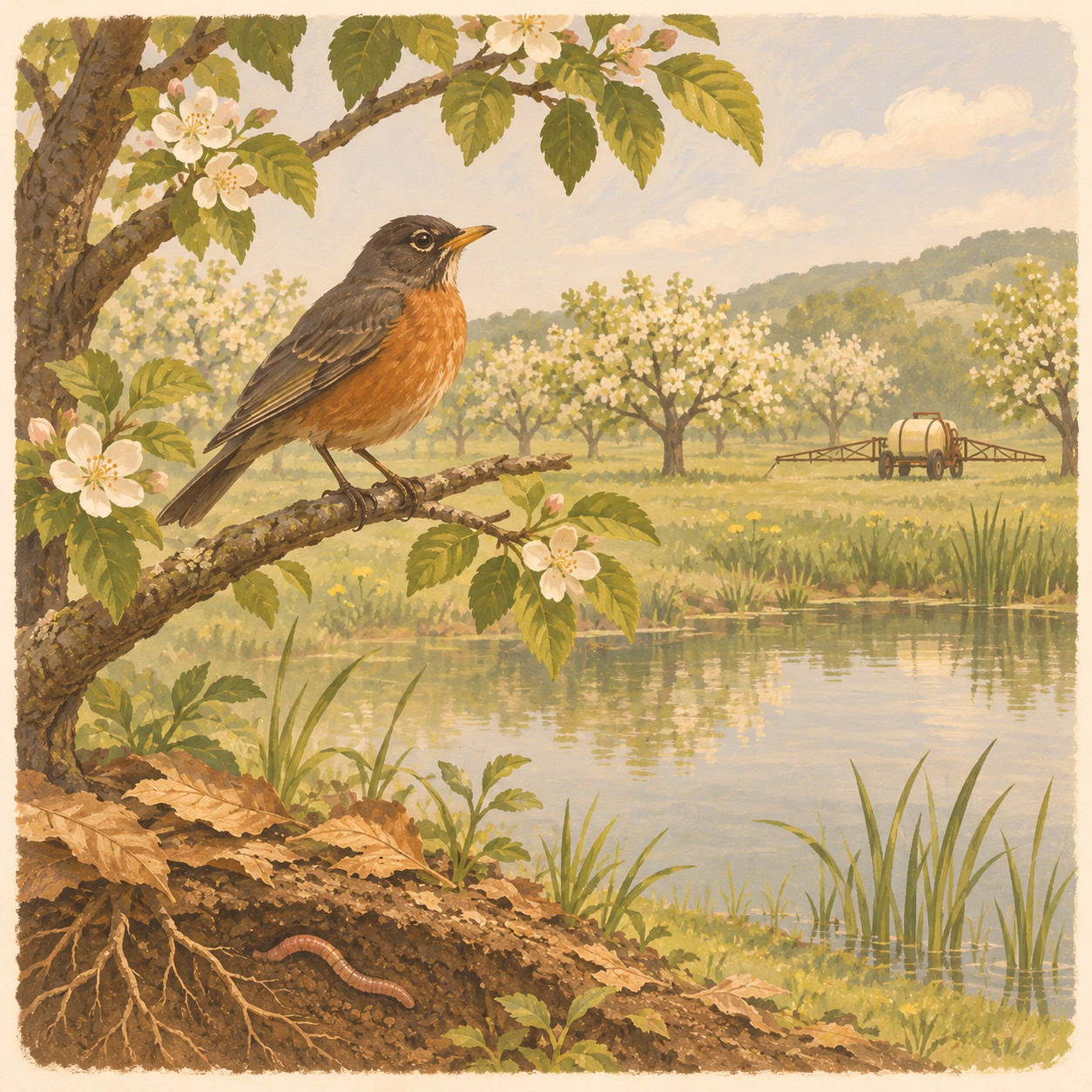
Carson describes robins poisoned after elm trees were sprayed to control insects associated with Dutch elm disease. Contaminated leaves fell, earthworms fed on them, and robins ate the worms. A treatment directed at trees reached birds through their food.
At Clear Lake in California, applications of DDD, a chemical related to DDT, targeted gnats. Residues moved through aquatic organisms and fish to fish-eating grebes. Carson reports bird deaths and reproductive failure. Her account shows why testing water alone could miss contamination held in living organisms. Both cases appear in her original serialization: the lake in part I and the robins in part II.
Read together, the examples change the question. Asking whether a spray directly hits a bird is too narrow. We must also ask what the bird eats and where that food acquired its residues. An intervention needs an ecological account of exposure.
Spraying can undermine its own purpose
Carson challenges the assumption that more chemical treatment must bring better control. Two different mechanisms can defeat that expectation.
The first is resistance. Pests vary in their inherited susceptibility. Treatment can kill susceptible individuals while leaving resistant ones to reproduce. Repeated use can then favor a population that the same pesticide controls poorly. Individual insects do not need to learn how to withstand the spray; the population changes across generations.
Resistance remains a practical problem. The EPA’s account of pesticide resistance explains why maintaining effectiveness requires deliberate management. Initial success is insufficient evidence that a method will remain useful.
The second mechanism is the loss of natural enemies. Predators, parasites, and disease organisms already suppress many pests. Broad treatments can damage these controls. The original pest may rebound, or another species may become troublesome after its enemies disappear. The University of California’s biological-control guidance describes both pest resurgence and secondary outbreaks.
These mechanisms need different explanations. Resistance changes the pest population’s susceptibility. Resurgence can result from a damaged relationship between pests and their enemies. In either case, counting dead insects immediately after treatment gives an incomplete measure of success.
Human exposure belongs in the same inquiry
Carson includes people within the ecological story. Her discussion moves from visible wildlife losses to possible damage within living bodies. She examines concerns about effects on cells, reproduction, and cancer. The final part of the serialization presents this biological argument.
These passages require a historical distinction. Carson assembled the evidence available in her period. Her discussion should not be treated as a current risk assessment for every chemical or exposure. An observed association, an animal experiment, and proof of a particular cause in humans provide different kinds of evidence.
Later evidence supports important parts of her warning about DDT. The EPA’s history and status account identifies its persistence, accumulation in fatty tissue, and ability to travel long distances. It also distinguishes established environmental concerns from potential human health risks. A responsible reading preserves those differences rather than turning uncertainty into either reassurance or certainty of harm.
Better control starts with better knowledge
Carson argues for methods based on the biology of the pest and its surroundings. Her alternatives include biological controls and techniques that interfere with reproduction. The aim is to reduce damage while avoiding unnecessary destruction of other life. She questions indiscriminate use rather than demanding that society abandon every pesticide. The Smithsonian’s account of the book notes that she recognized benefits in disease control and crop protection.
Modern integrated pest management, or IPM, offers a useful comparison. It combines identification, monitoring, prevention, and control. The EPA’s IPM principles include setting an action threshold: the point at which a pest problem warrants intervention. Seeing one insect does not automatically justify treatment. Chemical controls remain available, with effectiveness and risk considered together.
A practical application is to assess a proposed treatment through four questions:
- What organism is causing the damage, and how serious is the problem?
- What conditions support it, and can those conditions change?
- What else will the intervention expose or disrupt?
- What will monitoring show about lasting benefits and harm?
These questions are an application of the book’s reasoning, rather than a checklist quoted from Carson. They shift attention from purchasing a remedy to understanding a problem.
Public decisions need public scrutiny
Carson also challenges who controls the evidence. Manufacturers and agencies responsible for a treatment may have reasons to emphasize benefits and discount damage. Her argument gives affected people a legitimate role in questioning what enters their surroundings. Independent investigation and accessible information become part of environmental protection.
The American Chemical Society’s historical assessment describes how the book widened debate about the effects of chemicals and helped change scientific practice and public policy. Its contribution extended beyond one pesticide: it made consequences outside the intended target central to evaluating progress.
A useful implication is that accountability must continue after approval. A decision made with limited knowledge needs ways to detect unexpected harm and revise the decision. Otherwise, uncertainty becomes a permanent excuse for carrying on.
Read the warning with its limits intact
Silent Spring is a forceful case against destructive practices, rather than a complete manual for managing agriculture or disease. It cannot settle every local trade-off. The benefits of controlling a disease-carrying insect and the risks of a particular treatment both require specific evidence.
Biological alternatives also need scrutiny. Calling a method natural does not establish its safety or effectiveness. The same questions about wider effects should apply to introducing an organism or altering habitat. This is a critical extension of Carson’s reasoning, not a guarantee supplied by the book.
The book helped stimulate public concern before the EPA’s 1972 cancellation order for DDT. The agency’s history places that decision within a longer regulatory process. A single book did not perform the research, hearings, and policy work by itself.
Carson’s lasting contribution is a standard of judgment: an effective intervention must be evaluated within the living system it changes. Immediate benefit matters. So do the effects that travel, accumulate, emerge later, or fall on people and species outside the original calculation.
Sources
- Rachel Carson website: Silent Spring — book identity, central argument, and public accountability.
- Rachel Carson’s original serialization: part I, part II, and part III — primary text and representative cases.
- Smithsonian: Silent Spring, Rachel Carson, 1962 and American Chemical Society: the book’s legacy — historical context.
- NPIC: Ecotoxicology, EPA: resistance, and UC IPM: biological control — supporting explanations of ecological mechanisms.
- EPA: DDT history and status and IPM principles — later evidence and practical context.