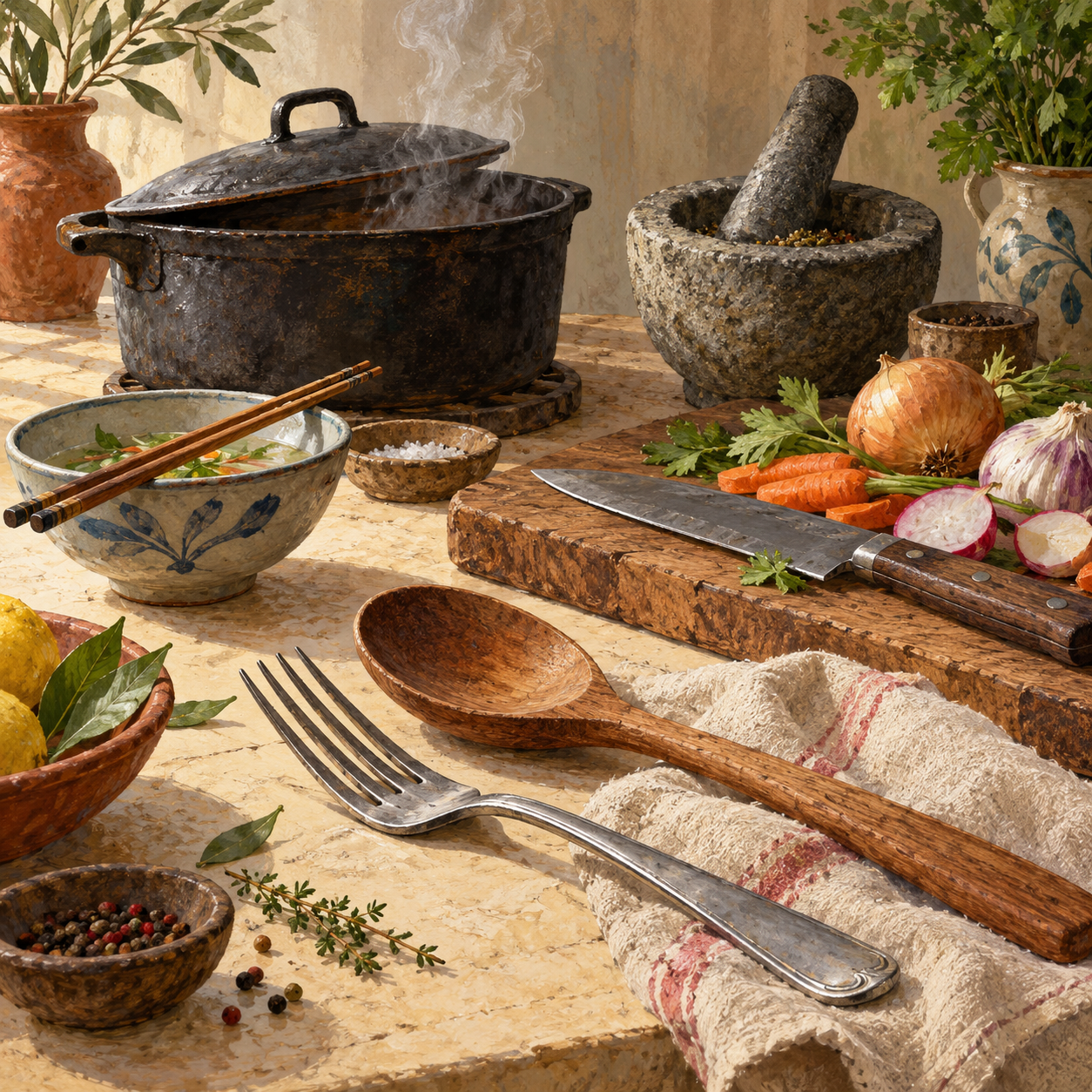
How Kitchen Tools Shape What We Eat
A wooden spoon is so familiar that it scarcely registers as an invention. A fork seems like the obvious way to eat until we encounter a meal better suited to chopsticks, fingers, or a spoon. Bee Wilson’s Consider the Fork makes these ordinary objects strange again. Its subject is the history of cooking and eating technology, including the humble implements that rarely receive the attention given to machines.
Wilson’s central argument is that tools do more than help us prepare a menu already decided upon. They influence which dishes become possible, which textures people enjoy, how much labor a meal demands, and what counts as good manners. Food culture and equipment develop together. This is the perspective behind the book’s subtitle, A History of How We Cook and Eat. Wilson’s introduction to the book describes that broad scope.
The book moves through pots and pans, knives, fire, measurement, grinding, eating, ice, and the kitchen itself. Its history is organized around activities rather than a single march from primitive equipment to superior modern machines. An old tool can remain useful while an ingenious novelty disappears.
Pots: A Container Becomes a Culinary Possibility
The pot changes the relationship between food and heat. A vessel that holds liquid makes boiling and stewing available alongside cooking directly over fire. Ingredients can soften together, and the liquid becomes part of the meal. In Wilson’s account, cookware belongs among the inventions that widened the possibilities of eating, including for people who could no longer manage tough food. Publishers Weekly’s contemporary review highlights this argument.
The larger implication is easy to miss: a recipe depends on a material environment. Before asking whether a cook knows how to make a dish, we should ask whether the cook has a vessel capable of producing it. Equipment establishes possibilities that taste and custom then develop.
Wilson also resists the fantasy of perfect cookware. The qualities cooks want do not always coincide. Responsiveness, robustness, ease of handling, and familiarity create competing demands. As the Christian Science Monitor review observes, her treatment of pans combines technical questions with affection for the imperfect objects people learn to use. Knowing a particular pan is itself part of cooking knowledge.
Knives: Where the Cutting Happens Matters
A knife’s role extends beyond sharpness. Wilson contrasts traditions in which substantial pieces of cooked food are cut at the table with Chinese preparation in which food is cut into small pieces before cooking. Small, evenly prepared pieces suit quick cooking and a meal eaten with chopsticks. Her account connects this organization of work to fuel economy as well as dining habits. Kirkus’s review identifies this as a central comparison in the knife chapter.
This contrast reveals how misleading it can be to judge an implement in isolation. Chopsticks work within a cuisine whose preparation has already made food manageable. A table knife assumes that some cutting remains for the eater. The visible ease of dining can therefore conceal work completed earlier in the kitchen.
These are broad historical patterns, not descriptions of every Chinese or European meal. Their value is in showing how preparation, cooking, and serving form a connected process.
Fire: Convenience Has a History of Labor
Controlling heat once meant tending fuel and managing the physical distance between food and flame. Wilson’s history restores this work to the apparently simple idea of roasting. Meat turning before an open fire required attention and repeated movement; turnspit labor could fall to children or to dogs running in wheels linked to the spit. Enclosed stoves and more controllable heat altered both the work and its hazards. Steven Shapin’s review in Harper’s discusses these examples from the book.
The point is larger than gratitude for a thermostat. A meal that looks traditional or luxurious may rest on exhausting labor. Looking only at the finished roast gives a different picture of culinary history from looking at the person who kept it turning.
For today’s reader, this suggests a useful distinction: choosing a demanding technique for pleasure is different from having no alternative to it. Nostalgia becomes more honest when it includes the working conditions behind the taste.
Grinding: Refined Food Can Mean Unrefined Work
Smooth sauces, finely ground ingredients, and delicate preparations can appear effortless at the table. Wilson emphasizes the pounding, grinding, chopping, and sifting needed to produce them before powered equipment. Wealthier households could pursue demanding textures because servants supplied the labor. The food processor changes who can undertake such work and at what personal cost. Kirkus notes Wilson’s appreciation of this transformation.
Her approach complicates the easy division between virtuous handmade food and suspect machine preparation. A traditional method may offer a valued result while also demanding time or strength a cook cannot spare. The useful question becomes what the technique contributes and what it asks of the person using it.
This is also why labor belongs inside the history of taste. Texture expresses the means available to produce it, not simply an abstract preference.
Measurement: Recipes Need Both Precision and Judgment
Wilson treats measurement as a change in how culinary knowledge is communicated. Many older recipes assumed an experienced cook who needed reminders rather than complete instructions. In discussing Fannie Farmer, she describes an ambition to make recipes teachable and reproducible through explicit quantities. Yet she questions the precision of cup measures, especially where ingredients can occupy different volumes depending on their density. She explains this tension in her NPR interview with Ira Flatow.
The lesson is not that instinct defeats measurement. Numbers allow knowledge to travel beyond a particular household, but they cannot specify every relevant condition. A cook still has to notice what is happening.
Applied to everyday cooking, this means treating instructions as support for attention. Measuring carefully and observing texture are complementary skills. A recipe becomes more useful when the cook understands the result its quantities are intended to produce.
Forks: Familiar Manners Are Learned Preferences
The title utensil offers Wilson’s clearest demonstration that acceptance is cultural. In her account, the table fork met ridicule before becoming routine in European dining. Pasta helped establish its usefulness in Italy, while travelers who brought the habit elsewhere could look affected rather than sophisticated. Over time, an object once mocked became a marker of proper behavior.
Wilson also distinguishes function from appearance. Different numbers of tines suit different tasks; an implement for steadying meat is not quite the same tool as one for carrying food to the mouth. Nor does widespread use prove universal superiority. A fork’s usefulness with one dish can coexist with awkwardness when eating another. These examples appear in the authorized BookBrowse excerpt.
The implication extends beyond cutlery. We often mistake our practiced habits for the most efficient or natural arrangement. Understanding another way of eating requires attention to its food, preparation, and learned movements.
Ice and the Kitchen: Tools Reorganize Domestic Life
Refrigeration extends the book’s argument from individual utensils to household organization. Preserving food through controlled cold changes the relationship between shopping, storage, and eating. Shapin’s review describes Wilson’s suggestion that the refrigerator assumed an organizing role once associated with the hearth.
The kitchen can therefore be understood as an arrangement of activities as much as a collection of possessions. Where food is stored and where work happens influence the rhythm of meals. A practical inference is that improving a kitchen should begin with recurring tasks: carrying ingredients, preparing them, cooking, serving, and clearing up. Buying another appliance addresses only some of those needs.
What to Take Away—and Where to Be Cautious
Wilson offers a way to evaluate equipment without assuming that newer means better or older means more authentic. Ask what a tool makes possible, whose effort it saves, and how it fits the food actually cooked. A useful purchase solves a recurring problem; a familiar implement may deserve to stay because years of practice make it effective.
The book’s breadth also calls for care. A lively survey cannot give every culinary tradition equal depth, and a revealing anecdote does not establish a universal explanation. Wilson discusses C. Loring Brace’s hypothesis linking changes in bite to the cutting of food into small pieces; in her NPR interview, she explicitly presents that connection conditionally. It should be read as a reported hypothesis rather than a settled verdict about human anatomy.
The book is most useful as a history of relationships among tools, skills, labor, and taste. Its enduring invitation is to pay closer attention to the equipment already in our hands—and to the people whose work made our ordinary meals possible.
Sources
- Bee Wilson: Consider the Fork — author’s overview and central premise.
- Basic Books / Hachette: book details — title, author, and publisher description.
- BookBrowse: authorized excerpt — fork history; continuation across three pages.
- NPR: interview with Bee Wilson, via Texas Public Radio — measurement, kitchen habits, and the bite hypothesis.
- Publishers Weekly review, Kirkus review, and Christian Science Monitor review — corroboration of cookware, knife, and labor examples.
- Steven Shapin, “The Tines They Are A-Changin’,” Harper’s, January 2013 — discussion of heat, refrigeration, and domestic life.