The Americas had a history before Europeans arrived
Charles C. Mann’s 1491: New Revelations of the Americas Before Columbus challenges a familiar picture: a vast wilderness occupied by small groups whose lives had barely changed for thousands of years. He presents a hemisphere of varied societies, long histories, major settlements, and landscapes shaped by human work.
The book joins three questions. How many people lived in the Americas before sustained European contact? How far back did their histories extend? How much had they changed their surroundings? Mann argues that older answers often underestimated all three. The publisher’s account establishes this broad argument.
This is a survey of research and disagreement, rather than a census of the hemisphere in one year. Its title marks the world before Columbus’s arrival. Its examples reach much further into the past and follow the losses that came afterward.
A damaged society can look deceptively ancient
Mann calls one central error Holmberg’s mistake. An anthropologist described a struggling Indigenous community in Bolivia as though its way of life preserved a remote human past. Mann argues that persecution and displacement had helped produce the conditions the observer saw.
In his interview with Indian Country Today, Mann uses this example to explain his larger aim: restore Indigenous people’s capacity to act, adapt, and make mistakes. A community observed after severe disruption cannot automatically stand for its ancestors.
This is a useful rule for reading any historical account. Ask what happened before the observer arrived. Poverty, isolation, or a small population may reflect recent loss. They do not establish that people had always lived that way.
Population loss changed the evidence
European settlement accounts often describe thinly populated land. Mann asks whether those accounts sometimes record the aftermath of epidemics rather than the earlier population.
Diseases could travel through existing networks beyond the places Europeans had reached. Later observers might therefore encounter survivors without knowing the size of the communities that preceded them. The research discussion involving Henry Dobyns, William Denevan, William Woods, and Mann explains why this matters to population history.
Mann gives serious attention to researchers who estimate much larger populations than older scholarship allowed. He also reports objections to reconstructing earlier totals from later counts and assumed death rates. A small change in an assumed survival rate can produce a large change in the estimated starting population.
The important distinction is between the scale of loss and a precise total. Evidence for devastating epidemics does not make every high population estimate correct. Nor does uncertainty about totals support the old picture of an almost empty hemisphere. The book is strongest when these separate claims remain separate.
New England was already a political world
The opening story about Plymouth changes when Indigenous leaders become central participants. Massasoit, a Wampanoag leader, faced his own strategic choices. Tisquantum, often called Squanto, was an interpreter with a complicated history of captivity and travel. Neither was simply a supporting character in the colonists’ survival story.
Mann’s authorized opening excerpt describes their meeting as a cautious negotiation. Both sides assessed danger. Translation, hostages, and the display or absence of weapons mattered.
Epidemic losses also changed the setting in which Plymouth was established. Mann’s earlier Atlantic essay explains how abandoned settlements could appear to newcomers as available land. Read this way, colonization involved entering a world whose balance of power had already been severely disturbed.
The interpretive gain is substantial. Helping newcomers can express diplomacy, calculation, or a search for allies. It need not imply innocence about conflict or consent to everything that followed.
The timeline reaches beyond the old migration story
Mann examines challenges to the once-dominant view that the Clovis culture represented the first Americans. Evidence from southern Chile helped unsettle that timetable. Researchers had to reconsider both when people arrived and how they moved past the great ice sheets.
The book presents this as an active scientific dispute. Its value lies partly in showing how a convincing explanation can harden into textbook certainty. Readers should treat its proposed routes and dates as a record of research at the time, rather than a final account of the first settlement of the Americas.
Human achievement does not follow one ladder
Mann also challenges the idea that one invention can rank an entire society. Mesoamerican writing, mathematics, and astronomy developed along paths different from those of Eurasia. Their history cannot be reduced to a checklist of European technologies.
Food production makes the point concrete. Maize differs greatly from its wild relative, teosinte. Its development required generations of plant selection. Mann treats this as a major intellectual and practical achievement. The book’s introduction places crop development alongside other forms of innovation.
This changes what deserves attention in a history of technology. A productive crop, a managed water system, or knowledge of local growing conditions can matter as much as a conspicuous machine. Their effects become visible through the people and institutions they support.
The broader lesson is to compare particular capabilities. Being skilled in one field does not make a society superior in every field. Missing a familiar technology does not erase other achievements.
Much of the landscape carried human work
The book’s most unsettling argument concerns nature. Mann describes the Americas as landscapes with long histories of cultivation, burning, construction, and selective use of plants.
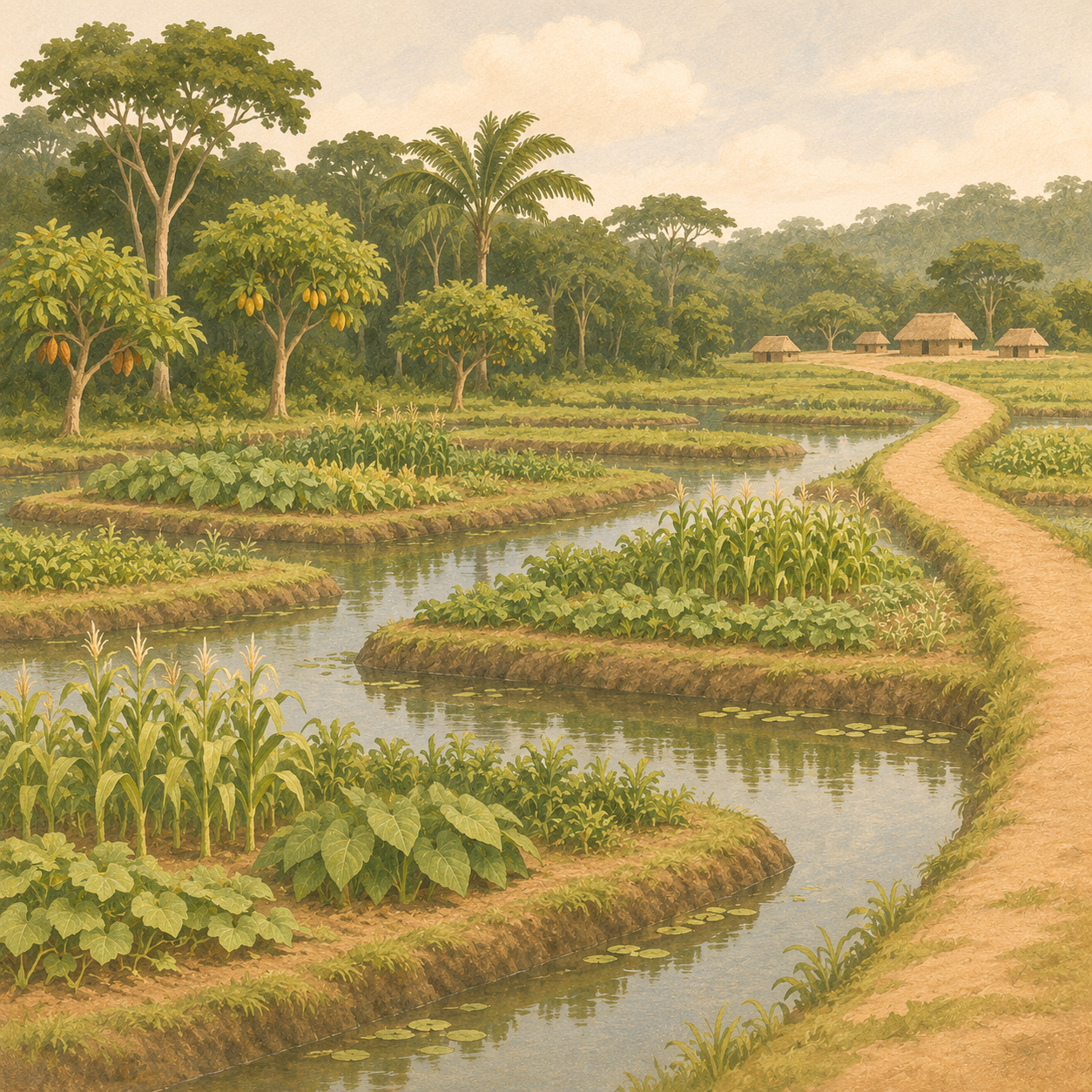
The examples vary by place. Andean terraces changed steep slopes into farmland. In the Bolivian lowlands, raised earthworks and causeways suggest organized work in a landscape shaped by seasonal flooding. These examples undermine the assumption that challenging environments necessarily prevented substantial human transformation.
Amazonian terra preta, or dark earth, adds another kind of evidence. These human-influenced soils contain traces of long occupation and soil enrichment. Useful trees, managed forests, and altered waterways also complicate a simple division between farms and wilderness. The scholarly discussion linked above describes a range of changes, with different intensities in different places.
The mechanism matters. When people stop maintaining fields, managing vegetation, or burning particular areas, the landscape changes again. A forest seen much later may conceal an earlier settlement or cultivated area. Its apparently natural state may be one stage in a continuing history.
This does not mean every forest was planted or every patch of land was intensively managed. It means that appearance alone cannot establish an absence of human influence.
Later research supports important parts of the argument
Evidence published after the book strengthens some of its central challenges. A 2017 study led by Carolina Levis found that domesticated woody plant species were especially abundant around archaeological sites in Amazonia. The findings support a lasting relationship between Indigenous plant use and present forest composition.
A 2022 lidar study of the Casarabe culture mapped substantial settlements and connecting infrastructure in the Bolivian Amazon. Lidar uses laser measurements to reveal ground features beneath vegetation. The researchers interpreted the settlement system as a form of low-density urbanism: an urban landscape spread across a broad area.
These are later findings, not evidence available to the original book. They support significant settlement and landscape modification in particular regions. They do not prove every population estimate Mann discusses or turn the entire Amazon into one uniform kind of society.
What the argument changes—and what it leaves open
For readers, a practical use of 1491 is to question historical starting points. When an account begins with European arrival, ask which earlier institutions, conflicts, and land uses it leaves out. When a landscape is called untouched, ask what evidence supports that description.
For conservation, the implication is that protecting an ecosystem may require understanding the human practices that helped shape it. This is an application of the book’s argument, not a general instruction to burn forests or recreate ancient farming methods. Different places need different evidence and choices.
The book’s wide scope creates limits. It gathers findings from many disciplines, and some conclusions remain provisional. An earthwork can establish construction without revealing an exact population. A later forest can preserve human influence without showing how every earlier household lived.
Disease also needs careful treatment. Its enormous importance should not make conquest seem automatic or erase the roles of violence, forced labor, dispossession, and Indigenous political decisions. These are distinct causes that a complete historical account must examine together.
Finally, recognizing achievement should not replace one stereotype with another. Indigenous societies included conflict, unequal power, successful experiments, and damaging choices. Nor are Indigenous peoples confined to the past. Mann’s argument asks readers to grant them the historical complexity routinely granted to other peoples.
Sources
- Penguin Random House: book details and author interview.
- Book introduction, hosted by the University of Pennsylvania, and authorized opening excerpt at BookBrowse.
- Peter d’Errico’s Indian Country Today interview with Mann, and Mann’s earlier Atlantic essay.
- Journal of the Southwest: “1491: In Search of Native America”, a discussion of the research behind the earlier essay.
- Levis and colleagues, 2017: plant domestication and Amazonian forests; Prümers and colleagues, 2022: Casarabe settlements revealed by lidar. These studies provide later context.
The book’s range also imposes limits. A continent-wide synthesis cannot give every community equal attention. Disease explains much of the disruption, but readers should keep warfare, enslavement, dispossession, and Indigenous resistance in view as well. A biological explanation alone cannot account for colonial history.
Mann’s achievement is to make the earlier world harder to overlook. His argument is most useful when it prompts specific questions about a place, its people, and the evidence for how they lived.
Sources
- Penguin Random House: book details and interview with Mann.
- Book introduction, hosted by the University of Pennsylvania, and authorized Plymouth excerpt at BookBrowse.
- Mann’s interview with Indian Country Today, hosted by the University of Massachusetts.
- Mann’s earlier Atlantic essay and scholarly discussion in Journal of the Southwest.
- Later evidence: Levis and colleagues on Amazonian forest composition (2017) and Prümers and colleagues on Casarabe settlements (2022).

