Music Takes the Shape of Its Surroundings
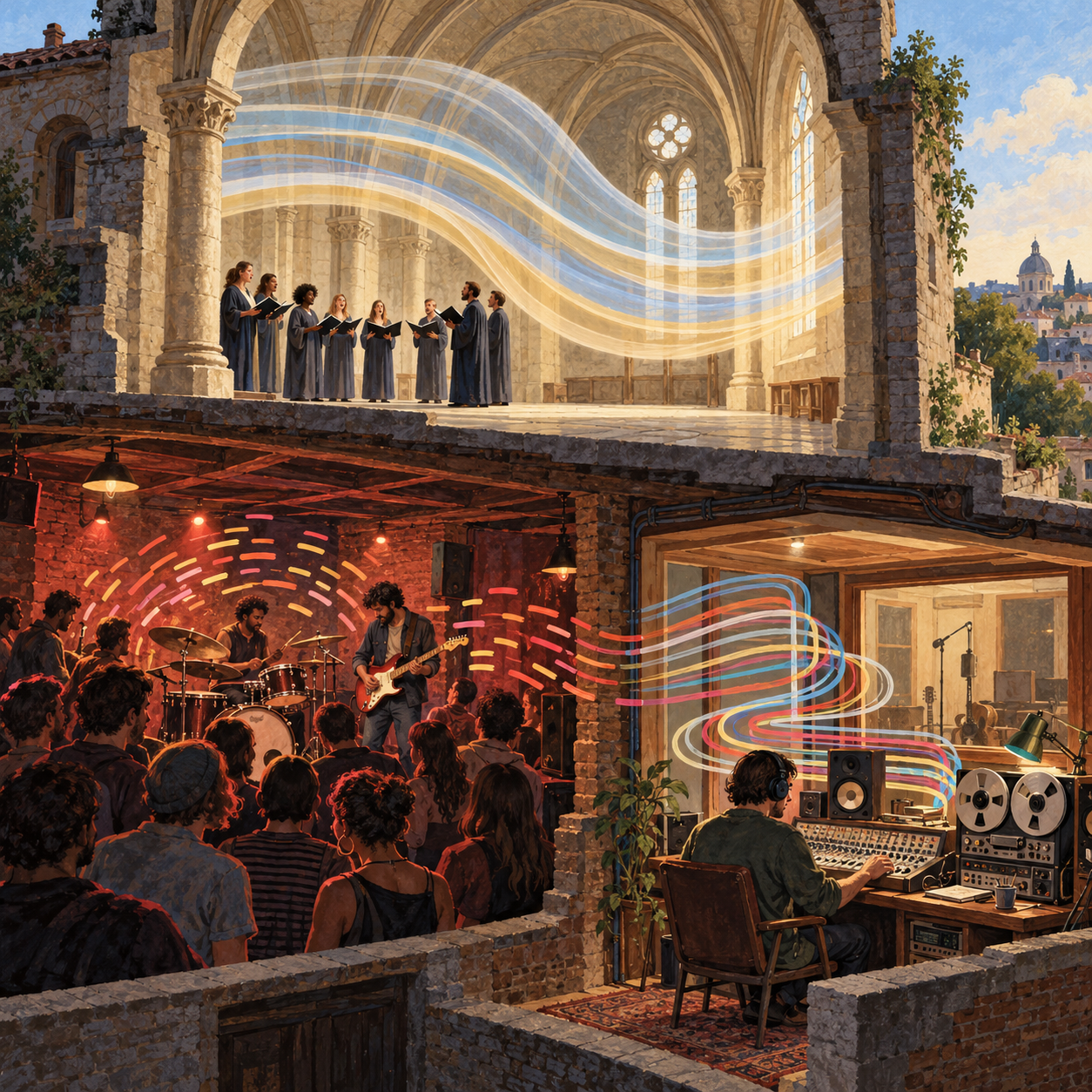
A song can feel intimate through headphones, lose its detail in a reverberant hall, or become a shared physical experience on a dance floor. In How Music Works, David Byrne asks us to take those differences seriously. The surroundings of music help determine its form, its meaning, and whether anyone gets to hear it.
Drawing on Talking Heads and his collaborations, Byrne combines a musician’s working experience with reflections on architecture, technology, economics, and cultural participation. His career supplies examples rather than a continuous autobiography. The organizing question is how all the circumstances around a piece of music enter into the music itself. The book first appeared in 2012; the 2017 edition adds a chapter on digital curation. The publisher’s description identifies that expanded scope.
Creation in Reverse: The Setting Comes First
Byrne challenges the familiar story in which an artist experiences a powerful emotion, creates a work, and then finds somewhere to present it. Frequently, he argues, an available format comes first. Musicians absorb its possibilities and restrictions, often unconsciously, and make something that fits. Passion still matters, but it takes shape within those conditions.
His account of CBGB makes the argument concrete. The small club’s clutter and irregular surfaces absorbed sound and broke up reflections. Musical details remained audible, and audiences could see intimate gestures. Such a room rewarded different choices from a vast echoing space. In a stone cathedral, lingering notes can enrich sustained singing while blurring rapid rhythmic detail. Byrne treats these contrasts as examples of music adapting to an acoustic niche. His opening-chapter excerpt lays out this reversal.
A useful implication is that constraints deserve attention before they become problems. For a performer, arranging for a room can be part of composing. For a listener, asking where music was meant to function may reveal qualities that a recording alone makes difficult to appreciate.
Recording Technology Changes the Musical Possibilities
Recording is another environment, with its own selective pressures. Byrne’s discussion of microphones is especially revealing: amplification allowed singers to use quiet, conversational delivery that would have disappeared in an unamplified public performance. Crooning made technological mediation feel like personal closeness. The machine helped create an emotional vocabulary.
Recording also separates the musical event from the occasion of hearing it. A listener can replay a performance, hear it alone, and carry it into a setting its makers never visited. In the book’s technological history, live performance and recorded sound become distinct forms with different demands. A recording need not reproduce the experience of standing before a band. Byrne also develops these examples in his TED talk on architecture and music.
The practical lesson is to notice what a tool encourages. A microphone, an editing system, or a playback device makes some choices easier and more persuasive than others. Choosing equipment is therefore also a choice about which kinds of musical expression to explore.
The Studio Can Be a Place to Compose
Byrne’s working methods extend this argument. A song does not always arrive in the studio as a completed object awaiting documentation. Recording can generate the material from which the song develops.
His work with Brian Eno and Talking Heads offers a representative example. In a Library of Congress interview, Byrne describes building Remain in Light from repeated parts, layered performances, and arrangements created by bringing groups of parts in and out. He then worked toward vocal sounds and words over the resulting tracks. This firsthand account corroborates the relationship between process and musical form that runs through the book.
Here, collaboration changes what it is possible to imagine. One musician responds to material another has supplied; an arrangement emerges through listening and selection. Authorship involves contributions, decisions, and revision as well as an initial idea.
For someone making music, the liberating implication is that a fragment can be enough to begin. A rhythmic pattern or an unfinished recording can invite discoveries that would be difficult to plan in advance. The quality of the result depends partly on how people respond to one another’s incomplete work.
Money Helps Decide What Gets Made
Byrne includes business because resources and financial arrangements affect artistic choices. He examines different relationships between artists and labels, including self-distribution, and uses his own projects to make the consequences visible. In his interview about the book with WIRED, he explains that financial transparency is intended to help musicians understand how decisions affect their ability to continue working.
The durable distinction is between money moving through a project and money an artist can live on. Recording, promotion, administration, and other expenses matter alongside sales. Creative control also carries work: taking responsibility for distribution does not make the practical tasks disappear.
Read this part as a way to frame questions rather than a ready-made business plan. What services does a partner provide? Who carries the costs? How much time will administration take away from music? These are applications of Byrne’s approach, not current legal or financial recommendations. His specific examples belong to the circumstances in which those projects were made.
A Music Scene Needs Somewhere to Gather
The book widens its attention from individual careers to the conditions that let groups of musicians develop. A scene depends on places where people can perform, encounter one another, and return often enough for relationships to form. CBGB serves as both a physical room and a social meeting point.
In the section on making a scene, Byrne observes that a venue should allow people to socialize and sometimes ignore the band. That apparently irreverent detail matters: a room can support experimentation because people have reasons to gather beyond judging a particular performance. An academic review of the book highlights this connection between venue design and musical community.
My reading is that a scene lowers the social cost of beginning. People can watch others try, become familiar with unfinished work, and find collaborators. Supporting music therefore includes supporting ordinary places where that repeated contact can happen.
Participation Is a Musical Value
Byrne’s defense of amateurs follows naturally. When professional achievement becomes the only standard, people may conclude that their own singing or playing has little value. He argues for retaining an active connection to music even while admiring accomplished performers.
In his Smithsonian interview, Byrne connects this position to music education and questions about cultural funding. The issue is who gets an opportunity to participate. Music made for enjoyment, sociability, or learning belongs within an account of how music works.
For readers, this offers a different way to assess a musical activity: ask what the people involved gain from doing it. A rehearsal or informal singalong can matter without producing a saleable recording. That is an interpretation of the book’s values, rather than a claim that training or artistic excellence is unimportant.
Access, Discovery, and the Limits of the Argument
The expanded edition’s attention to digital curation adds another surrounding condition: how listeners find music. An abundant catalog still leaves the question of what reaches someone’s attention. Discovery belongs alongside production and distribution in Byrne’s account of the forces shaping musical experience.
His broader perspective also leaves room for ambivalence about abundance. In a published book excerpt for Smithsonian, he describes finding background music intrusive and reflects on what recorded sound cannot capture about shared presence. Having music available everywhere does not make every encounter equally rewarding.
The book’s strength is its musician’s eye for overlooked conditions. Its limitations follow from that same approach. Byrne’s experiences are illuminating cases, not controlled demonstrations that a room or technology caused a musical style. Cultural traditions, individual decisions, and historical circumstances can interact in ways an acoustic explanation alone cannot settle. His discussions of biology and music’s origins should likewise be read as exploratory, rather than as a complete scientific explanation.
The most useful habit to carry away is a broader kind of listening. Alongside melody, rhythm, and lyrics, notice the room, the recording process, the people gathered, and the arrangements that made the encounter possible. Byrne makes those surrounding conditions audible.
Sources
- Penguin Random House: book and expanded-edition details.
- McSweeney’s: Byrne’s opening-chapter excerpt.
- TED: Byrne on architecture and music.
- Library of Congress: Byrne on the making of Remain in Light.
- WIRED: interview about the book and its financial examples.
- University of Edinburgh: scholarly book review.
- Smithsonian: interview on participation and cultural institutions and Byrne’s excerpt on listening and social experience.