A small set of laws can explain a great variety of events
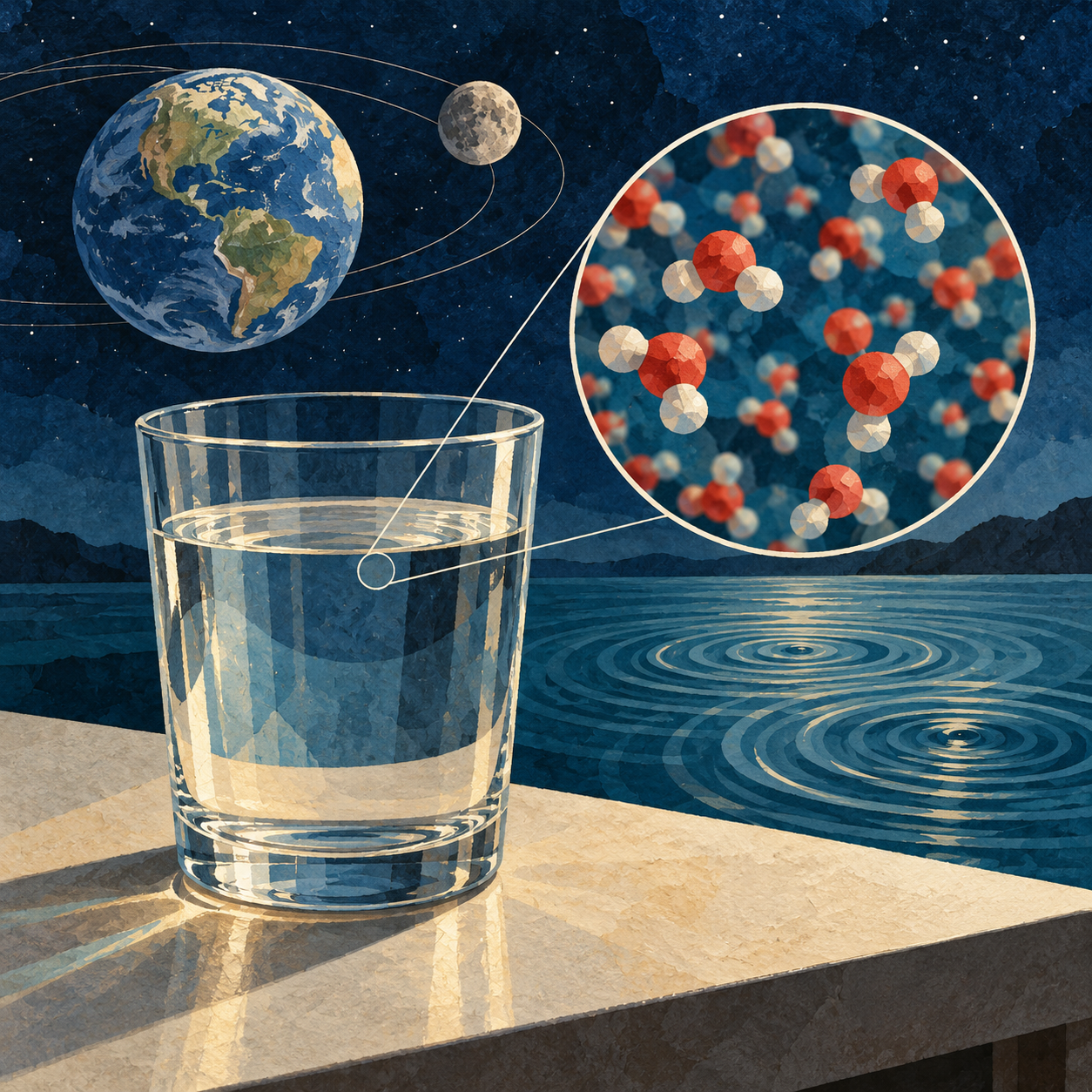
A glass of water looks still. Its molecules are moving. The Moon seems suspended above Earth. It is continually falling away from a straight path. An electron arrives at a detector as a single event, yet many such arrivals can form an interference pattern.
Six Easy Pieces teaches readers to look beneath familiar appearances. It collects six accessible selections from Richard P. Feynman’s Caltech lectures, with Robert B. Leighton and Matthew Sands credited alongside him. The topics are atoms, basic physics, connections between sciences, energy, gravitation, and quantum behavior. Basic Books confirms the credits and the collection’s origin.
The book has no single discovery to defend. Its organizing idea is that a few general principles can connect many events. Learning physics means understanding those connections, testing them, and recognizing where a model stops working.
Scientific knowledge combines imagination with experiment
Feynman begins with a difficulty in teaching. We cannot simply state the final laws and derive everything. We do not know all the laws. Even the known ones require concepts that take time to learn.
Experiment supplies clues, but clues do not organize themselves. Scientists must imagine possible patterns, work out their consequences, and compare those consequences with measurements. An attractive explanation still needs a test. Feynman’s opening lecture transcript makes this partnership between imagination and experiment explicit.
An approximation can remain useful after a deeper theory replaces it. Its reliability depends on the conditions and the precision required. This gives readers a more useful question than whether a model is simply right or wrong: what can it predict accurately, and under which conditions?
1. Atoms make familiar matter intelligible
Feynman gives special weight to the atomic picture. Matter consists of tiny particles in continual motion. They attract one another at some separations and resist being pushed too close together. These few ideas begin to explain pressure, temperature, and changes of state.
In a gas, molecules move widely apart and strike their container. Their impacts produce pressure. In a liquid, molecules remain close but can move past one another. In a solid, atoms retain an organized arrangement while vibrating.
Evaporation makes the model concrete. Molecules can escape from a liquid’s surface, while vapor molecules can return. In the simple picture, the escaping molecules tend to carry away more than the average energy. The liquid can therefore cool as it evaporates. What looks like a quiet surface contains traffic in both directions.
The value of the model is its range. The same unseen activity explains several visible effects. However, Feynman’s moving-particle picture is an introduction; it does not supply the full quantum account of matter. These examples come from “Atoms in Motion”.
2. Basic physics connects matter, fields, and light
The second selection gives readers a map of physical ideas. Atoms contain negatively charged electrons and positively charged nuclei. Electrical attraction and repulsion help explain why atoms hold together and how matter interacts.
A field describes physical conditions throughout space. Instead of treating an electrical influence only as a direct connection between distant objects, physics can describe a field that changes and carries energy. Electromagnetic waves connect this account to light.
Radio waves and visible light belong to the same electromagnetic spectrum. Their different frequencies help explain their different behavior. A distinction that matters strongly to human senses need not mark a fundamental separation in nature.
Feynman then shows why this classical picture needs revision. Relativity changes the description of space and time. Quantum mechanics changes the rules used for microscopic matter. Neither is an optional decoration on an otherwise complete account. “Basic Physics” introduces them as necessary parts of the map, while leaving detailed mathematical treatment for later study.
3. Shared laws do not remove the difficulty of other sciences
Feynman connects physics with chemistry, biology, astronomy, geology, and psychology. Chemical bonding becomes understandable through atomic physics and quantum mechanics. Biological processes involve chemical reactions. Astronomers use physical laws to interpret light from distant objects.
These connections do not make the other sciences effortless applications of a formula. Knowing the ingredients and their interactions differs from understanding a complex arrangement of them. A living system presents questions about organization that a list of its atoms does not answer.
Feynman also stresses that the boundaries between disciplines reflect how people divide their work. Nature does not organize itself around university departments. A problem may require several kinds of explanation and several experimental methods.
The distinction matters for the reader: a common physical foundation does not mean every useful explanation must be expressed at the smallest scale. The lecture’s discussion of other sciences supports both the unity of natural processes and the continuing difficulty of understanding their complex forms.
4. Energy is a quantity we can track through change
Energy conservation is powerful because very different processes preserve a common numerical total. Feynman avoids presenting energy as a visible substance. It is a quantity calculated in different ways for different physical situations.
His central analogy involves a child’s indestructible toy blocks. Some disappear beneath a rug or inside a box. Their apparent loss prompts a better counting method. The total stays constant when the observer includes hidden blocks and accounts for blocks entering or leaving the room.
The analogy explains the search for missing terms in an energy calculation. A falling object exchanges gravitational potential energy for kinetic energy. Friction requires accounting for thermal energy as well. A total can look wrong because the calculation leaves something out.
The analogy also has a limit: energy is not literally a collection of hidden blocks. Its different forms require different calculations. In applying the principle, the system’s boundary matters. Energy can leave the object being studied without disappearing. “Conservation of Energy” develops this distinction between a changing appearance and a conserved total.
5. Gravity joins falling objects with orbiting worlds
Newton’s theory connects events once treated as separate: falling near Earth’s surface and motion in the heavens. For two masses treated as particles, gravitational attraction grows with either mass and weakens with the square of their separation. Doubling the distance reduces the force to one quarter.
Combine this force with the laws of motion, and planetary paths become consequences to calculate. Kepler’s patterns in planetary observations acquire a common explanation.
The Moon provides the memorable example. Without Earth’s attraction, it would continue along a straight path. Gravity continually bends that path. Its sideways motion carries it around Earth as it falls. An orbit therefore requires no exemption from falling.
Feynman uses this achievement to distinguish describing a law from supplying a mechanical cause for it. Newton’s successful rule does not itself explain gravity through some familiar machinery. The lecture also discusses departures from Newton’s account and Einstein’s correction. The lesson is that broad predictive success can coexist with limits. “The Theory of Gravitation” makes both points.
6. Quantum behavior requires a different rule for alternatives
The final selection compares imagined experiments with bullets, water waves, and electrons passing through two openings.
For bullets, the distribution with both openings available is the sum of the distributions from each opening separately. Water waves behave differently. Their amplitudes can reinforce or cancel, producing interference.
Electrons arrive in individual events. Yet their accumulated distribution can show interference. Lowering the rate of emission does not turn that distribution into the ordinary sum expected for bullets.
Quantum theory handles this through probability amplitudes. When the alternatives remain indistinguishable, amplitudes combine before the probability is calculated. When an experiment distinguishes which opening an electron used, the interference between those alternatives disappears.
Feynman’s example of observing electrons with light emphasizes physical interaction. Measurement requires an arrangement that affects what can be observed. The argument supplies no reason to think that human attention alone changes matter. In “Quantum Behavior”, ordinary particle and wave pictures each capture part of the result, but neither supplies a complete classical explanation.
What readers can carry forward
My reading of the collection suggests three useful habits. First, ask what a model actually predicts. Second, distinguish an analogy from the physical claim it illustrates. Third, state the conditions under which an explanation works.
For example, the toy blocks help explain conservation, but treating energy as little objects would misuse the analogy. The Moon’s fall explains an orbit, but a precise orbital calculation still requires mathematics. Understanding the illustration is a beginning, rather than proof of mastery.
Limits of the collection
“Easy” is relative to the larger lecture course. The book reduces mathematical demands, but its concepts require patient thought. It offers orientation rather than a complete training in solving physics problems.
The lectures also retain their historical setting. Their descriptions of research frontiers should be read as reports from that setting. This summary does not treat their accounts of unresolved particle, geological, or biological questions as a current survey. Caltech’s description of the collection identifies the original lecture period as 1961–1963.
The enduring value is a way to connect observations with explanations while keeping their limits visible. Feynman’s examples reward curiosity, but they also ask readers to accept that a reliable prediction may exceed what everyday imagination can comfortably picture.
Sources
- Basic Books: Six Easy Pieces: title, author credits, and scope.
- Caltech: collection overview and opening lecture transcript: origin, purpose, and scientific method.
- Caltech’s authorized lecture texts: Atoms in Motion, Basic Physics, and The Relation of Physics to Other Sciences.
- Remaining lecture texts: Conservation of Energy, The Theory of Gravitation, and Quantum Behavior.
