Why physics needs a deeper common language
Brian Greene’s The Elegant Universe: Superstrings, Hidden Dimensions, and the Quest for the Ultimate Theory explains an uncomfortable situation: physics has extraordinarily successful descriptions of nature that do not yet form a complete, consistent whole. General relativity describes gravity through the geometry of spacetime. Quantum mechanics supplies the framework for understanding matter and its interactions at microscopic scales. Where both become indispensable, especially near gravitational singularities, their usual formulations cease to be adequate.
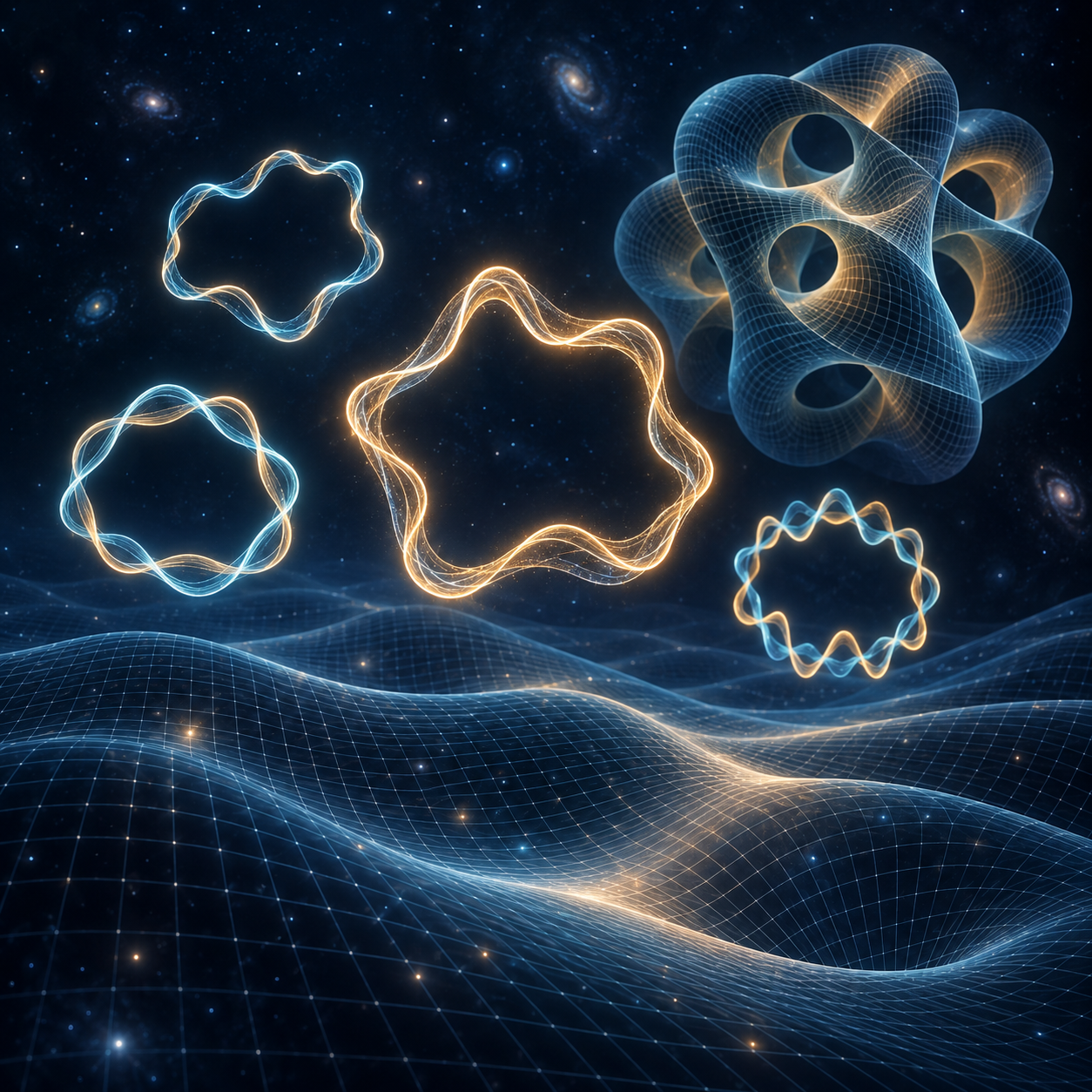
Greene presents superstring theory as a candidate for resolving this problem. Its central proposal replaces elementary point particles with tiny vibrating strings. Different vibration patterns would appear as different particles, potentially bringing matter and all fundamental forces into one framework. This is the book’s organizing ambition, rather than an experimentally established account of what everything is made of. Greene’s book page identifies the same unifying project and its implications for space and time.
The discussion below follows the book’s central argument, with later experimental context identified separately. The twenty-fifth anniversary edition adds a preface and epilogue; the underlying journey from relativity to quantum gravity remains its foundation.
Relativity changes the stage on which physics happens
Greene first loosens the reader’s confidence in everyday ideas about space and time. Special relativity begins with the same laws of physics for observers moving uniformly relative to one another, together with the invariant speed of light in vacuum. The consequence is that elapsed time and measured distance cannot be absolute quantities shared by everyone.
A useful example is a light clock: imagine light bouncing between two mirrors. For someone moving with the clock, the light travels directly between them. Another observer sees the moving clock’s light follow a longer, diagonal route. Since both measure the same light speed, their measurements of the clock’s ticking must differ. Time dilation follows from taking the behavior of light seriously, rather than from a defect in the clock.
General relativity makes a further change. Gravity becomes a manifestation of curved spacetime, and spacetime itself responds to matter and energy. Greene’s accessible treatment connects this geometric account with the history of unification: theories can explain apparently different phenomena through a common principle. His NOVA account of relativity and unification develops that motivation. The important shift is that geometry participates in physical events; it is no longer merely their fixed background.
Quantum mechanics makes that stage restless
The quantum world undermines a different everyday assumption: that objects always possess definite classical trajectories, even when nobody measures them. Quantum mechanics instead calculates probabilities through states that can exhibit interference. Its uncertainty relations place limits on simultaneously sharp values of certain pairs of quantities, such as position and momentum.
Greene uses this microscopic unfamiliarity to prepare the central conflict. General relativity’s smooth geometry becomes difficult to maintain when quantum effects in gravity can no longer be neglected. In the conventional point-particle treatment, calculations at extremely short distances produce divergences that resist the methods successful for other forces.
This does not mean relativity and quantum mechanics disagree in every application. Both work remarkably well within their tested domains, and gravity can be treated quantum mechanically as an effective theory at sufficiently low energies. The unresolved demand is for a more complete description in extreme regimes. Black-hole interiors and the universe’s earliest stages make that demand physical rather than merely aesthetic: a phenomenon can involve both intense gravity and microscopic scales.
Strings turn particle variety into different modes of vibration
The book’s signature analogy is musical. One violin string can produce different notes; similarly, a fundamental string could have different allowed vibration patterns. What appears to us as a particular particle would correspond to one such quantum state. The analogy concerns a shared underlying object with varied states, not literal sound traveling through space.
This offers a possible answer to a question the Standard Model leaves open: why does nature contain its particular assortment of particles and properties? Instead of treating every particle species as a separate basic ingredient, strings offer a common starting point. Their allowed states and interactions would have to reproduce the particles we observe.
Gravity is especially significant. The closed-string spectrum includes a massless spin-two state with the properties expected of a graviton, the hypothetical quantum carrier of gravity. A theory explored for other reasons thus contains gravity within its mathematics. Greene treats this as a major reason to pursue it, as explained in the second part of his NOVA presentation.
Strings also spread interactions over an extended object instead of concentrating them at a dimensionless point. This changes the short-distance mathematics and softens the troublesome behavior of pointlike gravitational interactions. It provides a route toward quantum gravity, although explaining this mechanism is different from demonstrating that physical particles really are strings.
Hidden dimensions could shape visible physics
The mathematics introduces a demanding consequence: superstring theories use ten spacetime dimensions, comprising nine spatial dimensions and one time dimension. We directly experience only three spatial dimensions. Greene explains how additional directions might exist without being obvious by using the image of an ant on a garden hose.
Viewed from far away, a thin hose looks like a line. An ant on its surface can move along its length and around its circumference. A direction that is inaccessible at one scale becomes apparent at another. Likewise, additional spatial dimensions might be compact and too small for ordinary observations to resolve. The author’s publisher description highlights this analogy.
The compact dimensions would matter even if we could not see them. Their geometry helps determine the possible motions of strings and, consequently, the particle properties measured in the large dimensions. Calabi–Yau spaces enter as a class of candidate geometries. The explanatory promise is striking: some facts about matter might ultimately be facts about spatial shape. The difficulty is equally important: a framework allowing many possible shapes does not automatically select the one corresponding to our universe.
Quantum geometry can exceed ordinary geometry
Greene’s discussion of mirror symmetry pushes the reader beyond picturing hidden dimensions as unusually small containers. Certain geometrically different compact spaces can produce equivalent physics. A difficult calculation in one description can become manageable in its mirror description. Geometry remains important, but its relationship to observable physics becomes subtler than a single familiar shape determining a single result.
He also explores transitions in which the topology of compact space changes. Classical geometric language can suggest a catastrophic tearing; string theory can supply a physically controlled continuation through particular transitions. Greene’s technical lectures on Calabi–Yau spaces explain the underlying quantum geometry. His research with David Morrison and Andrew Strominger connects certain changes of topology with black-hole states. These are theoretical results within the framework, rather than observations of our own space tearing.
M-theory reframes apparent rivals as related descriptions
Another obstacle to unification was the existence of five consistent superstring theories. Why should an ultimate framework come in several versions? Dualities offered a different interpretation: apparently distinct theories could describe the same physics in different regimes.
Greene follows this development toward M-theory, an eleven-dimensional framework connecting the string theories and involving extended objects called branes. A brane can have more spatial dimensions than a string. The lesson is that even strings may be only part of the underlying story. The third NOVA installment explains this shift. M-theory represents a proposed deeper unity whose complete formulation remains a challenge, rather than a finished master equation presented by the book.
Black holes supply another important test of theoretical coherence. Strominger and Cumrun Vafa showed that counting microscopic states in string theory reproduces the Bekenstein–Hawking entropy for a special class of black holes. Their original paper establishes the restricted setting. Such agreement links microscopic quantum states with macroscopic gravitational behavior; it does not amount to experimental confirmation of string theory or a complete description of every astrophysical black hole.
What the argument establishes—and what remains open
Greene’s enthusiasm rests on explanatory reach and mathematical consistency. Supersymmetry, which relates bosons and fermions, helps organize superstring theory and motivates searches for additional particles. But detecting supersymmetry would not uniquely establish strings, because supersymmetry also appears in other frameworks.
Later evidence has not fulfilled the early hope for a quick discovery. In March 2026, CERN reported two further ATLAS searches without signs of the supersymmetric particles sought. These constrain particular possibilities; they do not exclude every supersymmetric model. Greene’s own anniversary-edition reflection acknowledges the continuing lack of experimental confirmation and the difficulty of deriving testable consequences.
For a reader, the practical value is intellectual: learning to distinguish a successful calculation, a suggestive analogy, and a verified claim about nature. My interpretation of the book’s strongest lesson is that a theory can deserve serious investigation without deserving assent as established fact. Even a successful unified theory would supply fundamental laws, not an effortless explanation of every complex phenomenon. Greene makes the search compelling by showing what might become understandable, while leaving experiment the task of deciding whether that elegant possibility describes our universe.
Sources
- Brian Greene: book overview and anniversary-edition reflection: identity, central thesis, and evidential limits.
- Penguin Random House: publisher description: scope and representative analogies.
- NOVA: The Elegant Universe, Parts 1, 2, and 3: Greene’s accompanying explanations of relativity, strings, and M-theory.
- Greene’s Calabi–Yau lectures, Greene, Morrison, and Strominger on topology change, and Strominger and Vafa on black-hole entropy: primary theoretical research behind the geometric and black-hole discussions.
- CERN: ATLAS supersymmetry search results, March 2026: later experimental context.