How ordinary encounters become performances
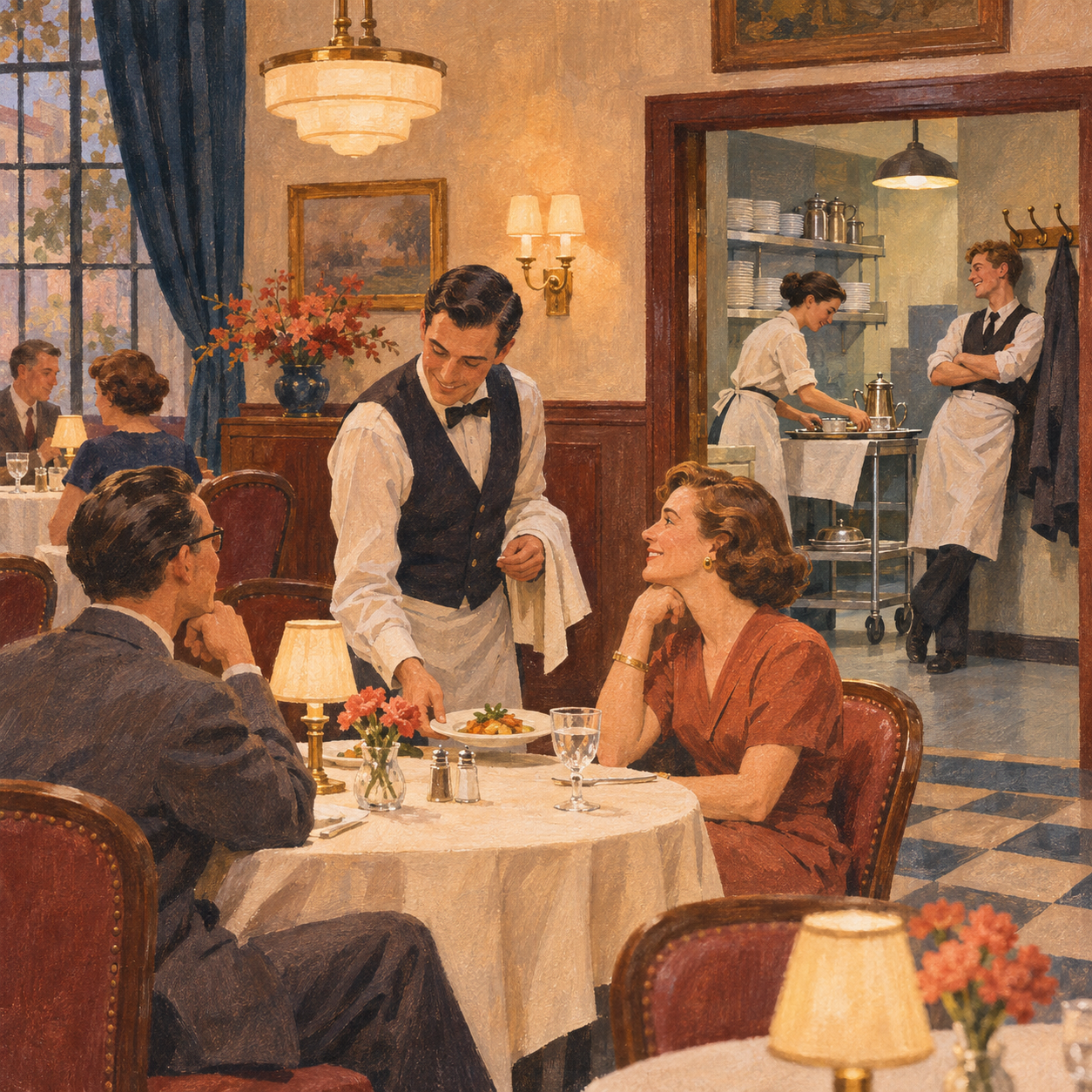
A waiter approaches a table with a calm voice and controlled movements. Behind the service door, staff may hurry, complain, and correct mistakes. Both scenes belong to the same job. Their separation helps guests experience an orderly meal.
Erving Goffman’s The Presentation of Self in Everyday Life makes such ordinary arrangements the subject of sociology. People act before others who must judge them with limited information. They therefore shape the signs through which others understand them. The resulting impression depends on cooperation, shared expectations, and control over what becomes visible.
The book first appeared as an Edinburgh monograph in 1956. A revised edition followed in 1959. Its theatrical framework asks how people sustain a credible definition of a situation. A performance can involve deliberate deception, but it can also express a role the performer sincerely accepts. Penguin’s description identifies this connection between everyday interaction and theatrical performance as the book’s central approach.
People act on signs they cannot fully verify
In an encounter, we rarely know another person’s motives, skills, or intentions directly. We rely on speech, clothing, surroundings, gestures, and past experience. These signs help us decide what to expect and how to respond.
Goffman distinguishes expressions a person gives from expressions a person gives off. The first includes explicit communication, such as a claim to know a subject. The second includes conduct that observers treat as revealing, such as hesitation or apparent ease. This is not a reliable division between lies and truth. A person can try to manage apparently spontaneous behavior too.
An illustrative case is a consultant who claims confidence while repeatedly checking notes. The client may give the checking more weight than the spoken claim. Neither sign alone establishes competence. The encounter still requires the client to form a provisional judgment. Goffman develops this problem in the introduction to the original monograph.
Participants also establish a working consensus. They temporarily honor certain claims so that the encounter can proceed. This does not require full agreement or affection. A customer and a service worker can maintain courtesy while privately disliking each other. They cooperate enough to preserve a workable account of what is happening.
The front makes a role recognizable
A performance is activity before observers that influences their understanding of the performer. Its front is the expressive equipment that regularly helps define the situation.
Goffman separates several parts of the front:
- Setting: furniture, layout, decoration, and other features of the place.
- Appearance: signs that suggest social status or the kind of activity underway.
- Manner: signs of the interaction role a person expects to take, such as directing or serving.
A uniform may suggest an occupation. A formal manner may suggest authority. Observers usually expect these signs to fit together, although exceptions can become striking.
Fronts also outlast particular performers. A newcomer enters a role with expectations already attached to it. The person must often use an established front rather than invent one freely. The University of Minnesota Duluth’s excerpt reproduces Goffman’s account of these parts and their tendency to become institutionalized.
Doing the work and showing the work
Some useful activity is hard for an audience to see. Goffman’s concept of dramatic realization concerns making relevant qualities visible during a performance. A person must sometimes display care or skill in ways that observers can recognize.
This creates a tension. Doing a task well and communicating that it is being done well require different efforts. A smooth result can conceal the labor that produced it. An impressive display can also exist without the substance it promises.
Idealization adds another pressure. Performers tend to present conduct that fits accepted values. They may hide errors, preparation, unpleasant tasks, or motives that would weaken the approved picture. Competence can appear effortless when the learning process stays out of view.
Goffman does not equate this selection with fraud. People cannot show every aspect of their lives in every encounter. His question is how a selective presentation becomes convincing, and what happens when contrary evidence appears. These arguments run through “Performances” in the original monograph.
Teams sustain a shared version of events
Impression management is often collective. A team consists of people whose cooperation sustains a particular definition of the situation. They need not be friends or equals.
The book’s hotel material shows why this matters. Service depends on staff coordinating what guests encounter. One worker’s conduct can support or undermine the impression created by everyone else. A shared performance therefore produces mutual dependence.
Team members also know things the audience does not. They see preparation, mistakes, and discrepancies between the public account and the work behind it. This creates familiarity without necessarily creating warmth. A junior employee can know embarrassing details about a superior while remaining subordinate.
Goffman also examines communication outside the official role. Staff can discuss staging, comment on absent guests, or exchange discreet signals while a performance continues. Such communication shows that people can participate in a role while also standing back from it. The monograph’s “Teams” and “Communication out of Character” develop these relationships.
Front and backstage depend on the audience
A front region is where a performance is presented. A back region, or backstage, is where participants can prepare it or act in ways that contradict its public impression. Doors, screens, schedules, and rules about entry help maintain the boundary.
In the hotel example, guests encounter service while staff handle preparation and less formal conduct elsewhere. Goffman’s observations on a Shetland island supplied material for the book. The University of Edinburgh’s historical account connects the monograph to his earlier island research.
Backstage is relative to a performance. It need not be solitary, pleasant, or free from expectations. Colleagues can expect a particular kind of informality from one another. The same room can serve as a back region at one time and a front region at another.
Audience segregation protects different performances by keeping their observers apart. People may present themselves differently to colleagues, relatives, and friends. Bringing those audiences together can expose differences that usually remain manageable. This does not establish that one presentation is the person’s only authentic identity.
Secrets and access complicate the cast
The division between performer and audience is rarely complete. Goffman’s discrepant roles concern people whose access to information does not match their apparent position.
An informer gains access to a team’s secrets and reveals them. A shill appears to be an independent audience member while helping the performers. A service specialist may learn private details through work without joining the team whose presentation depends on that work.
Goffman also describes the non-person: someone physically present whom others treat as if absent. Servants provide a prominent example. This treatment can give a low-status person access to information that higher-status people overlook. The term describes a social response to a person, not their human worth.
These cases show why control over impressions depends on who can see, hear, and disclose what happens. They appear in “Discrepant Roles” in the primary text.
Audiences help prevent embarrassment
A misplaced remark or an unexpected entrance can damage a performance. The problem extends beyond one individual’s discomfort. Other participants may lose the shared understanding that guided their conduct.
Goffman groups defensive practices under three qualities. Dramaturgical loyalty means protecting the team’s presentation. Discipline means controlling conduct and recovering from trouble. Circumspection means planning for risks, including the choice of setting and audience.
Audiences provide protection too. They may overlook a slip, avoid an intrusive question, or give someone time to recover. Performers must remain sensitive enough to accept this help. Social order thus depends partly on reciprocal tact, rather than on successful concealment alone. “The Arts of Impression Management” examines these practices in detail.
What this perspective helps us notice
The following applications extend Goffman’s framework; they are not instructions from the book.
In a workplace, the framework directs attention to the preparation that public competence requires. Training, privacy, and coordination can support reliable service. Demanding a polished appearance without allowing preparation can make the performance fragile.
For a customer, the same framework suggests separating evidence of competence from its display. Calm delivery and impressive surroundings may help an encounter proceed. They cannot, by themselves, establish the quality of the underlying work.
Online profiles offer another application. A post intended for friends can reach employers or relatives. This resembles a failure of audience segregation. Goffman’s book predates these platforms; assessing their effects requires additional evidence about their design and use.
Limits of the theatrical lens
Goffman presents a perspective for studying interaction, not a complete explanation of society. His preface openly draws on materials of uneven kinds, including research and informal accounts. The examples make patterns visible, but they do not establish how common each pattern is across cultures.
The stage analogy also has limits. In ordinary life, the people observing us are usually participants whose conduct we observe in return. Roles are less neatly separated than in a theater.
A further limitation concerns explanation. Showing how authority is presented does not fully explain who gains authority or controls resources. Class, institutions, and coercion require attention beyond the immediate encounter. This is a limit of the lens, rather than evidence that Goffman ignores unequal status.
Finally, cooperation is not automatically desirable. Tact can spare needless humiliation, while loyalty can protect harmful concealment. The framework helps identify how a presentation survives. Judging whether it deserves to survive requires an ethical assessment of what it hides and whom it affects.
Sources
- Penguin: The Presentation of Self in Everyday Life — title, sole author credit, and publisher’s overview.
- Goffman’s original monograph, hosted by New Bulgarian University (PDF) — primary text for the concepts discussed here. Despite the filename, the scan’s title page identifies the 1956 Edinburgh edition.
- University of Minnesota Duluth: excerpts on front and performance — primary passages on setting, appearance, manner, and sincere performance.
- University of Edinburgh: historical account of the Social Sciences Research Centre — research context and original publication history.