
The Perennial Philosophy: A Path to Meaning and Fulfillment
Aldous Huxley’s “The Perennial Philosophy” isn’t a self-help manual in the conventional sense. It doesn’t offer quick fixes or guaranteed results. Instead, it presents an exploration of a core wisdom tradition found across various religions and mystical traditions. Its aim is to illuminate a path toward a richer, more meaningful life by understanding the underlying unity of spiritual experience. The book’s power lies in its ability to synthesize disparate spiritual insights, offering a framework for personal transformation.
The Core Principles: A Universal Wisdom
Huxley argues for the existence of a “Perennial Philosophy,” a set of fundamental truths about reality and human nature that transcends cultural and religious differences. These truths, while expressed differently in various traditions, consistently point towards:
The Transcendent Reality: A higher reality exists beyond the limitations of our ordinary sensory experience. This reality is often described as God, the Absolute, Brahman, the Tao, or other similar terms. This isn’t necessarily a theistic God, but rather an ultimate ground of being.
The Illusion of Separateness: Our everyday perception creates a false sense of separation between ourselves, others, and the world. The Perennial Philosophy emphasizes the interconnectedness of all things.
The Nature of the Self: The true self is not merely the ego, the limited personality we identify with, but rather a deeper essence, connected to the transcendent reality.
The Path to Realization: This involves practices such as meditation, contemplation, prayer, and ethical living, designed to transcend the ego and experience the deeper reality of the self and the universe.
Practical Application: Cultivating Inner Peace
The Perennial Philosophy isn’t simply a philosophical exercise. Huxley suggests actionable steps towards realizing the core principles in daily life:
Mindfulness and Meditation: Regular practice of mindfulness and meditation helps to quiet the incessant chatter of the mind, allowing for deeper self-awareness and a clearer perception of reality. This reduces stress and fosters inner peace.
Contemplation and Prayer: Engaging in contemplative practices, whether through formal prayer or quiet reflection, allows for a deeper connection with the transcendent. This involves actively listening for inner guidance and wisdom.
Ethical Living: The Perennial Philosophy emphasizes the importance of living ethically, not simply for social reasons but also as a path to inner transformation. Acts of kindness, compassion, and service contribute to both personal growth and a harmonious society.
Transcending the Ego: The Key to Liberation
A central theme in Huxley’s work is the need to transcend the ego, that limited sense of self that creates suffering and separation. This doesn’t imply self-annihilation, but rather a recognition of the ego’s limitations and the expansion of consciousness beyond its boundaries.
Self-Awareness: The first step is to become aware of the ego’s workings, its desires, fears, and attachments. This can be achieved through self-reflection, journaling, and mindful observation of one’s thoughts and feelings.
Detachment: This does not mean emotional coldness, but rather a balanced perspective, allowing one to experience emotions without being overwhelmed by them.
Acceptance: Accepting oneself and others without judgment is crucial. This involves letting go of perfectionism and embracing imperfection as part of the human condition.
The Role of Love and Compassion
The Perennial Philosophy emphasizes the importance of love and compassion as essential components of the path to spiritual realization. Love, in this context, goes beyond romantic love; it encompasses universal love and compassion for all beings.
Empathy and Understanding: Developing empathy and understanding for others helps to break down the barriers of separateness and fosters connection.
Service and Giving: Engaging in acts of service and giving to others brings about a shift in focus from self-centeredness to a more outward-oriented perspective.
Forgiveness: Forgiveness, both of oneself and others, is essential for releasing negativity and cultivating inner peace.
Overcoming Obstacles: Facing Inner Demons
The path towards realizing the Perennial Philosophy isn’t always easy. Huxley acknowledges the presence of obstacles and challenges along the way:
Ignorance: Lack of self-awareness and understanding of the true nature of reality can be a significant obstacle.
Attachment: Attachment to material possessions, relationships, and ideas can hinder spiritual growth.
Fear: Fear of death, failure, or the unknown can prevent one from taking the necessary steps towards transformation.
Addressing these obstacles involves cultivating courage, self-compassion, and a willingness to confront one’s own limitations.
Integrating the Perennial Philosophy into Daily Life
Huxley doesn’t advocate for abandoning the everyday world to pursue spiritual enlightenment. Instead, he suggests integrating the wisdom of the Perennial Philosophy into daily life:
Mindful Living: Bringing mindful awareness to everyday activities, such as eating, working, and interacting with others.
Purposeful Action: Acting with intention and aligning one’s actions with one’s values and spiritual goals.
Finding Meaning and Purpose: Connecting with something larger than oneself, whether it’s a spiritual practice, a creative pursuit, or a commitment to social justice.
Visualizing the Path: A Conceptual Model
The journey towards realizing the Perennial Philosophy can be visualized as follows:
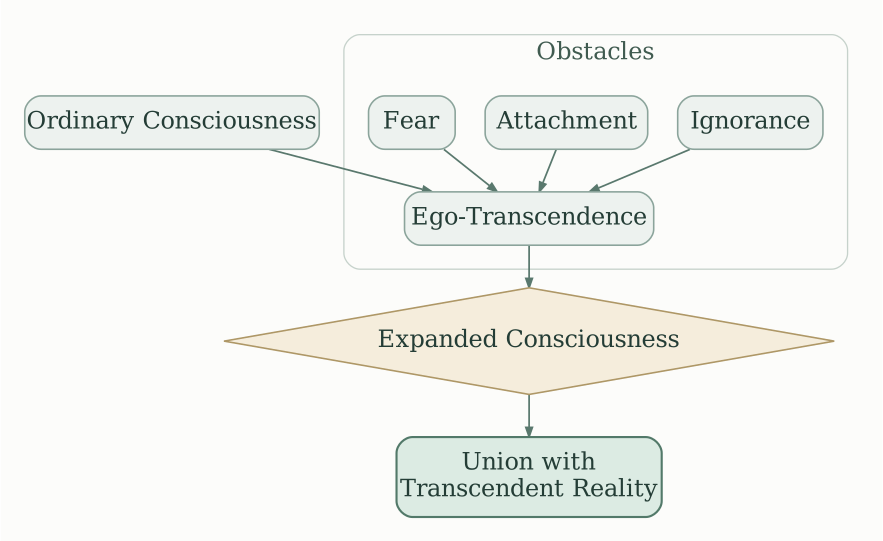
This diagram illustrates the process of moving from ordinary consciousness, by ego-identification, to an expanded state of consciousness through ego-transcendence, ultimately leading to union with the transcendent reality. Obstacles such as ignorance, attachment, and fear are depicted as hindering this process.
A Life of Purpose and Meaning
“The Perennial Philosophy” doesn’t provide a quick recipe for happiness. Instead, it offers a framework for understanding the deeper dimensions of human existence and a path towards a more meaningful and fulfilling life. By cultivating mindfulness, compassion, ethical action, and a commitment to self-awareness, individuals can begin to transcend the limitations of the ego and experience a richer connection with themselves, others, and the transcendent reality. The core message is that a life lived in accordance with the Perennial Philosophy is one of purpose, meaning, and lasting inner peace, a journey of self-discovery that continues throughout life. The key lies in consistent effort, self-reflection, and the unwavering pursuit of a deeper understanding of oneself and the universe.


